ESG Funds and ETFs in Australia: Compare ESG Investments
Looking for the best ESG funds and ETFs in Australia? We don’t rank them. Below are ESG ETFs, ethical managed funds and impact funds, filterable by category, objective and investor type, with fees, performance and the offer document where the issuer has published them.
Use the filters to narrow the listings, open the ones that fit your goals and judge each fund on its own numbers. Everything on this page is general information only, not personal advice, so consider your own circumstances and read the offer document before you invest.
Key Takeaways
▪ ESG investing weighs environmental, social and governance factors alongside financial analysis when choosing investments.
▪ Global sustainable funds recorded US$84 billion of net outflows in 2025, the first calendar year of outflows since tracking began in 2018, yet assets still topped US$3.9 trillion (Morningstar).
▪ ASIC has won three Federal Court greenwashing penalties totalling A$34.7 million against Mercer, Vanguard and Active Super, so labels deserve scrutiny.
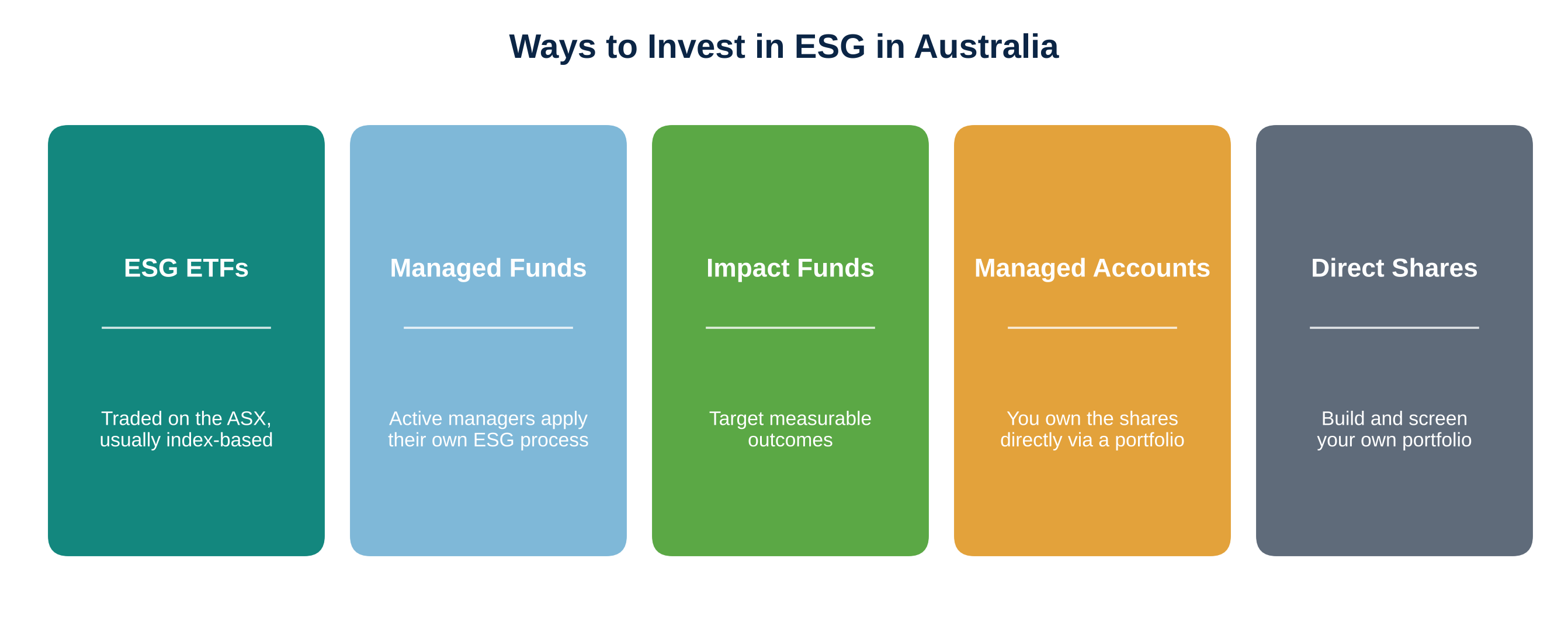
▪ You can invest through ESG ETFs, managed funds, impact funds, managed accounts or direct shares, each with different costs, liquidity and control.
▪ The right ESG fund depends on the job it does in your portfolio. Compare fees, performance against a relevant benchmark, holdings and the ESG approach in the offer document.
What Are the Best ESG Funds and ETFs in Australia?
There is no single best ESG fund. The right one depends on what you want it to do: track a screened share index cheaply, back an active manager’s judgement, target a theme such as clean energy, or fund measurable social and environmental outcomes. The listings on this page let you sort those options by category, objective and investor type, then compare them on the numbers the issuer has published.
Start with the outcome you want, then match it to the type of fund. The table below maps common goals to the InvestmentMarkets listing pages where you can see the funds listed.
If You Want To…
Consider
Browse
Hold a low-cost, screened share portfolio
Index-based ESG ETFs that exclude sectors such as fossil fuels, tobacco or weapons
Filter the listings by category, objective (such as growth or income) and investor type (retail or wholesale). Where the issuer has published them, listings show fees, performance figures and the offer document, along with the minimum investment, liquidity and structure. Open a listing to read the detail or enquire directly with the issuer.
Five checks to run on any ESG fund before you invest.
These are the numbers and facts worth comparing, and where to find them.
What To Compare
Why It Matters
Where To Find It
Fees and costs
ESG funds range from low-cost index ETFs to higher-fee active and impact funds. Fees compound over time.
Listing, where the issuer has published them, and the offer document
Performance against a benchmark
Compare with a relevant index, ideally both an ESG and a non-ESG one, over several years.
Listing, where the issuer has published it, and the issuer’s fund updates
ESG approach
Integration, exclusions, best-in-class, thematic or impact. Each delivers something different.
Offer document and the issuer’s responsible investment policy
Exclusions and thresholds
‘Excludes fossil fuels’ can mean 0% or up to a revenue threshold. Check the detail.
Offer document and index methodology
Holdings
Shows whether the portfolio matches the label.
Issuer’s published holdings list
Independent evidence
Third-party certification, stewardship and impact reports add credibility.
InvestmentMarkets is building Australia’s central hub for fund and ETF investing. Here is how this page works.
What We Do
▪ List ESG ETFs, managed funds and other investments so you can browse them in one place.
▪ Show issuer figures such as fees and performance, and link to the offer document, where the issuer has published them.
▪ Let you filter by category, objective and investor type.
▪ Connect you directly with issuers so you can ask questions before you invest.
▪ Publish independent ESG articles and investor education to help you ask better questions.
What We Don’t Do
▪ Rank funds or tell you which one to buy.
▪ Provide personal financial advice. Information here is general only.
▪ Verify or certify any fund’s ESG claims. Check the offer document and the issuer’s own reporting.
What Is ESG Investing?
ESG investing integrates environmental, social and governance factors into investment decisions. It goes beyond traditional financial analysis by considering a company’s impact on the environment, how it treats people and the quality of its corporate governance. The aim is to generate sustainable long-term returns while managing risks that conventional analysis can miss, and in some strategies, to create positive outcomes for society and the planet.
The three pillars of ESG investing and the issues each one covers.
▪ Environmental: evaluates a company’s impact on the environment, including its carbon footprint, resource use, waste management and efforts to reduce pollution. Companies that prioritise sustainability, energy efficiency and responsible resource management are favoured in ESG portfolios.
▪ Social: focuses on how a company manages relationships with its employees, customers, suppliers and communities. ESG investors look for diversity, labour rights, safe working conditions and community engagement.
▪ Governance: assesses a company’s internal policies and practices, including board structure, executive remuneration and shareholder rights. Strong governance tends to mean greater transparency and accountability.
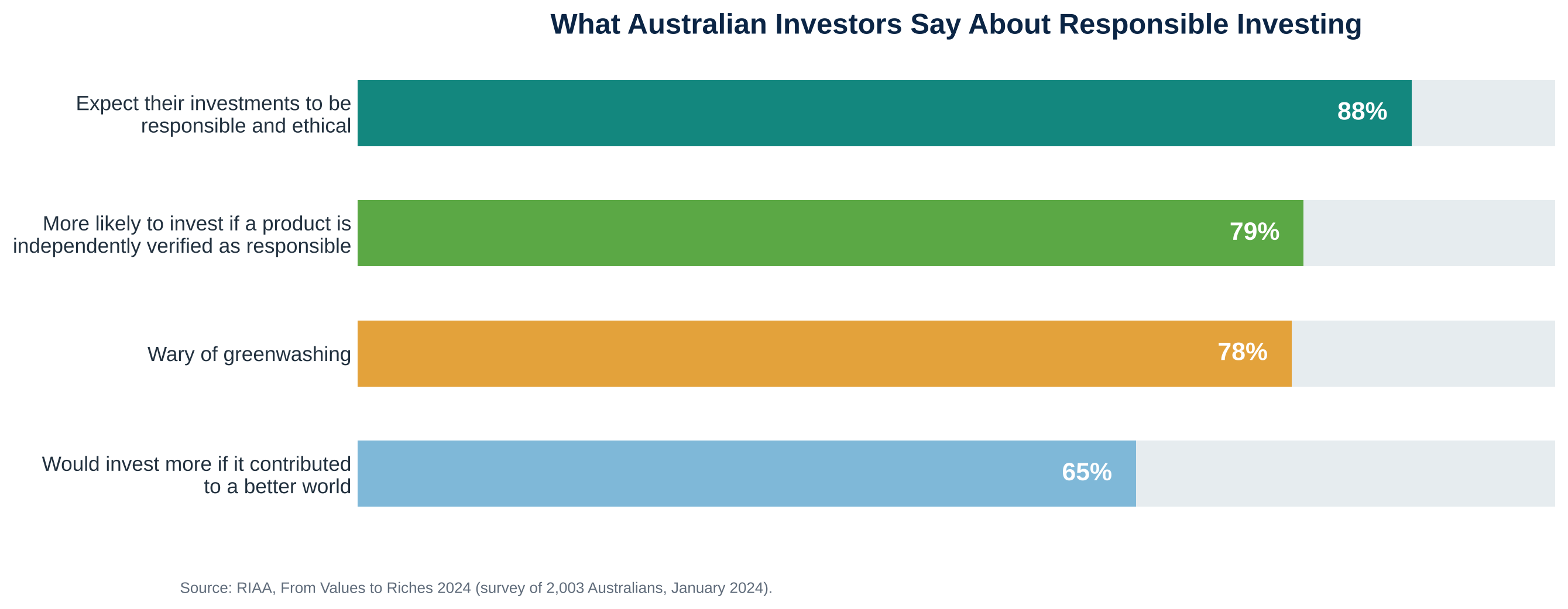
Investor demand is a big part of the story. RIAA’s From Values to Riches 2024 survey of 2,003 Australians in January 2024 found 88% expect their investments to be responsible and ethical, 79% would be more likely to invest in a product independently verified as responsible, and 78% are wary of greenwashing.
Sometimes better, sometimes worse. Performance depends far more on the sectors a fund holds or avoids than on the ESG label. Sustainable strategies are generally underweight energy, defence and other cyclical sectors, which have performed strongly recently, while some clean energy holdings have been hurt by higher interest rates. That helps explain why leading global ESG indices have slightly lagged the broader market over longer periods, as shown in The ESG Reset: Sustainability Trends Worth Knowing About.
Flows have followed performance. Morningstar reports global sustainable funds suffered US$84 billion of net outflows in calendar 2025, after US$38 billion of inflows in 2024. Outflows slowed to an estimated US$27 billion in the fourth quarter, and global sustainable fund assets rose about 4% to more than US$3.9 trillion by the end of 2025.
The long-term ESG case is financial: companies with stronger sustainability characteristics may face lower regulatory, litigation and stranded-asset risks. Whether that translates into outperformance is never guaranteed. Compare each fund’s returns against a relevant benchmark over several years, and remember that past performance is not a reliable indicator of future performance.
The opportunity set is far broader than a handful of clean energy stocks. The International Energy Agency’s World Energy Investment 2025 estimated global energy investment of US$3.3 trillion in 2025, with US$2.2 trillion going to clean energy, twice the amount directed to fossil fuels. Solar was the largest single item at US$450 billion, battery storage reached around US$66 billion and grids about US$400 billion.
Companies and projects in wind, solar, hydro and geothermal power, such as panel manufacturers, wind farm operators and renewable infrastructure funds. Australia’s 2035 target to cut emissions 62% to 70% below 2005 levels implies A$475 billion to A$630 billion of investment over the coming decade, as outlined in Australia’s Environmental Investment Window.
Companies promoting energy efficiency, waste reduction and emissions reduction, including electric vehicles, efficient appliances and advanced recycling. Many sit within thematic ETFs and thematic global equity funds.
Sustainable Agriculture and Food
Investments that reduce environmental impact, promote responsible land use and improve food security, such as regenerative farming, sustainable fisheries and plant-based food.
Water technology firms, utilities and wastewater treatment businesses that support efficient water use and climate resilience.
Natural Capital and Carbon
Carbon and biodiversity projects under schemes such as Australia’s ACCU Scheme and Nature Repair Market. These demand careful assessment of integrity, permanence and liquidity.
Impact funds target specific, measurable outcomes such as cutting carbon emissions, improving access to clean water or advancing gender equality. Many are unlisted and some are open to wholesale investors only, often investing in infrastructure, private equity or other alternatives.
LICs and LITs are another listed route to a manager’s strategy.
Direct Stock Ownership
You can build your own ESG portfolio by buying individual shares that match your values. This gives full control but requires research and diversification discipline.
▪ Ethical alignment: invest in line with your values and avoid industries you object to. See Investing Ethically.
▪ Long-term value: ESG investing aims to identify companies well placed to navigate environmental and social challenges, offering potential long-term value.
▪ Risk management: companies with strong ESG practices may be better prepared for crises, regulatory change and environmental shocks, potentially reducing long-term risk.
▪ Access to capital: companies with strong ESG credentials can find it easier and cheaper to raise capital, which may support growth.
▪ Influence: through voting and engagement, investors can push companies to improve their practices.
What Are the Risks of ESG Investing?
▪ Lack of standardised metrics: ESG data and ratings vary across providers, so two funds with similar labels can hold very different portfolios.
▪ Greenwashing: some products overstate their ESG credentials. See the next section for how to check.
▪ Potential underperformance: excluding sectors such as energy or defence means returns can diverge from the broader market for long periods.
ASIC alleges governance failures and misleading conduct about an ESG fund
Five questions to ask any ESG fund:
▪ What exactly does the offer document say the fund excludes, and are there revenue thresholds?
▪ Do the published holdings match the label?
▪ Is the ESG process applied to the whole portfolio or only part of it?
▪ Is there independent certification or impact reporting?
▪ How does the fund vote and engage with the companies it owns?
What Does Mandatory Climate Reporting Mean for ESG Investors?
Australia’s mandatory climate reporting regime should improve the quality of ESG data. From 1 January 2025, the largest companies and financial institutions began preparing annual sustainability reports containing climate-related financial disclosures under the Corporations Act and AASB S2, according to ASIC. Smaller cohorts follow for financial years starting on or after 1 July 2026 and 1 July 2027, as covered in The ESG Reset.
Group
First Reporting Periods
What It Means for Investors
Group 1 (largest entities)
Financial years starting on or after 1 January 2025
First wave of standardised climate data from major ASX companies
Group 2
Financial years starting on or after 1 July 2026
Broader coverage across mid-sized entities
Group 3
Financial years starting on or after 1 July 2027
Data extends further down the market
Better disclosure gives analysts, index providers and fund managers more reliable raw material, and gives you more to check when a fund makes climate claims. Climate is currently the only mandatory component, though other sustainability topics may follow.
ESG is a Mainstream Opportunity
ESG investing has moved from niche to mainstream in Australia, and it has become more demanding. The easy phase of rising inflows is over, greenwashing enforcement is real, and new climate reporting is lifting the quality of data. That makes the basics more important: know what job you want a fund to do, read the offer document, check the holdings and compare fees and performance against a fair benchmark.
Use the listings on this page to compare the ESG ETFs, managed funds and impact funds available, then judge each one on its numbers.
FAQ
ESG investing lets you align your financial goals with your values. It can also help manage risks linked to environmental and social issues, because companies with strong ESG practices may be more resilient over the long term.
Look for funds that track an ESG index or apply a stated ESG process, review ESG ratings and reports, and consider managers who specialise in ESG strategies. On InvestmentMarkets you can browse ESG funds and filter by category, objective and investor type, then read the offer document where the issuer has published it.
Returns vary widely. Some research links strong ESG performance with better long-term outcomes, but ESG indices have also lagged the broader market at times, partly because they underweight energy and defence. Compare each fund’s returns against a relevant benchmark over several years. Past performance is not a reliable indicator of future performance.
Yes. As investors prioritise ESG factors, companies have an incentive to improve their practices to attract and retain capital. Shareholder voting and engagement by fund managers can also drive change in areas such as climate targets and board diversity.
ESG ratings assess a company’s performance on environmental, social and governance factors, such as carbon emissions, labour practices, board diversity and transparency. Providers use different methods and weightings, so the same company can receive very different scores. Treat ratings as a starting point.
They can be, if the fund suits your goals, risk tolerance and time frame. An ESG label does not make a fund good or bad on its own. Judge it on fees, performance against a benchmark, diversification and how credibly it delivers its ESG promise.
ESG investing assesses environmental, social and governance factors, often as financial risks. Ethical investing applies values-based rules, usually by excluding industries such as tobacco, gambling or weapons. Many funds combine both.
Not always. Some exclude all fossil fuel producers, some apply revenue thresholds, and others keep energy companies to engage with them on transition plans. Check the exclusions and thresholds in the offer document.
Yes. Many ESG ETFs and managed funds can be held in a self-managed super fund, subject to your fund’s investment strategy.
ESG ETFs can be bought on the ASX for the price of a single unit plus brokerage. Unlisted managed funds often have minimums in the thousands of dollars, and wholesale funds usually require higher amounts and wholesale investor status.
The Responsible Investment Association Australasia runs a certification programme for responsible investment products. Certification indicates a product has met RIAA’s standards for disclosure and process. RIAA’s survey found 79% of Australians would be more likely to invest in a product independently verified as responsible.
No. ESG investing considers ESG factors, often to manage risk. Impact investing intends to create measurable positive social or environmental outcomes alongside returns and reports on them. Read ESG Doesn’t Mean Impact.
Disclaimer: This article is prepared by Simon Turner. It is for educational purposes only. While all reasonable care has been taken by the author in the preparation of this information, the author and InvestmentMarkets (Aust) Pty. Ltd. as publisher take no responsibility for any actions taken based on information contained herein or for any errors or omissions within it. Interested parties should seek independent professional advice prior to acting on any information presented. Please note past performance is not a reliable indicator of future performance.
DGGF aims to provide exposure to a cost-effective, multi-asset class portfolio, for investors whose priority is investing in a way that aligns with their values. DGGF offers the potential for growth over the long term, and targets an allocation of 70% growth assets (Australian and international shares), 30% defensive assets (Australian and international bonds).
The Fund aims to provide investors with the performance of the MSCI Australia IMI Custom ESG Leaders Index, before fees and expenses. The objective of the Fund is to provide exposure to large, mid and small cap segments of the Australian market with better sustainability credentials relative to their sector peers.
Vanguard Ethically Conscious Australian Shares ETF seeks to track the return of the FTSE Australia 300 Choice Index before taking into account fees, expenses and tax.
The Perpetual ESG Australian Share Fund is an actively managed fund, targeting long-term capital growth and income through investment predominantly in quality Australian shares that meet Perpetual’s ESG and values-based criteria.
The Fund’s performance objective is to provide investment returns which exceed conventional global equity indices, after management fees, over the long term.
The Fund aims to outperform the S&P / ASX 300 Accumulation Index (Benchmark) on a net of fees basis, by investing in companies that operate ethically, responsibly and sustainably. (For Wholesale Investors Only)
The objective of the portfolio is to grow the value of an investment through a combination of capital growth and income via dividends by taking into consideration a company’s environmental, governance and social impacts.
Providing exposure to a diversified portfolio of Australian clean energy infrastructure assets through its investment in development, construction and operational renewable energy projects.
GRNV gives investors access to a diversified portfolio of sustainable Australian companies selected on the basis of in-depth analysis by world leading research agency MSCI ESG Research. This fund aims to provide investment returns, before fees and other costs, which track the performance of the Index.
The Fund is a long only, actively managed, global equity fund. The Fund seeks to provide investors with exposure to a diversified global portfolio of companies, whose products and services are aligned to the development of a sustainable global economy.
ERTH aims to track the performance of an index (before fees and expenses) that comprises a portfolio of up to 100 leading global companies that derive at least 50% of their revenues from products and services that help to address climate change and other environmental problems through the reduction or avoidance of CO2 emissions. This covers clean energy providers, along with leading companies tackling green transport, waste management, sustainable product development, and improved energy efficiency and storage.
MCCL.ASX is a concentrated portfolio of global companies enabling or benefiting from the transition to decarbonise the planet. The Munro Climate Change Leaders Fund Active ETF was quoted on the ASX on 20 January 2022 with ticker MCCL.
The Fund aims to provide investors with the performance of the various indices of the Underlying Funds in which the Fund invests, in proportion to a ‘Balanced’ long term Strategic Asset Allocation (SAA), before fees and expenses, of approximately 50% equities and 50% fixed income exposure.
The Russell Investments Australian Responsible Investment ETF (the 'Fund') seeks to track the Russell Australia ESG High Dividend Index ('the Index'), which is weighted towards companies that demonstrate positive environmental, social and governance (ESG) characteristics after negatively screening for companies that have significant involvement in a range of activities deemed inconsistent with widely recognised responsible investment considerations. The Fund invests in Australian shares and trusts listed on the Australian Securities Exchange (ASX), with the aim of providing investors with exposure to an ESG enhanced, responsible investment portfolio.
The Fund invests in a highly concentrated portfolio of global equities aiming to deliver returns greater than the RBA Cash Rate + 3% and MSCI World Total Return Index over the long term.