What Are Australian Large Cap Shares?
Australia's large cap market is defined by three key indices that track the country's biggest companies by market capitalisation.
The ASX 50 comprises Australia's 50 largest companies, with a minimum market capitalisation of approximately $5 billion. The ASX 50 index represents some 60% of Australia's total sharemarket capitalisation as of late 2025. It’s often referred to as the blue chip index because it contains only the most established, liquid companies on the Australian market. For example, it includes the Big Four banks (Commonwealth Bank, NAB, Westpac, ANZ) and global mining leaders like BHP and Rio Tinto.
The ASX 100 expands beyond the ASX 50 by including the next 50 largest companies by market cap. Companies in the ASX 100 typically have market capitalisations of $10 billion or more, and represent 69% of the total Australian sharemarket. This index strikes a balance between the concentrated exposure of the ASX 50 and the broader diversification of the ASX 200, making it a popular benchmark for large cap fund managers and investors alike.
The ASX 200 serves as Australia's primary benchmark index, representing the top 200 companies by market capitalisation. The ASX 200 accounts for 77% of Australia's total sharemarket capitalisation. Its constituent companies range in size from $380 million to over $100 billion. The ASX 200 is rebalanced quarterly, and most passive ETFs tracking Australian equities benchmark against it due to its comprehensive market coverage and high liquidity.
When comparing large cap investment options, investors should note whether ETFs and funds track the ASX 50 (most concentrated), ASX 100, or ASX 200 (broadest large cap exposure).
👉 Terminology Definition: Market capitalisation represents the total market value of a company's outstanding shares, calculated by multiplying the current share price by the total number of shares outstanding. For example, a company with 100 million shares trading at $50 per share has a market capitalisation of $5 billion.
Why Large Caps Dominate Australian portfolios
Australian large caps are unusually important compared to other developed markets.
The Reserve Bank of Australia has observed that Australian households have a higher exposure to domestic equities and bank shares than most OECD peers, largely due to the dividend income and franking credits on offer.
The benefits are compelling. ASIC’s Moneysmart guidance highlights that ‘blue chip shares tend to be more stable and pay regular dividends, but still carry market risk’.
For many investors, the combination of familiarity, income and liquidity makes Australian large caps a natural starting point for portfolio construction.
Sector Concentration and Why It Matters
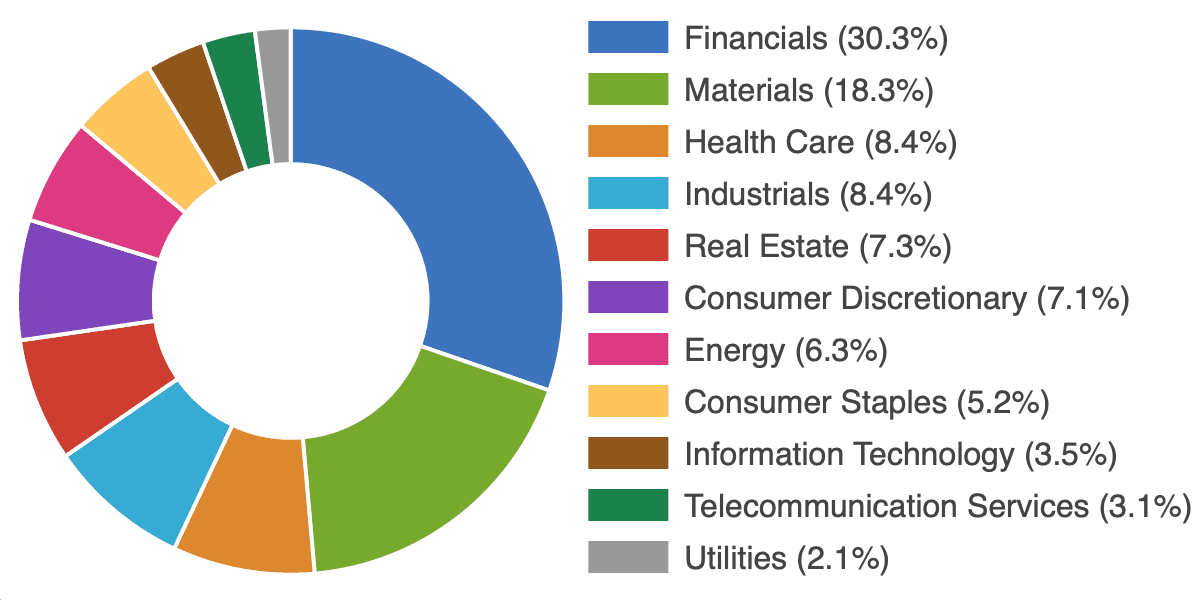
Australia’s large cap market is not evenly diversified by sector.
According to S&P Dow Jones Indices data, the Financials and Materials sectors together regularly account for around half of the ASX 200 with the Big Four banks holding four of its five largest positions.
Source: asx200list
As Vanguard Australia explains, ‘Australian shares are more concentrated by sector than global markets, which can increase volatility relative to more diversified indices’.
This means Australian large cap investors are implicitly exposed to:
- Bank profitability, housing credit growth and interest rate cycles.
- Commodity prices such as iron ore, coal and lithium.
- Global demand from China and emerging markets.
👉 Investor takeaway: Australian large caps behave differently to global equities and should be treated as a component, not a proxy, for global share exposure.
How Investors Access Large Caps on InvestmentMarkets
InvestmentMarkets enables investors to browse, filter and compare large cap investments available to Australian investors, including ETFs and managed funds.
You can explore the full category here.
Examples of Large Cap Funds Available on the InvestmentMarkets Platform
iShares Core S&P/ASX 200 ETF (ASX: IOZ):
A low-cost ETF designed to track the performance of the S&P/ASX 200 Accumulation Index. Created to be a core building block for Australian equity exposure.
SPDR S&P/ASX 200 ETF (ASX: STW):
One of Australia’s oldest ETFs, offering broad large cap exposure by tracking the performance of the S&P/ASX 200 Accumulation Index with high liquidity.
Global X S&P/ASX 200 Covered Call ETF (ASX: AYLD):
Applies an options strategy over ASX 200 stocks to generate higher income, illustrating how large caps can be adapted to different objectives.
These examples demonstrate how investors can tailor their Australian large cap exposure to their growth, income or yield enhancement objectives.
Key Benefits and Risks of Large Cap Investing
Benefits of Large Cap Shares
Large cap companies may offer lower volatility compared to mid and small cap alternatives. Established market positions, diversified operations, and substantial financial resources help buffer these businesses against competitive disruptions and economic downturns. This relative stability proves particularly valuable for conservative investors prioritising capital preservation.
Many Australian large cap companies provide regular dividend income, often with full franking credits attached. The combination of dividend yields and franking credits creates attractive after-tax returns for Australian resident investors. Large cap dividend reliability tends to exceed smaller companies due to stable earnings, though the COVID-19 pandemic demonstrated that dividends are not guaranteed.
High liquidity characterises large cap shares due to substantial trading volumes. Investors can enter or exit positions quickly without creating significant price impact.
Extensive information availability surrounds large cap companies through multiple analyst research reports and media coverage. The Moneysmart share selection guide emphasises that blue chip companies typically offer more accessible information for investor analysis.
Core portfolio suitability makes large caps appropriate building blocks for diversified investment strategies. The combination of lower volatility, dividend income, and liquidity aligns with conservative portfolio objectives while still providing equity market exposure and growth potential.
Risks to Consider
Lower growth potential represents the primary trade-off for large cap stability. Companies with $50 billion or $100 billion market capitalisations generally cannot replicate the growth rates of smaller businesses. Historical return data shows mid- and small-caps generating higher long-term earnings growth than large caps, though with greater volatility.
Sector concentration risk specifically affects Australian large cap investors due to the market's heavy weighting toward Financials and Materials sectors. This concentration means Australian large cap portfolios perform differently from diversified global portfolios during various economic conditions.
Valuation risk emerges when popular large cap shares trade at high prices relative to earnings or dividends. High price-to-earnings ratios and low dividend yields relative to historical averages signal potential valuation risk. When large caps trade expensively, subsequent returns may disappoint even if companies meet earnings expectations.
Market risk affects all equities including large caps. During broad market downturns, large cap shares decline alongside smaller companies. The 2008 Global Financial Crisis saw Australian large cap indices decline over 40% from peak to trough. The COVID-19 market collapse in March 2020 triggered a 36% decline in just one month.
Dividend cut risk represents a specific concern for income-focused investors in Australia. The COVID-19 pandemic provided a clear example when major Australian banks reduced their dividends under regulatory pressure. Also, resource companies cut dividends sharply when commodity prices collapsed in 2014-2016.
How to Evaluate Large Cap Investments
For Individual Large Cap Companies
Investors selecting individual large cap shares should assess valuation metrics and sustainability indicators.
Valuation metrics include the Price-to-Earnings (P/E) Ratio, comparing share price to earnings per share. Compare P/E ratios to the company's historical average, sector peers, and broader market averages. Dividend Yield represents annual dividend as a percentage of share price. Compare yields to cash interest rates and historical company yields. Price-to-Book (P/B) Ratio proves most relevant for banks and asset-heavy companies.
Sustainability indicators include the Payout Ratio, measuring the percentage of earnings paid as dividends. Payout ratios between 50-70% generally indicate sustainable policies. Ratios exceeding 80-90% leave limited buffer for earnings volatility.
Debt Levels indicate financial leverage through debt-to-equity ratios.
Return on Equity (ROE) above 15% for large cap companies generally indicates strong profitability.
For Large Cap Funds
Management approach determines fund strategy.
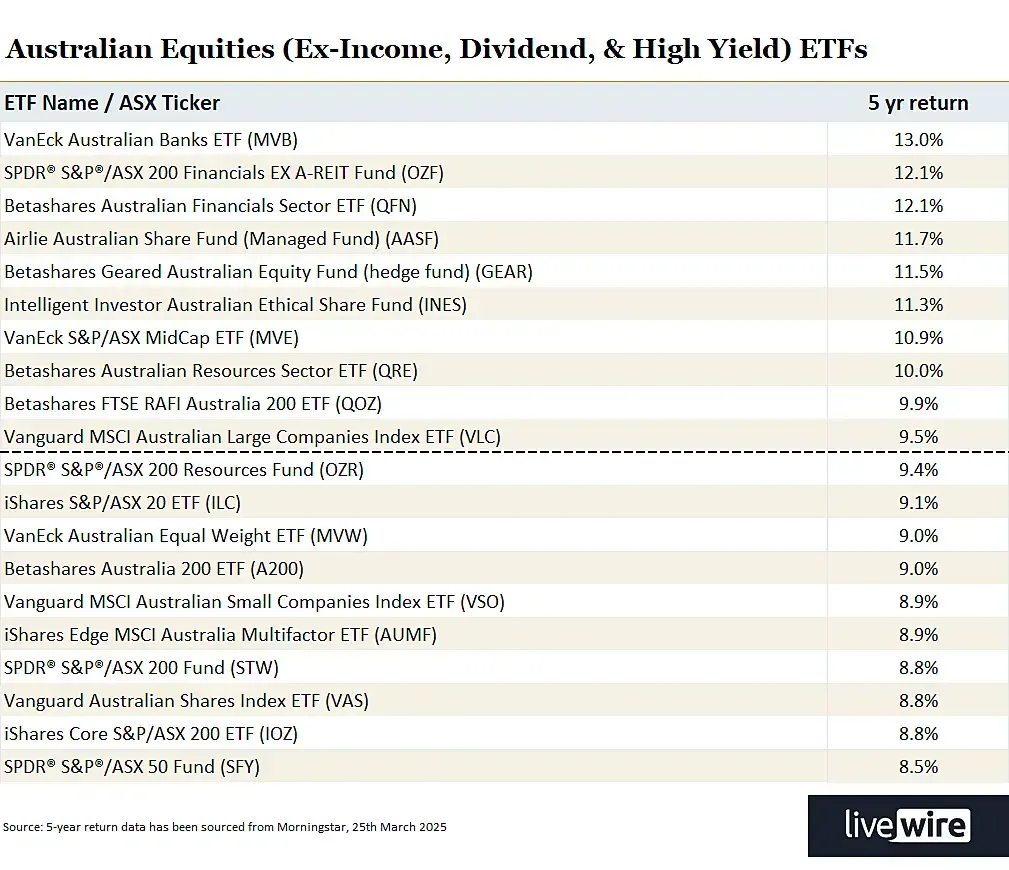
Index tracking (passive) funds replicate ASX 50, ASX 100, or ASX 200 indices by holding all constituent stocks in proportion to index weightings. Focusing on long-term returns combined with the Sortino ratio (risk-adjusted return measurement) provides valuable context, as shown below (using data to March 25th 2025).
Source: Livewire
Active management funds employ professional managers to select stocks they believe will outperform benchmarks. Review each prospective fund’s track record versus its benchmark index over three, five, and ten-year periods.
Cost structure significantly impacts long-term returns. Passive index ETFs typically charge 0.04-0.20% annually, while active managed funds charge 0.50-1.50% p.a. or more. A 1% annual fee difference compounds substantially over decades.
Portfolio characteristics include reviewing top 10 holdings for concentration risk, sector exposure, number of holdings, and dividend yield. The Market Index ASX companies database provides comprehensive information for researching individual large cap holdings.
Tax Considerations for Large Cap Investors
Dividend Taxation & Franking Credits
According to ATO dividend tax guidance, investors must include all dividend income in tax returns even when reinvested.
Many Australian large cap companies attach franking credits representing the 30% company tax already paid on profits.
High-income earners with marginal tax rates above 30% pay additional tax on the grossed-up dividend amount.
Low-income earners with marginal tax rates below 30% receive refunds of excess franking credits.
Retirees in pension phase superannuation pay 0% tax and receive full franking credit refunds, making fully franked dividends particularly valuable.
Capital Gains Tax
Selling shares at a profit triggers capital gains tax. The ATO capital gains tax guide explains that a 50% CGT discount applies for Australian resident individuals holding shares more than 12 months. Only half the capital gain adds to assessable income and tax applies at marginal rates to this reduced amount. This creates strong incentive to hold large cap investments at least 12 months before selling.
SMSF Investors
Self-Managed Superannuation Funds face different tax treatment.
Accumulation phase SMSFs pay 15% tax on investment income including dividends and capital gains.
Pension phase SMSFs supporting retirement income streams pay 0% tax on investment income. All dividends, capital gains, and franking credits flow through tax-free, creating the most tax-effective environment for Australian large cap investing.
The Moneysmart investing tax guide emphasises that tax shouldn't drive investment decisions, but understanding implications helps optimise after-tax returns. Tax regulations change periodically and individual circumstances vary significantly.
Investors should consult registered tax agents or financial advisers for personal tax advice.
Using Large Caps in a Portfolio Context
For most investors, Australian large cap shares are best used as the foundation of a portfolio rather than the whole solution.
A common and widely adopted approach is the core and satellite framework, whereby a low-cost ASX 200 ETF or diversified large cap fund forms the core allocation, providing stability, liquidity and reliable income. This core exposure is then complemented by satellite investments such as global equities, small and mid-cap shares, and specialist assets including property, infrastructure or thematic strategies. Together, these satellites introduce additional sources of growth and diversification that large caps alone cannot provide.
This structure is well established in institutional portfolio construction, with Morningstar noting that ‘core holdings provide stability, while satellites drive differentiation and return potential’.
Key Takeaways
Australian large cap shares remain a cornerstone of wealth building for Australian investors due to their scale, income and liquidity. However, concentration risk and growth limitations mean they should be used deliberately rather than by default.
InvestmentMarkets gives investors the tools to compare, evaluate and understand Australian large cap investments in one place, helping turn broad market exposure into a well-constructed portfolio.