Compare the income funds listed on InvestmentMarkets by category, objective and investor type, then sort by minimum investment and liquidity. Where the issuer has published them, listings link the offer document, which sets out the distribution terms, and show a last-updated date.
We don’t rank funds, and this is general information, not advice.
If regular income is the goal, and particularly if you are a retiree living on what your portfolio pays, read two things first: the liquidity terms on the listing and the distribution section of the offer document.
Income Funds for Retirees and Regular Income: What to Check on a Listing
Most investors arrive at this page with one of three questions:
Best Income Investments for Retirees Australia
We don’t rank income funds, and we won’t name a ‘best’ one, because the right fund depends on your circumstances. What we do is show you the income funds listed here and the numbers to judge them on.
A retiree usually starts with two of them:
▪ The Objective filter. Narrow the table to funds whose stated objective is income, or growth and income, so you are comparing funds built to pay you.
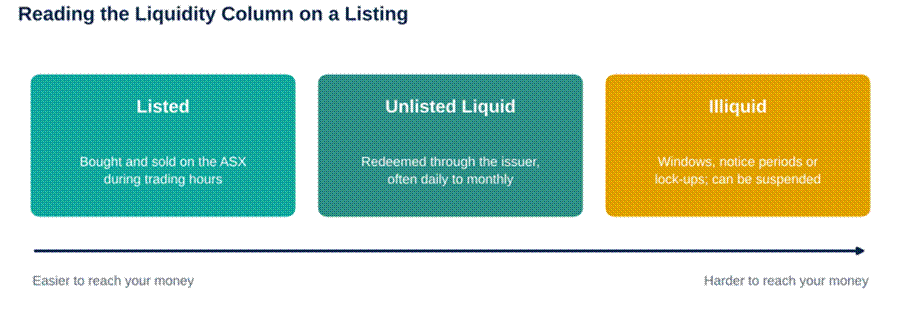
▪ The Liquidity column. It tells you how readily you can turn units back into cash: listed, unlisted liquid or illiquid. When the portfolio is paying the bills, this matters as much as the income itself.
Then open the offer document, where the issuer has published it, and go straight to the distribution section. That is where the fund explains how often it aims to pay, how each payment is worked out and when payments can be reduced or stopped.
The Liquidity column sorts funds by how easily you can get your money back. Confirm the detail in the offer document.
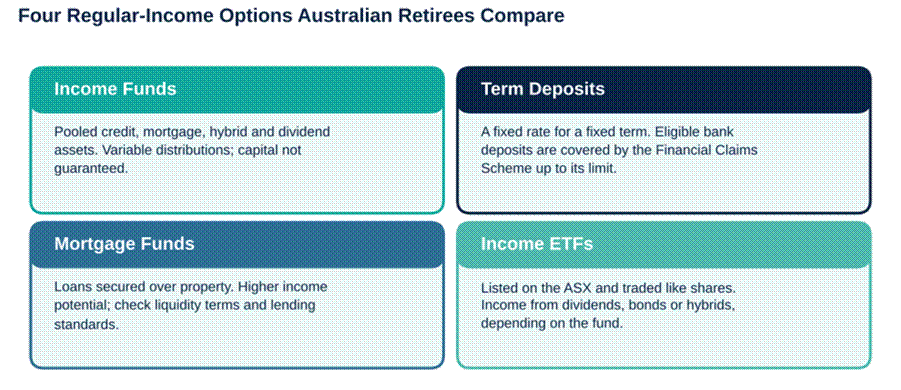
The four differ on the three things that matter most once a salary stops: whether your capital is guaranteed, how quickly you can reach your money and how steady the income is. The comparison tables further down set out the detail.
Four regular-income options, each with its own InvestmentMarkets hub.
For a fund, passive income means regular distributions: cash paid to you from what the fund earns, without you having to sell units. The terms behind those payments sit in the fund’s offer document, linked from the listing where the issuer has published it.
Any yield or distribution figure you see is the issuer’s figure, as at the date the issuer gives, not ours. Check that date, check whether the figure is before or after fees, and remember that income fund distributions are not guaranteed.
Monthly Income Funds Australia: Where to Find the Payment Frequency
Many income funds aim to pay monthly; others pay quarterly or half-yearly. The frequency, and the policy behind it, is set out in the offer document.
If monthly cash flow matters to you, confirm three things there: the stated frequency, whether payments can be varied or suspended, and whether you can reinvest instead of taking cash.
Keeps the comparison to funds designed to pay income
Investor type
Investor Type filter
Wholesale funds are only open to investors who meet the legal tests
Liquidity
Liquidity column
Shows how quickly you can turn units back into cash
Minimum investment
Min. Investment column (sortable)
Sets how much of your savings a single fund would hold
Distribution terms
Offer document, linked from the listing where the issuer has published it
Frequency, calculation method and when payments can change
Fees and performance
On the listing where the issuer has published them; confirm in the offer document
Your income is what is left after fees
Last-updated date
On the listing, where shown
Tells you how current the issuer’s figures are
What We Do and Don’t Do
▪ We don’t rank funds. Nothing on this page is a ‘best of’ list. The order of the table follows your filters and sorting, and sponsored listings are labelled.
▪ Figures are the issuer’s, and dated. Fees, performance and distribution figures come from the issuer. Where a listing shows them, check the date they relate to.
▪ This is general information, not advice. It does not take into account your objectives, financial situation or needs. Read the offer document and consider professional advice before you invest.
Income Investing in Australia: How Income Funds Work
What Is an Income Fund?
An income fund is a managed investment built to pay regular income. It pools investors’ money into income-producing assets such as floating-rate loans, credit securities, mortgage portfolios, hybrids and high-dividend shares, rather than government or corporate bonds alone. You hold units, and a professional manager runs the portfolio, shifting towards floating-rate or credit assets as rates and credit spreads move.
Distributions are usually paid monthly, quarterly or half-yearly, but they vary with what the assets earn. That is the key difference from a traditional fixed income fund, where bond coupons are more predictable. In return for that variability, income funds can offer higher yields, along with more credit, equity and liquidity risk. Many are open only to wholesale investors.
Worth Remembering
As MoneySmart notes, when you buy units in a pooled fund, ‘you could lose some or all of the money you invest’.
Structure, Unit Pricing and Liquidity
Most Australian income funds are unit trusts registered as managed investment schemes under the ASIC framework.
A licensed responsible entity operates the scheme, selects the assets and pays distributions.
Unit prices are usually struck daily or monthly from net asset value (assets minus liabilities, divided by units on issue), and the money is invested according to the strategy in the fund’s offer document and constitution.
According to Moneysmart, most income funds are unlisted, so you apply and redeem through the responsible entity rather than on the ASX.
Redemptions may be daily, monthly or quarterly. Money Mag notes that wholesale-only funds holding less liquid assets often impose longer notice periods or restrictions.
How Income Is Generated and Paid
Income comes from three main sources: interest on debt, dividends from shares and loan income from credit or mortgage pools.
Managers typically pay out most or all of the net income after fees and expenses.
Many offer a distribution reinvestment plan (DRP), so you can take payments as new units rather than cash.
▪ Regular income. Scheduled distributions make cash flow easier to plan than selling down capital, which is why they suit retirees in pension phase and pre-retirees matching income to living costs.
▪ Professional management. You hand over security selection, credit assessment and rebalancing. The Financial Services Council points to the value of continual portfolio management, and MoneySmart describes a managed fund as ‘paying a professional to make the investment decisions for you’.
▪ Diversification. One fund spreads your money across many securities, issuers and sectors, which is hard to replicate with a smaller sum. MoneySmart highlights spreading money across managers and asset classes as a way to manage risk.
▪ Access to institutional assets. Private credit, wholesale bonds and mortgage pools often carry large minimums. A fund opens the door and brings the manager’s negotiating power, a point the FSC also makes.
▪ Flexible amounts. Retail minimums are often between $1,000 and $25,000, with top-ups and DRPs letting income compound inside the fund.
▪ Tax efficiency, for some types. Funds holding Australian shares can pass on franking credits, which are particularly valuable to low-tax investors and super funds in pension phase.
Risks & Considerations When Investing in Income Funds
Every income fund trades some certainty for yield. These are the risks to understand before you invest, and where to look for each.
Risk
What it means
What to check
Distribution variability
Payments are not guaranteed and move with asset performance, rates and credit conditions
Distribution history and policy in the offer document
Asset mix
Credit, mortgages, hybrids and shares each fail in different conditions. MoneySmart stresses knowing the main risk types
The portfolio breakdown and how it is diversified
Interest rates
Floating-rate assets reprice upwards as rates rise; fixed-rate assets lose capital value. See ASIC’s guidance
The fixed and floating split and the manager’s positioning
Credit
Borrowers or issuers fail to pay, hitting income and unit prices
Lending standards, credit quality and arrears reporting
Liquidity
Illiquid assets can mean redemption windows, 30 to 90 day notice periods and, under stress, suspension, as ASIC points out
The Liquidity column and the offer document’s withdrawal terms
Wholesale restrictions
Wholesale funds carry fewer protections and, per an ASIC submission, often less transparency
The Investor Type filter and your eligibility
Fees
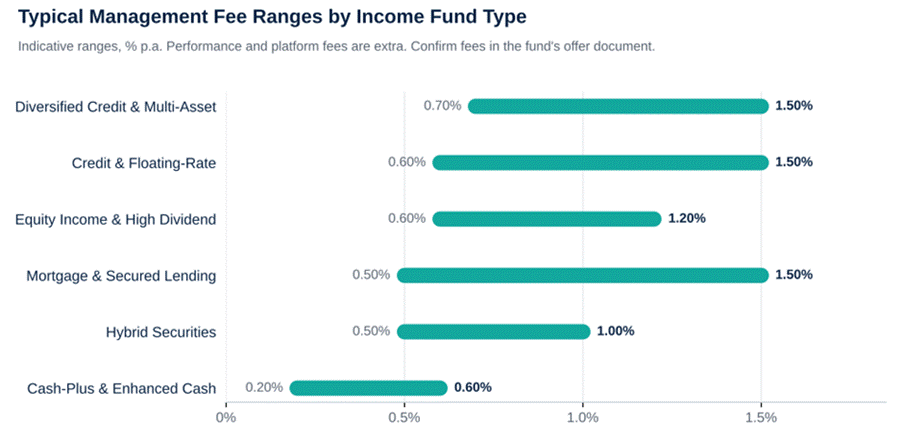
Roughly 0.20% to 1.50% p.a., sometimes plus performance fees, all taken before you are paid
Must fit the SMSF’s investment strategy, diversification and liquidity needs
Financial adviser
Tailored recommendations, manager due diligence and sometimes institutional unit classes
Adds an advice cost; alignment with your goals is key
Ten Steps to Start Investing in Income Funds
1. Define your income objectives: how much, how often and for how long.
2. Assess your risk tolerance: how much capital movement you can accept.
3. Research fund options: compare types, strategies, fees and distribution history.
4. Read the offer document: strategy, risks, fees and liquidity terms.
5. Check the responsible entity: experience, resourcing and regulatory standing.
6. Consider the tax implications for your circumstances.
7. Complete the application with the required identification.
8. Make your initial investment as the application instructs.
9. Choose cash or reinvestment for distributions.
10. Monitor and review statements and holdings regularly.
How to Compare Income Funds
A high headline yield is the start of the conversation, not the end of it. Weigh these factors together.
▪ Distribution yield and consistency. Has the yield held up through the cycle, or been cut? Unusually high yields often signal elevated risk. As Moneysmart advises, ‘Look at long-term returns’, ideally across five to ten years.
▪ Strategy and asset allocation. What the fund holds, its credit quality, diversification and rate sensitivity. Moneysmart stresses understanding how an investment works before you choose it.
▪ Fees and costs. Small differences compound. Use the Managed Funds Fee Calculator, check for performance and entry or exit fees, and work out the yield after all costs.
▪ Liquidity and redemption terms. How often you can redeem, the notice period and any lock-up or suspension risk. Moneysmart warns: ‘You may not be able to withdraw your money until a certain point in time.’
▪ Capital stability. How the unit price held up in periods of market stress.
▪ Fund size and manager experience. Scale can add stability; look at the track record and tenure of the key portfolio managers.
▪ Distribution composition. The mix of interest, dividends, gains and franking credits, and what it means for your tax.
▪ Regulatory status. Whether the fund is registered with ASIC and whether it is retail or wholesale.
Credit, mortgages, floating-rate debt, hybrids and sometimes dividend shares
Fixed-interest securities such as government and corporate bonds
Income
Variable, moving with asset performance
More predictable, from bond coupons
Interest rates
Can adapt through floating-rate assets and active allocation
Bond values typically fall when rates rise
Yield and risk
Higher potential yield, higher and more variable risk
Lower, steadier yield and generally lower risk
Liquidity
Varies; private credit can be less liquid
Typically liquid and transparent
Typical benchmark
Blended, for example Bloomberg AusBond Credit plus the RBA cash rate
Bloomberg AusBond Composite 0+ Yr Index
Key Distinction
Income funds trade some of the predictability of a bond portfolio for flexibility and potentially higher yields. Compare fixed income investments and bond funds.
Income Funds vs Term Deposits
Feature
Income funds
Term deposits
Capital
Not guaranteed; unit prices rise and fall
Eligible deposits covered by the Financial Claims Scheme up to $250,000 per account holder per authorised institution
Income
Variable, often higher than term deposit rates
Fixed for the term
Access
Redemptions daily, monthly or quarterly, depending on the fund
Early withdrawal usually costs interest or carries a penalty
Investors seeking more income who can accept variability
Investors who put capital certainty first
Key Distinction
Income funds offer higher potential income through diversified, managed assets. Term deposits offer certainty at the cost of flexibility and growth. Compare rates on the term deposits hub.
Income Funds vs Direct High-Dividend Shares
Feature
Income funds
High-dividend shares
Holdings
A mix of equities, credit, hybrids and floating-rate debt
Direct shares, often concentrated in banks and resources
Income
Drawn from several sources for steadier payments
Dividends move with company earnings and can be cut
Risk
Spread across assets under professional management
Tied to individual companies and sectors
Liquidity
Periodic redemptions, depending on the fund
Traded on the ASX at any time during market hours
Costs
Management fees, typically 0.50% to 1.50% p.a.
No management fee; brokerage applies
Suits
Investors who want managed diversification and steadier income
Hands-on investors comfortable with market risk
Key Distinction
Income funds offer diversified, managed income with less volatility. High-dividend shares give direct ownership and franking credits with more market risk. Listed alternatives sit on the income ETFs hub.
Tax Considerations for Income Fund Investors
An income fund distribution is rarely one kind of income. Your annual tax statement (often called an AMMA statement) breaks it into components, each taxed differently. The ATO requires you to declare income and credits from trust investments in your return.
Component
How it is treated
Interest
Taxed at your marginal rate, with no special concessions, according to the ATO
Dividends and franking credits
Declare both the dividend and the credit; credits can reduce tax and may be refunded to low-tax investors or funds in pension phase (ATO)
Capital gains
Report in the capital gains section (ATO instructions); individuals may get the 50% discount on assets held over 12 months
Foreign income
Assessable, with a foreign income tax offset available for tax paid overseas (ATO)
Tax-deferred amounts
Not taxed when received but reduce your cost base, as ANZ explains
In an SMSF in pension phase, income and gains may be tax-exempt and franking credits fully refundable, which can make income funds especially tax-efficient. Keep every statement and record for at least five years after lodging, and seek professional tax advice for your situation.
There is no single way to use income funds. These six approaches are common; the listings named are examples, not recommendations.
▪ Core income. A conservative base, often 40% to 60% of the income portfolio, aimed at steady income and capital preservation. Example: Affluence Income Trust.
▪ Enhanced yield. A lower-risk core with 20% to 40% in higher-yielding credit or mortgage funds, accepting more credit risk for more income. Example: Real Income Fund.
▪ Diversified income. Spreading across fixed income, equity income, mortgage and hybrid funds to reduce reliance on any one source. Example: RAM Australian Diversified Fixed Income Fund.
▪ Tax-optimised income. Leaning on franked equity income, which can lift after-tax income for low-tax retirees and pension-phase SMSFs. Example: Hamilton12 Australian Shares Income Fund.
▪ Laddered liquidity. Mixing funds with immediate access and funds with longer notice periods, so some capital is always within reach. See The Income Ladder Strategy.
▪ Growth and income. Blending income funds with growth assets, often 40% to 60% each, which suits pre-retirees moving into the income phase. See Best Way to Invest 500K in Australia.
Common Mistakes to Avoid
▪ Chasing yield. Unusually high yields usually mean higher risk. Assess credit quality, liquidity and capital risk, not just the headline. Read Chasing Yield, Losing Wealth.
▪ Ignoring liquidity. A mismatch between redemption terms and your cash needs can trap you. Keep emergency money out of illiquid funds.
▪ Overlooking fees. Even an extra 1% a year erodes long-term returns. Morningstar found that ‘Managed fund fees are a key predictor of future returns.’
▪ Neglecting tax. Make tax efficiency part of the selection process, not an afterthought.
▪ Assuming past yields will continue. Rates shift and credit cycles turn; past distributions do not guarantee future ones.
▪ Too little diversification. Spread across fund types, asset classes and managers.
We don’t rank them. InvestmentMarkets lists income funds you can compare side by side.
For a retiree, the two most useful starting points are the Objective filter, set to income, and the Liquidity column.
The distribution details, including how often the fund pays, sit in the fund’s offer document, linked from the listing where the issuer has published it.
For a fund, passive income means regular distributions. The distribution terms are in the offer document, linked from the listing where the issuer has published it. Any yield figure you see is the issuer’s figure at the date the issuer gives, and income fund distributions are not guaranteed.
Yes. Many income funds aim to pay monthly, while others pay quarterly or half-yearly. The payment frequency and the conditions under which it can change are set out in each fund’s offer document.
Income funds invest across credit, mortgages, hybrids, high-dividend shares and other income assets, so distributions vary and yields are potentially higher, with more risk.
Fixed income funds, covered on our Fixed Income Investments page, hold government and corporate bonds for more predictable coupons, though bond values fall when rates rise.
Yes. Unit prices move with the value of the underlying assets, and selling below your purchase price locks in a loss. Credit and mortgage funds face borrower defaults, equity income funds face share market falls, and several of these risks can strike at once.
Usually into your nominated bank account on each payment date, monthly, quarterly or half-yearly depending on the fund. Amounts vary with what the fund earns. Many funds offer a DRP to reinvest distributions as new units without transaction costs.
Retail funds are open to everyone and come with fuller regulatory protections, including an offer document.
Wholesale funds are restricted to investors who meet the legal tests, broadly net assets of at least $2.5 million or gross income of at least $250,000 in each of the past two years, and carry fewer protections. Managers require certification.
Yes. Many super funds offer income options, and SMSFs can invest in most income funds directly. In pension phase, income is generally tax-free; in accumulation phase it is taxed at a concessional 15%. Check the offer document to confirm the fund accepts super investors.
Each component is taxed differently: interest at your marginal rate, dividends with any franking credits, capital gains possibly with the CGT discount, foreign income with possible offsets, and tax-deferred amounts by reducing your cost base. Your annual tax statement sets out the split. Consider professional tax advice.
It varies. Retail funds commonly ask for $1,000 to $25,000; wholesale funds often $250,000 or more, though some are lower. Sort the table by minimum investment, and confirm the figure in the offer document.
Yes, particularly mortgage and credit funds holding illiquid assets, when markets are stressed or cash is short. The constitution and offer document set out when this can happen. Check the Liquidity column and the fund’s redemption history before investing.
It depends on what the fund holds. Floating-rate credit tends to pay more as rates rise, with fairly stable unit prices. Fixed-rate loans and bonds can lose capital value. Hybrids respond according to their terms, and equity income is affected indirectly through company profits. Managers can shift between fixed and floating assets as conditions change.
Conclusion: Are Income Funds Right for Your Portfolio?
Income funds give Australian investors professionally managed, regular income across a wide range of assets. Their payment schedules, diversification and accessibility make them a natural fit for retirees, pension-phase SMSFs and conservative investors focused on income.
They are not one-size-fits-all. Distributions vary and are not guaranteed, and unit prices move with the underlying assets. Match a fund’s strategy, fees, liquidity and tax profile to your own needs, read the offer document before you invest, and consider professional advice on tax and portfolio construction.
Disclaimer: This article is prepared by Simon Turner. It is for educational purposes only. While all reasonable care has been taken by the author in the preparation of this information, the author and InvestmentMarkets (Aust) Pty. Ltd. as publisher take no responsibility for any actions taken based on information contained herein or for any errors or omissions within it. Interested parties should seek independent professional advice prior to acting on any information presented. Please note past performance is not a reliable indicator of future performance.
The Premium Income Fund offers Retail and Wholesale Investors the opportunity to invest in a pool of commercial loans, secured by mortgages over real Australian property.
The iPartners Credit Investment Fund aims to provide investors with a diversified portfolio of high yielding private credit assets including asset backed securities, corporate credit and property debt.
HBRD aims to provide investors with attractive monthly income from an actively managed diversified portfolio of hybrids, subordinated bonds, senior bonds and cash. The Fund is overseen by a professional manager that can allocate tactically between these investment types.
The Premium Income Fund offers Retail and Wholesale Investors the opportunity to invest in a pool of commercial loans, secured by mortgages over real Australian property.