Compare the private equity and venture capital funds listed on InvestmentMarkets by funding stage, minimum investment, liquidity and investor type. Most of those shown are open to wholesale investors only, and the investor type on the listing clarifies this.
We don’t rank funds, and this is general information. Where the issuer has published them, a listing carries the last-updated offer document.
Venture Capital Funds in Australia: What Is Listed Here, Who Can Invest and How to Find Them
Venture capital is the early end of private equity: money invested in young, fast-growing private companies in exchange for a share of the business, usually years before those companies turn a profit or list on a stock exchange. On InvestmentMarkets, venture capital and early-stage opportunities sit alongside the broader private equity funds in the listings above.
Best Venture Capital Funds Australia: What We Show Instead of a Ranking
We don’t rank venture capital funds, and we won’t call any of them the best. Instead, we show which venture capital and early-stage opportunities are listed, who can invest in them and, where the issuer has published them, the numbers you need to judge them yourself.
The venture capital and early-stage opportunities listed here fall into five broad groups. The funding stage shown on the listing tells you which group you are looking at.
Funding Stage on the Listing
What It Usually Means
What to Expect
Seed/Angel Investment
A stake in a start-up raising its first outside capital, or a vehicle that backs companies at that stage
Highest risk of total loss, long holding period, usually illiquid
Series A, B, C
A direct raise by a private company that already has a product and customers and is scaling up
High risk; capital tied up until a sale, a later round or a listing
Unlisted Early-Stage Fund
A pooled fund, often newly raised, that spreads money across several young companies
Diversified across holdings, but still long-dated and usually illiquid
Unlisted Mature Fund
An established fund, including diversified global venture capital portfolios
More history to assess; redemption terms vary by fund
Listed
LICs and ETFs on the ASX that hold private or fast-growing companies
Buy and sell on market, though the price can drift from the value of the holdings
Who Can Invest in Venture Capital Funds?
Most of the venture capital and early-stage opportunities shown here are open to wholesale investors only. The investor type on the listing says which.
‘Wholesale Investor’ means the offer is limited to people who meet the wholesale or sophisticated investor tests in the Corporations Act.
‘Retail Investor’ means anyone can apply, subject to the offer document.
Not a wholesale investor? The retail route into venture capital and private equity is usually through listed vehicles such as LICs and private equity ETFs, which trade on the ASX with small minimums.
1. Use the category filter.Venture capital and early-stage funds are usually filed under ‘Alternatives Funds‘, while listed vehicles appear under categories such as ‘LICs‘ and ‘ETFs‘.
2. Set the investor type filter to match your status, so you only see offers you can take up.
3. Read the funding stage shown on the listings to separate seed and series raises from pooled venture capital funds and listed vehicles.
4. Open a listing to read the issuer’s summary and, where the issuer has published them, the offer document, fees and performance figures.
Private equity funds differ far more than listed funds do. Two funds with the same label can have very different holding periods, entry tickets, exit rules and fees. Start with the five factors below, all shown on the listings where the issuer has published them.
Factor
Where to Find It
What to Look For
Funding stage
Funding stage on the listing
Earlier stages (seed, series A) carry more risk of loss and longer waits. Mature and listed funds trade some upside for more visibility.
Minimum investment
Min. investment on the listing
Ranges from the price of a single unit on the ASX to six figures for wholesale funds. Commit only money you can leave untouched for years.
Liquidity
Liquidity on the listing: ‘Listed’, ‘Unlisted liquid’ or ‘Illiquid’
‘Illiquid’ generally means no withdrawals until the fund returns capital. Check redemption terms in the offer document.
Investor type
Investor type on the listing
‘Wholesale Investor’ offers need a qualifying certificate or an investment of at least $500,000. ‘Retail Investor’ offers are open to anyone.
Fees
The offer document, where the issuer has published it
Management fee, performance fee or carried interest, hurdle rate, and fees charged inside any underlying funds.
Beyond the Listing: Five Questions for Any Private Equity Manager
● Strategy: What is the fund’s investment thesis, and does the manager stick to it?
● Track record: How have the manager’s earlier funds performed, net of fees, over a full cycle? The Thing With Private Equity Returns shows why the gap between the best and worst managers is so wide.
InvestmentMarkets is a place to find and compare investments. Here is exactly what that means on this page.
What We Do
What We Don’t Do
List private equity and venture capital funds from Australian issuers, with the details the issuer provides
Rank funds, or call any fund the ‘best’
Show the investor type on the listing, so you can see plainly whether an offer is for wholesale investors only
Decide whether you qualify as a wholesale investor. The issuer does that, usually on the strength of an accountant’s certificate
Carry the offer document, fees, performance figures and the last-updated date, where the issuer has published them
Give personal financial advice or consider your objectives, financial situation or needs
About Private Equity
Private equity has moved from the preserve of institutions and the very wealthy into a growing share of everyday portfolios. Super funds have held it for years, and a widening range of unlisted funds, LICs and ETFs now gives individual investors a way in. It is one part of the private markets, alongside private credit and infrastructure.
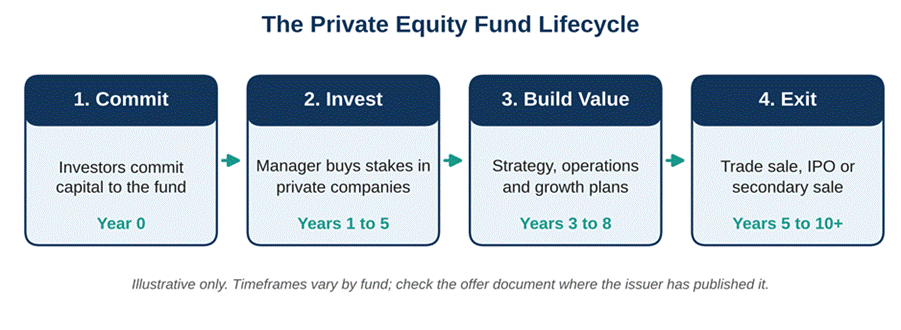
Private equity is investment in companies that are not listed on a stock exchange. A private equity fund pools money from investors, buys significant or controlling stakes in private businesses, works to lift their value through strategy, operational improvements and sometimes restructuring, then sells them, typically through a trade sale or an initial public offering (IPO).
Managers use their expertise, networks and capital to unlock growth the companies might not reach alone. The trade-off for investors is time and access: money is usually committed for years, and there is no daily share price to sell into.
Funds established companies that are expanding quickly, usually for a minority stake
Proven and scaling
Leveraged buyout (LBO)
Buys mature companies with a mix of equity and debt, improves them, then refinances or sells
Mature and cash generating
Distressed investing
Buys companies, or their debt, in financial difficulty or bankruptcy, aiming for a turnaround
Under financial stress
Secondaries
Buys existing stakes in private equity funds or companies from investors who want to sell early
Any stage, often mature
Private Equity Firms in Australia
A search for private equity firms in Australia usually means one of two things: the managers that run private equity funds, or the funds those managers offer to investors. This page focuses on the funds. The issuer named on the listing is the firm responsible for the offer, and some listings also name a separate investment manager. Open a listing to see who is behind the fund and how to make an enquiry.
Australian private equity firms range from large managers of institutional buyout funds to boutique specialists focused on a single sector, and venture capital firms that back technology and life sciences start-ups. Many of their funds are open only to institutions or wholesale investors, which is why the investor type on the listing matters.
Features and Risks of Private Equity
Features
Risks
Potential for higher returns. Private equity has historically outperformed listed markets over the long term, although results vary widely between managers.
Illiquidity. Money is often locked up for years, and early exits may be unavailable or come at a discount.
Active management. Managers provide strategic guidance and operational support to the companies they own.
Limited control. Managers may hold minority stakes with limited influence, and investors have little say over individual holdings.
Diversification. Unlisted holdings can behave differently from listed shares, adding a distinct source of return to a portfolio built on, say, Australian ETFs and Global ETFs.
High fees. Management fees, performance fees and carried interest are typically higher than for listed funds.
Access. Many fast-growing businesses now stay private for longer, so some growth is only available before a listing.
Less transparency. Valuations are periodic estimates rather than live market prices.
We don’t rank venture capital funds. The venture capital and early-stage opportunities listed on this page range from seed and series raises to pooled early-stage funds, diversified global venture capital funds and listed vehicles on the ASX. Most are open to wholesale investors only, and the investor type on the listing says which. Use the category filter to narrow the results, read the funding stage on the listings, and visit the early-stage capital hub for start-up opportunities across asset classes.
It depends on the investor type shown on the listing. ‘Retail Investor’ offers are open to anyone, subject to the offer document. ‘Wholesale Investor’ offers are limited to people who meet a test under the Corporations Act. The tests most issuers rely on are:
● Net assets of at least $2.5 million, or gross income of at least $250,000 in each of the last two financial years, certified by a qualified accountant; or
● Investing at least $500,000 in the offer; or
● Being a professional investor, or being assessed as a sophisticated investor by a licensed adviser.
The issuer decides whether you qualify, not InvestmentMarkets, and the thresholds are set in law and can change. Wholesale offers don’t carry the same consumer protections as retail ones, which is why it pays to read the offer document in full, as Private Credit Fund Management Fees: More Than Meets the Eye explains.
Yes. Listed vehicles, including LICs, LITs and private equity ETFs, trade on the ASX and are open to retail investors with small minimums. Some unlisted funds are also open to retail investors; set the investor type filter to see them.
Typical investments include leveraged buyouts (LBOs), venture capital, growth equity, distressed investing and secondaries. See Types of Private Equity above.
Initial public offerings (IPOs), trade sales to another company, mergers and acquisitions (M&A), and secondary sales to other investors or funds.
Management fees have traditionally been around 2 to 3% a year, and carried interest, the manager’s share of profits, can be as high as 20 to 30% of returns, usually above a hurdle rate. Fees vary widely, so check the offer document where the issuer has published it.
By providing strategic guidance, operational support, access to networks and capital, and by improving how the companies are financed and governed.
Start with the funding stage, minimum investment, liquidity, investor type and fees shown on the listings where the issuer has published them. Then weigh the investment thesis, track record, portfolio quality and exit strategy. Our comparison guide above walks through each one.
The main drivers are the price paid on entry, strategic decision-making, operating improvements, the use of debt and the timing and quality of the exit.
Unlisted private equity and venture capital funds commonly run for five to ten years or more, and capital is returned as investments are sold. Listed vehicles can be sold on the ASX at any time, at the market price.
It can be, but it is best suited to investors with a long time horizon, money they will not need for years and a reasonable tolerance for risk. Many unlisted funds are for wholesale investors only. This is general information, so consider personal advice before investing.
Often, yes. Private equity funds are commonly spread across sectors, geographies and expected exit dates. Concentration varies, though, and a raise for a single company offers no diversification at all.
Investing in Private Equity Conclusion:
Private equity offers access to a part of the economy that listed markets increasingly miss, along with the illiquidity, opacity and fees that come with it. It rewards investors who understand what they are buying and who can afford to wait.
Start with the listings above. Check the investor type, funding stage, minimum investment and liquidity, then read the offer document where the issuer has published it. Weigh the manager’s thesis, track record, portfolio quality and exit plan before you commit.
Disclaimer: This article is prepared by Simon Turner. It is for educational purposes only. While all reasonable care has been taken by the author in the preparation of this information, the author and InvestmentMarkets (Aust) Pty. Ltd. as publisher take no responsibility for any actions taken based on information contained herein or for any errors or omissions within it. Interested parties should seek independent professional advice prior to acting on any information presented. Please note past performance is not a reliable indicator of future performance.
GPEQ gives investors a diversified portfolio of the 50 largest and most liquid global listed private equity companies. This private equity ETF aims to provide investment returns, before fees and other costs, which track the performance of the Index.
WAM Alternative Assets offers investors access to a diversified portfolio of alternative assets, typically accessible only by institutional investors. The Company provides investors a unique investment solution, complementary to their traditional investment portfolios by investing in alternative assets.
PE1 aims to provide investors with access to the top-performing quartile of global private equity managers, and boasts exposure to over 400underlying private companies.