Early-stage Capital: How to Invest in Early-Stage Companies & Funds in Australia
Early-stage capital is money invested in young companies, or newly raising funds, before they have steady revenue or a track record. In Australia you can invest in Early-stage capital directly, through angel networks, through venture capital funds, through equity crowdfunding, or through an SMSF where its strategy allows.
Most direct deals and many venture capital funds are open only to wholesale investors; equity crowdfunding is open to everyone. We don’t rank opportunities. Below are the early-stage opportunities listed on InvestmentMarkets, and the numbers to judge them on: fees, performance, minimum investment, liquidity and the offer document, where the issuer has published them.
Key Takeaways
What it funds: the seed, Series A and venture rounds that take a company from idea to scale, and unlisted funds at an Early-stage of raising capital.
How to access it: direct investment, angel networks, venture capital funds, equity crowdfunding and, where the strategy allows, an SMSF.
Early-stage capital is funding for companies in the first phases of their life, typically before they have a stable revenue stream or an established market presence. Investors provide it in exchange for equity or convertible notes, hoping to share in the company’s growth as it matures. That makes it a high-risk, potentially high-reward part of the market.
On InvestmentMarkets, the Early-stage capital listings cover two kinds of opportunity: early-stage companies raising seed, Series A or later venture rounds, and unlisted funds that are at an Early-stage of raising capital themselves.
How Do I Invest in Early-stage Companies in Australia?
There are five main ways in. Which will suit you depends on your investor status, how much you want to commit to any one company, and how long you can leave the money untouched.
Route
How It Works
Who Can Invest
Diversification
Direct investment
You provide capital directly to a startup in exchange for equity or convertible debt.
An SMSF invests in early-stage companies or funds as part of its retirement strategy.
Depends on the fund’s size and status
Depends on the route used
Figure 2: Five ways to invest in Early-stage capital.
Because a single startup can fail, a venture capital fund is generally regarded as the lowest-risk way to gain exposure to this high-risk asset class: the fund spreads your capital across many companies and is run by a professional manager.
What Are the Best Early-stage Investments in Australia?
The best Early-stage investment is the one whose risk, lock-up and minimum fit your circumstances, and that question has no universal answer. What you can do is compare like with like. Filter the listings by category, objective and investor type, then judge each opportunity on its numbers and its offer document. The sections below explain what to look for.
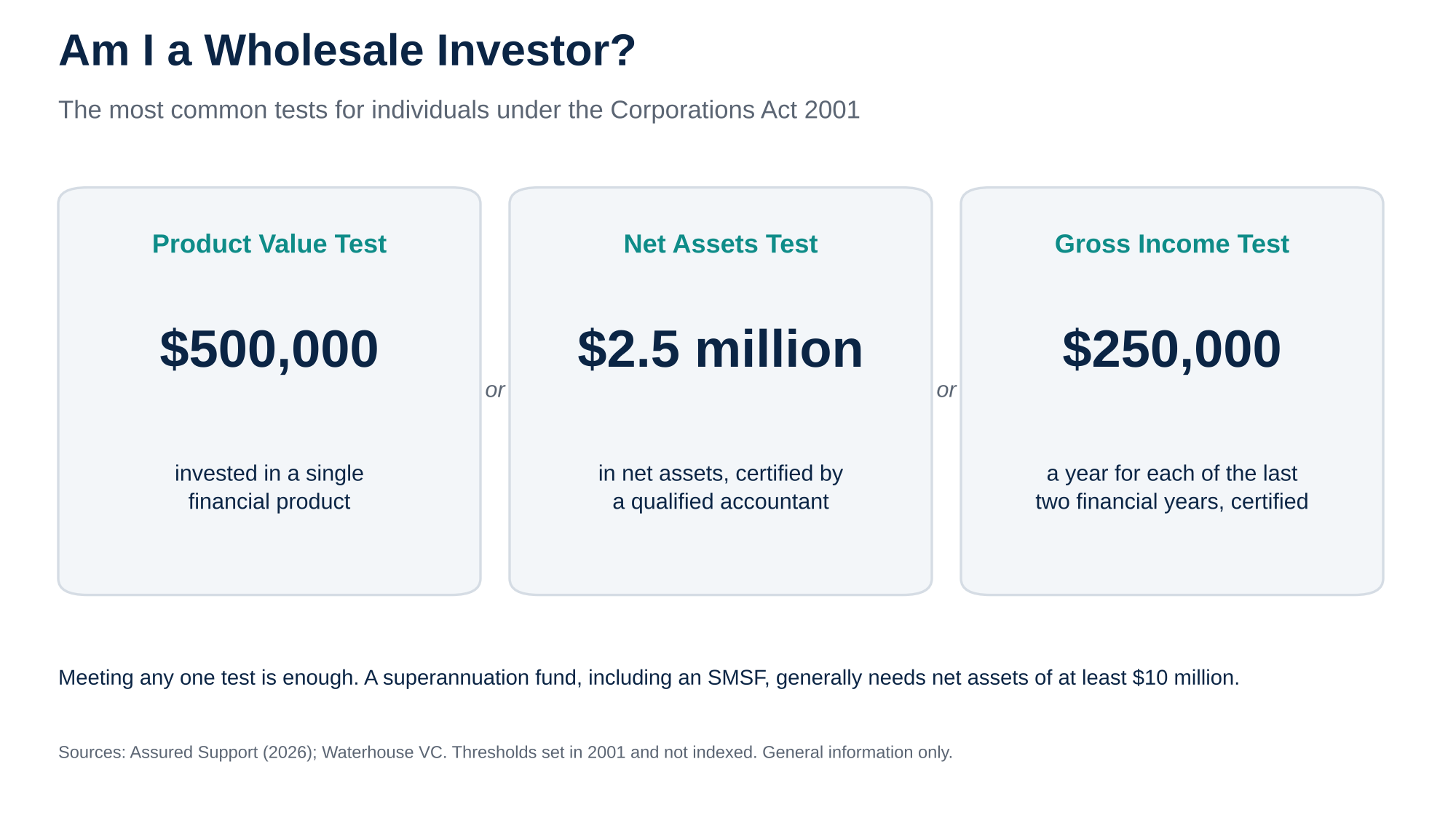
Figure 3: The most common wholesale investor tests for individuals.
Because of the high risks involved, Early-stage investing is generally best suited to high-net-worth investors with experience of the asset class. Typical participants include angel investors, venture capitalists, incubators and accelerators, family offices and high net worth individuals seeking high-risk, high-reward opportunities.
What Is the Minimum Investment for Early-stage Capital?
It ranges from a small amount to several million dollars, depending on the opportunity. Equity crowdfunding offers can accept small amounts, while direct rounds and venture capital funds often set much higher minimums. Where the issuer has published it, the minimum investment appears on the listing.
How Long Is My Money Locked Up in an Early-stage Investment?
Usually for many years. Early-stage investments generally require a long-term commitment, and you are typically repaid only when the company is sold, lists through an IPO, or your shares are bought in a secondary sale. Many listings are marked as illiquid; others describe themselves as unlisted but liquid, with redemptions on the terms set out in the offer document. Read Patience is an Investment Decision for why a long horizon is part of the discipline, not a flaw in it.
What Returns Can Early-stage Investing Deliver?
Returns vary widely and are never guaranteed.
A successful early-stage investment can return several times the original capital; an unsuccessful one can return nothing. Many startups won’t succeed and will be worthless in the future, so Early-stage investors aim for their winners to more than offset the losses from their losers. Where the issuer has published them, performance figures for funds appear on the listing; always check the period they cover and whether they are after fees.
Can I Invest in Early-stage Capital Through My SMSF?
Yes, where the fund’s trust deed and documented investment strategy allow it, and the investment meets the sole purpose test and related-party rules. Because an SMSF generally needs net assets of at least $10 million to be treated as wholesale, many will be limited to retail routes such as equity crowdfunding and retail early-stage funds. Speak with your SMSF adviser before investing.
How to Compare Early-stage Investments
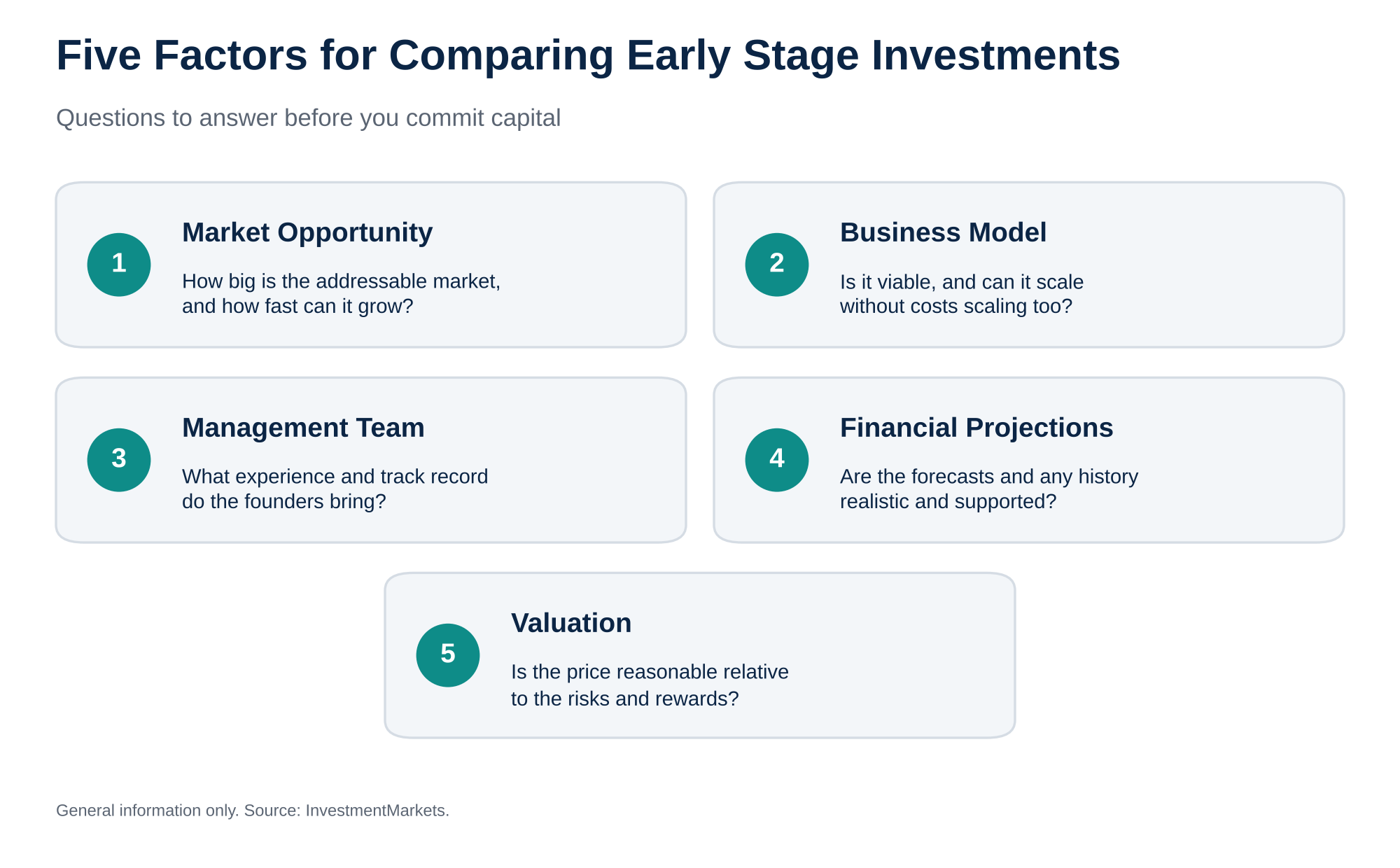
Five factors do most of the work when comparing early-stage opportunities:
Market opportunity: the company’s total addressable market and its realistic growth potential.
Business model: whether the model is viable and can scale without its costs scaling just as fast.
Management team: the experience, capabilities and track record of the founders.
Financial projections: the projections and any historical performance data, read with healthy scepticism.
Valuation: whether the proposed valuation is reasonable relative to the risks and rewards.
Figure 6: Five factors for comparing Early-stage investments.
Narrow the listings with the category, objective and investor type filters. Where the issuer has published them, listings carry the details below. Always confirm them against the offer document.
Listing Detail
What It Tells You
Investor type
Whether the opportunity is open to retail investors or to wholesale investors only.
Objective
Whether it targets growth, income, or growth and income.
Spread your capital across several startups in different industries, stages and geographies, and consider different vehicles, such as venture capital funds alongside angel networks. Diversification will not remove the risk of individual failures, but it stops any one of them from deciding your outcome.
Source: Funding figures from The State of Australian Startup Funding reports and quarterly reports by Cut Through Venture and Folklore Ventures, as reported by the linked publications. Fund assets from the Australian Investment Council and Preqin.
Early-stage investing can be grouped into four main types.
Seed Funding
Capital provided to early-stage startups to develop and test their ideas, often in exchange for equity.
Series A Funding
The first significant round after seed capital, typically used to scale operations and refine the company’s products.
Venture Capital
Investment from firms dedicated to funding early-stage businesses. It often involves larger amounts of capital, alongside strategic support for the companies backed. Venture capital sits within the broader private equity universe, and listed private equity ETFs and LICs offer daily-traded access to some managers in the space.
Angel Investing
Funding from wealthy individuals who provide capital, guidance and mentorship to startups in exchange for equity.
Why Early-stage Investing Matters
Early-stage investing is a crucial part of the entrepreneurial ecosystem. By providing capital at the earliest phase of a company’s life, investors help propel innovation and create jobs, and may earn substantial returns if the ventures succeed.
High Growth Potential
Early-stage investments can deliver substantial returns if the company succeeds.
Investor Involvement
Early-stage investors often have the opportunity to influence a company’s direction and strategy.
Diverse Investment Vehicles
Options range from ordinary equity to convertible notes, giving investors flexibility in how they structure their exposure.
The earliest rounds, used to prove an idea and build a first product.
Series A
The first significant round after seed, used to scale operations.
Series B and beyond
Later rounds that fund expansion once a company has traction.
Convertible note
A loan that converts into shares at a later round, often at a discount.
Valuation
The price put on the whole company in a round, which sets what your shares cost.
Dilution
The fall in your percentage ownership when new shares are issued.
Exit
How investors realise a return: an acquisition, IPO, secondary sale or strategic partnership.
ESIC
Early-stage innovation company: a company whose investors may qualify for tax incentives.
ESVCLP
Early-stage venture capital limited partnership: a tax-advantaged venture fund structure.
Wholesale investor
An investor who meets a legal test of wealth, income or investment size, and receives fewer retail protections.
Early Stage Investing FAQs
It can range from a small amount through equity crowdfunding to several million dollars, depending on the opportunity. Where the issuer has published it, the minimum investment appears on the listing.
Early-stage investments typically require a long-term commitment, often lasting many years, until the company is sold, lists or your shares are bought in a secondary sale.
Expected returns vary significantly. A successful investment can return several times the original capital, but many startups won’t succeed and will become worthless. That is why Early-stage investors aim for their winners to more than offset the losses from their losers.
No. Because of the high risks involved, Early-stage investing is generally best suited to high-net-worth investors with adequate experience of the asset class.
Spread your capital across multiple startups in various industries, stages and geographies, and consider different vehicles such as venture capital funds or angel investing networks.
Angel investors, venture capitalists, incubators and accelerators, family offices and high net worth individuals seeking high-risk, high-reward opportunities.
Acquisitions by larger companies, initial public offerings, secondary sales and strategic partnerships, all of which can give investors liquidity once the company has matured.
Early-stage capital, including venture capital, backs young companies before they are established. Private equity more broadly also includes buyouts of mature businesses, growth equity and distressed investing.
Yes, through equity crowdfunding, where retail investors can invest up to $10,000 per company in any 12-month period, and through early-stage funds open to retail investors. Use the investor type filter to find them.
It depends on your goals, risk tolerance and investor status. Filter the listings by category, objective and investor type, then compare fees, performance, liquidity and the offer document where the issuer has published them.
Largely, yes. Early-stage capital funds startups through their seed and venture rounds. On InvestmentMarkets the Early-stage capital listings also include unlisted funds at an Early-stage of raising capital.
Early-stage investing plays a crucial role in the entrepreneurial ecosystem, giving young companies with high growth potential the capital they need. It offers the promise of substantial returns, and carries significant risks, including high failure rates and limited information. Understand the types of Early-stage investing, assess each opportunity against clear criteria, and choose the route that fits your circumstances. Above all, it rewards thorough due diligence, engagement with the startup community and a long-term perspective.
Compare Early-stage Opportunities
Filter the Early-stage capital listings by category, objective and investor type, and enquire directly with issuers.
Disclaimer: This article is prepared by Simon Turner. It is for educational purposes only. While all reasonable care has been taken by the author in the preparation of this information, the author and InvestmentMarkets (Aust) Pty. Ltd. as publisher take no responsibility for any actions taken based on information contained herein or for any errors or omissions within it. Interested parties should seek independent professional advice prior to acting on any information presented. Please note past performance is not a reliable indicator of future performance.
This is an opportunity for wholesale investors to invest in an irrigated dairy aggregation of two substantial neighbouring properties in the tightly-held Derwent Valley of Tasmania (For Wholesale Investors Only)
The Fund takes a long-only investing approach to its portfolio with a view to invest in, on average, 25 to 40 positions across the ASX300. (For Wholesale Investors Only)
The portfolio provides investors with access to institutional quality renewable energy assets, spanning multiple technologies, and multiple jurisdictions.
Peak Equities has partnered with the experienced and proven Childcare Developer, TAL Group, to offer a portfolio of three childcare assets in Queensland and Western Australia. (For Wholesale Investors Only)
The Fund aims to generate high positive annualised returns of between 10% and 20% over the medium to long term regardless of equity market movements and without excess risk. (For Wholesale Investors Only)
The Fund invests in a portfolio of secured loans of $20m to $80m, in mid-market non-investment grade Australian corporates that are currently underserviced by banks and credit funds. (For Wholesale Investors Only)
The Fund will invest in early-stage high potential growth companies, with a focus on seed stage and follow-on investments. (For Wholesale Investors Only)