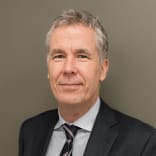
Our next presenter is Vaughan Hayne, Managing Director and Co-Founder at Exceed Capital.
Vaughan has over 30 years in funds management, specializing in building and growing investment businesses and delivering quality investor aligned opportunities.
Today, he's going to outline five practical ways for investors to build passive income from commercial property investment.
Can't wait to hear from you today, Vaughan.
Over to you.

Thanks, Darren.
We're really excited to be here today as part of your webinar and thank you very much for those who have tuned in today.
First of all, I'm just going to go through a little bit about Exceed Capital and provide a little bit of background, who we are.
So Exceed Capital is a Brisbane based commercial property investment manager.
We've got a strong track record of delivering some great results for our investors and we've been operating now for just over 10 years.
We currently manage in excess of half a billion dollars of assets under management and that's across 18 different properties that we own and invested in 14 different investment funds.
The portfolio has been diversified across multiple commercial property areas or sub-sectors we should say including office, retail, large format retail, allied health, medical and some specialist assets as well including the ever so trendy at the moment data centres and an automotive dealership.
So just now running through the five different ways.
So way one, which is the first way of smart property investing, is about regular stable income.
So most investors already have exposure to shares, areats, private credit or businesses in direct property.
However, the challenge in our view is building a portfolio that balances growth and income and risk.
Commercial property provides diversification.
Rather than trying to be the highest-returning asset class, it can deliver strong inflation-linked income, capital growth, and also add stability to investors' portfolios.
So there's three components of that.
One, first of all, is income.
So commercial property generally focuses around 8% cash returns to investors.
Well, that's in particular we focus on, as well as tax deferred benefits as well, which is a derivative of depreciation in particular.
The good thing is the income is inflation hedged income.
So therefore there is annual REIT reviews which are off the underlining leases there, which provide an inflation hedge there.
So very stable cash flows with strong underlining leases for security.
The capital component, so we have the saying that you make your money on the way in and you crystallise it on the way out.
So what is that all about?
It's about making sure that your entry and your exit timing points are important and critical of getting that right to maximise your capital returns.
Generally, as mentioned, the income has annual rent reviews, which means that also everything being stable, your net income is growing as well over time, which flows through to capital growth as well.
So property is also important to make sure that it's being managed well as well.
So it's not just about buying and holding, property is very much about being proactive as well.
And that could also include value-add opportunities, including things like splitting down tenancies or repositioning the asset if need be.
The other component to it is risk, and that is just about understanding the risk of the investment.
So, first of all, diversification across sub-sectors, location, is important, and also making sure that with regards to unlisted property versus listed,
it has a lower correlation there as well, so therefore you don't get the speculation there in unlisted property as you may do in listed property, which helps diversify a portfolio as well.
So number two, it's about spreading or reducing risk through diversification.
So the old rule that everybody's heard of, don't put all your eggs in one basket.
It's important to diversify across property sub-sectors and locations.
So we have a open-ended fund we call the collective, and I'll use that as an example.
So the collective has exposure there to three direct property investments and also exposure to further four other assets through existing trusts that we manage as well.
So that exposure is across office, across retail, medical, government and data sectors.
So you're getting great diversification there across all different property sub-sectors.
The portfolio also spans across Queensland, New South Wales and Adelaide, and is going to be continuing to grow as well.
So that strong diversification has been achieved in a short period of time of just around, or just under 18 months now, with that collective fund.
And we'll also be putting additional opportunities into that fund as it grows further.
Drilling down a little bit more into risk around property and making sure that property risks are considered, we can break that down into three different areas.
One, the asset itself.
So diversification, as I've touched on already, reduces the risk, reducing volatility of returns.
But it's also important to understand the capex or your capital expenditure I should say.
To make sure that when you are reviewing a property to purchase that there's no surprises there.
So doing a thorough due diligence is important to understand that.
Also it's important to proactively manage the outgoings of the property.
Outgoings including the likes of insurance, rates, cleaning, all different other property running expenditure.
Also understanding the tenant, the covenant of that tenant and the strength of that tenant.
On the numbers side of things, gearing, gearing levels, making sure that it's the reasonable gearing levels, that the gearing is not overly stretched.
For example, 50% is usually on the, I guess you wouldn't want to go much higher than 50% unless you're just taking head space for security purposes.
Then there's an interest cover.
Typically interest cover is somewhere around that 1.5 times, sometimes lower, sometimes a little bit higher as well, depending on the asset and the cash flows from that asset.
And then it's important to ensure and understand how the debt is structured.
So for example, has it got the security of a non-recourse loan facility or recourse only back to that asset?
And also the interest rate.
Is the interest going to be hedged or left on a variable where there's exposure to ups and downs in the market?
Last part there is the environment and that's just a checking through making sure again that you have a thorough due diligence process there.
With that we go through a 110 point due diligence process when we are considering and reviewing assets for acquisition.
It's important to also understand as part of that where in the property cycle are you buying with regards to that asset.
Because you may have to allow some buffers there in case things change.
Way three is about let the fund do the heavy lifting.
So what are we referring to here?
So why unlisted property over direct property?
Well some investors may have the capability to buy commercial or direct property but the question isn't necessary whether you can, it's whether that's the best way and best suited for your portfolio.
So an example here is a single property can actually, if you're buying a single property yourselves, it can represent several years worth of investment in capital to be able to acquire that, but it also can lead you to being heavily exposed on one property or one location, and it may even be 110 for that example.
In a fund structure like we put together, it's about pulling investors' money together and actually having some units in a trust where it is purchased with others.
So therefore, you can spread your risk of investment across different trusts.
across different assets, but importantly you gain exposure to higher quality assets and higher quality buildings and properties as well.
For example,
If you own the property directly, depending on the size of that property, it may only be a local mechanic, for example, as your tenant.
Where with ourselves, we have large listed companies, usually ASX listed or national tenants, sometimes international tenants, which are very well known and have got very strong balance sheets behind them.
And institutional grade assets as well.
So again, it's not necessary about the attraction of owning it all yourself sometimes.
Sometimes it's better to be diversified in a portfolio and have professionals there doing the hard work with regards to the tenant exposure, if there's any vacancies there, the property outgoings and various other things.
Way four, buy when others are holding back.
So we like to say and use the term that we run a top-down and counter-cyclical approach.
So we make our money on the way in and we crystallise it on the way out.
Cap rates rise and fall over time, but when yields push out, prices often soften, and that's when these good opportunities appear for buy.
For example, recent office and healthcare acquisitions that we have undertaken, where some may say that, especially after COVID, are some people not coming back to the office and is AI changing things?
Yes, we take all of that into consideration.
However,
Some of our best performing assets are in the office market and in very tight locations like the Gold Coast for example where we are the largest office holder there.
We're able to attract strong tenants with strong whale weighted average lease at Spiree and buying well through having a consistent approach to our acquisitions and being reputable in the market with those vendors.
And again, it's important to understand and go through a detailed due diligence process.
Understand the local region, the economy, the drivers.
What's happening with rents there?
Are the tenants in the property paying less than market rent or above market rent?
And importantly, a question that we always ask ourselves, why does the tenant actually have to be there?
What drives the tenant to both their asset and that location and being in the building?
Number five.
is choose the right fund for you.
So this comes down to the different structures.
So there's open-ended versus closed-ended asset funds.
So open-ended funds are where a fund is continually open for investment and typically would have certain areas or times with regards to when redemptions or liquidity events can be available.
With regards to the opposite, being a closed-ended fund, where typically it is one or sometimes two assets in a fund, the fund manager raises the money to purchase those assets or that asset, and then the fund is then, let's say, closed for investment and continues to be managed by the fund manager for the next five, sometimes ten years as well.
So it's important to understand where you are in your process of your part of your lifestyle.
So for example, understanding the investment term that you would like your investment to be tied up for.
Property is a medium to long-term hold due to its transaction costs, so should never really be considered as highly liquid or a short-term investment.
Understand your liquidity needs, because liquidity, generally, women reason, comes at a cost, which means that it has a lower return for those who are more liquid.
So on an open fund point of view, it is more flexible and diversified across assets.
It's lower risk and generally more stable.
Closed-ended funds, typically five years, single asset, single location.
But for those who invest in that, it's probably more about having the depth to be able to invest in a few of those and also
I guess you could say it's like trying to pick the winner or believing in a certain location is going to be very strong with different drivers over the near future.
Anyway, that is our view.
I hope you enjoyed it and that's our feedback on five ways of great investing.
Thank you very much for that, Vaughan.
Thank you.
5 Ways Smart Investors Build Passive Income Through Commercial Property
About this presentation
Commercial property can add stable, inflation-linked income and diversification to an investment portfolio, and this webinar sets out five practical strategies to build passive income from this asset class.
Presented by Vaughan Hayne, Managing Director and Co-Founder at Exceed Capital, and hosted by Darren Connolly, this November 2026 InvestmentMarkets webinar draws on more than 30 years of funds management and investment experience.
Vaughan begins with an overview of Exceed Capital, a Brisbane based commercial property investment manager with assets across office, retail, large format retail, allied health, medical and specialist sectors including data centres and an automotive dealership. He then works through five ways to approach commercial property investing: building regular, stable income from leases with annual rent reviews, reducing risk through diversification across sub-sectors and locations, letting a fund do the heavy lifting compared with buying direct, buying when others are holding back, and choosing the right fund for your needs.
The webinar also covers how to assess property risk, including due diligence, capital expenditure, outgoings, tenant strength, gearing, interest cover and debt structure. It also explains the difference between open-ended and closed-ended funds, and why investment term and liquidity needs matter when choosing between them.
Disclaimer
- The presentations made during this seminar are for informational and promotional purposes only.
- Any comments made or information provided does not consider the appropriateness for you having regard to your particular objectives, personal/financial situation and needs.
- Before investing you should consider independent professional financial advice.
- No comments made or information provided constitutes advice, an invitation, or an offer to buy any security or other financial product or engage in any investment activity.
- All securities and financial products involve risks.
- Past performance of any product is not a reliable indication of future performance.
- Read carefully the governing documents of a product’s offering such as its PDS or information memorandum.
- InvestmentMarkets does not vet, endorse or recommend any product the subject of the presentations and is only facilitating the exposure of the product.
- These presentations were made in November 2026 and therefore relevant facts, the economic environment, governing documentation and the law upon which they were based may change after that date such that the accuracy and reliability of their content may be affected.
Featuring


More Videos