Learning from the ‘AI Stock God’s’ Extraordinary Performance

Simon Turner
Wed 3 Jun 2026 10 minutesOne of the best ways to improve your performance as an investor is to learn from those who have mastered the craft.
Most investment masters are grey-haired, having earned their wisdom through decades of experience. Not so with the master featured in this article. Leopold Aschenbrenner is the twenty-four-year-old founder of Situational Awareness who worked in OpenAI’s Superalignment team before being fired in 2024. In the less than two years since he founded Situational Awareness, the fund’s performance has been nothing short of remarkable with returns of over 2,000%. Hence, he has already become known in some investment circles as ‘the AI Stock God’.
Let’s learn some lessons from this master of all things AI at a time when the sector’s promise remains potentially revolutionary.
A Word of Warning
First, some historical context.
Before you go investing in this fund or following it into the stocks it owns, it has to be mentioned that Situational Awareness is a relatively new fund and is most definitely a hot fund.
As we discussed in our article entitled Should you invest with a manager enjoying a purple patch?, extreme fund outperformance often, but not always, warrants investor caution.
Situational Awareness Introduced
Since its founding in September 2024, Situational Awareness has grown its disclosed U.S. equity exposure from US$225 million to US$5.5 billion at the end of 2025, and more recently to US$13.6 billion. You read that right.
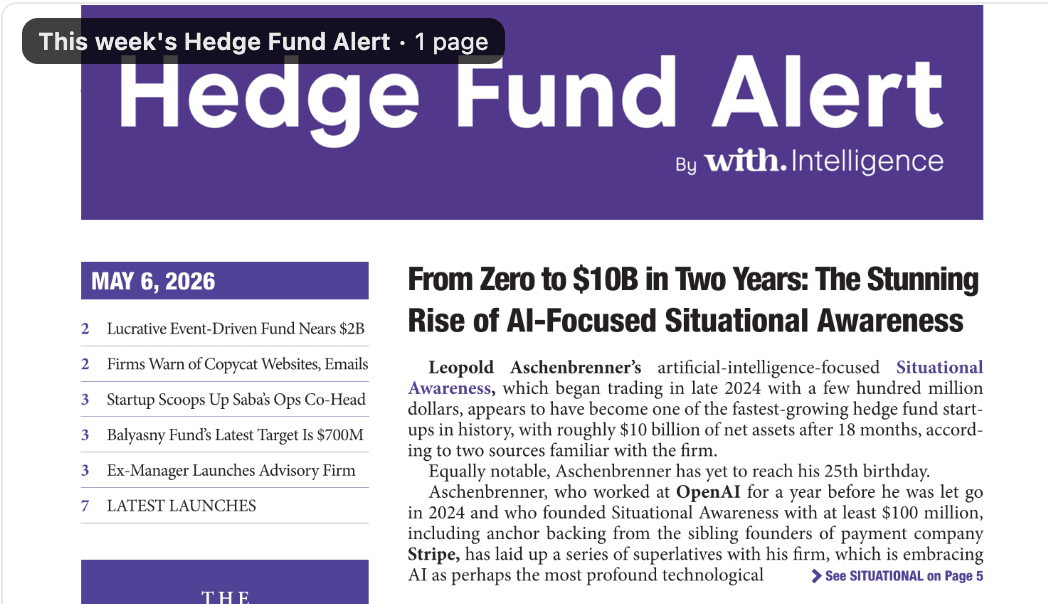
Interestingly, this astounding performance has been achieved without owning any of the Magnificent Seven. The fund’s portfolio has been focused on the lesser-known stocks positioned to benefit from the AI revolution.
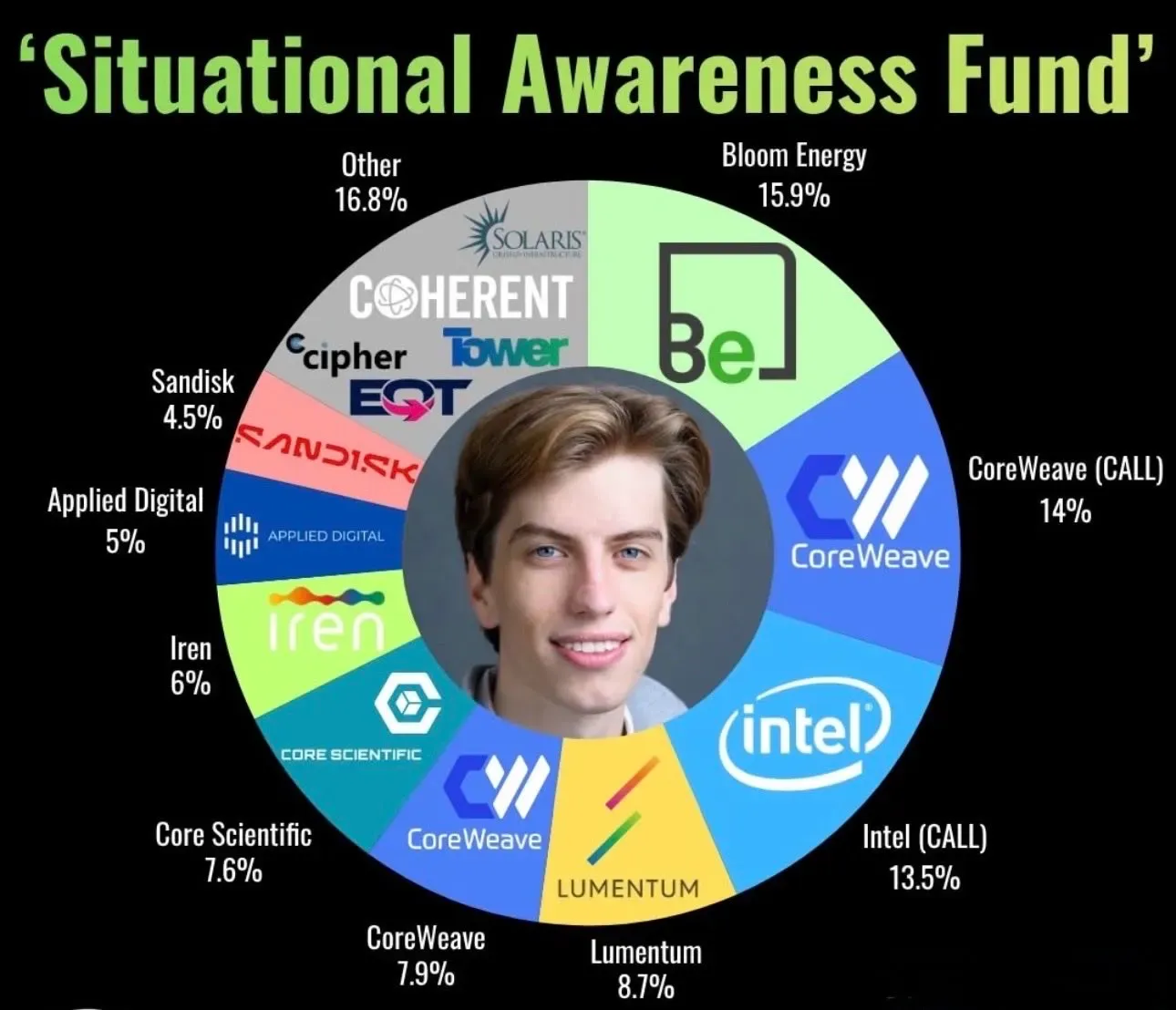
Not only that. The fund is also short many of the larger AI winners such as Nvidia.
Here’s the fund’s portfolio at the end of Q1 2026:
SMH - $2.04B (Put) NVDA - $1.57B (Put) ORCL - $1.07B (Put) AVGO - $1.01B (Put) AMD - $969.2M (Put) BE - $878.7M SNDK - $724.4M MU - $583.7M (Put) CRWV - $556.1M TSM - $535.1M (Put) ASML - $494.1M (Put) MU - $422.3M (Call) IREN - $401M CORZ - $389.1M SNDK - $388.8M (Call) TSM - $354.8M (Call) APLD - $320M INTC - $159.1M (Put) RIOT - $142.2M CRWV - $140.6M (Call) CLSK - $104.5M SEI - $62.5M BE - $55.3M (Call) TE - $43.9M BITF - $38.8M BTDR - $29.8M PSIX - $26.3M GLW - $21M (Put) WYFI - $20.9M AMD - $20.2M BW - $19.9M SHRN - $18.1M PUMP - $13.1M GDX - $10.3M INTC - $8.9M TSM - $7.6M INFY - $6.8M (Put) GIVE - $6.4M ASML - $6.1M MU - $5.9M GLW - $718K NVDA - $498K
And here’s a summary of the fund’s main thematic calls at the end of Q1 2026:
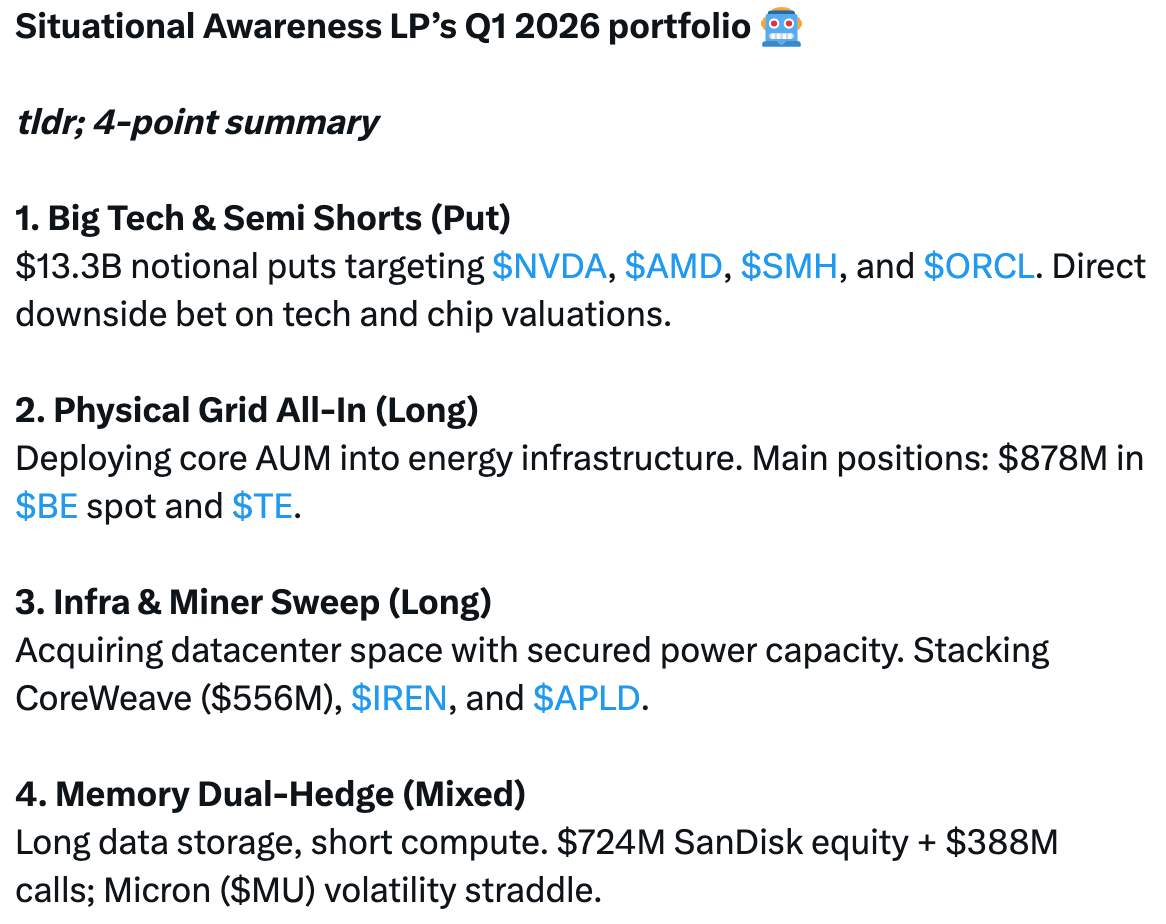
It has to be said that such massive outperformance indicates the fund has taken on a significant amount of risk thus far.
Equally, by focusing on one thematic the manager knows and understands like this, the fund has indeed showcased remarkable situational awareness. Leopold Aschenbrenner’s understanding of the AI opportunity and how best to play it is way ahead of most of his peers.
Explore 100's of investment opportunities and find your next hidden gem!
Search and compare a purposely broad range of investments and connect directly with product issuers.
Markets Not Always Efficient at Pricing in Revolutionary Change
One of the most valuable lessons from Situational Awareness is that markets consistently underestimate the speed at which structural change occurs.
Thanks to one of the more pervasive emotional biases, recency bias, investors tend to extrapolate the recent past rather than adjust their expectations to reality. Technological revolutions punish that instinct, particularly revolutions in which the pace of change accelerates exponentially.
AI couldn’t be a better representation of this situation.
It roared to life as a major global investment theme a couple of years ago when few investors understood the sector nor its constituents. Since then, the market has been playing catch up while the technology has been leaping forward faster and faster.
Revolutionary Investment Implications
Leopold Aschenbrenner’s central thesis is that AI development is compounding rapidly through larger models, greater compute power, and accelerating feedback loops.
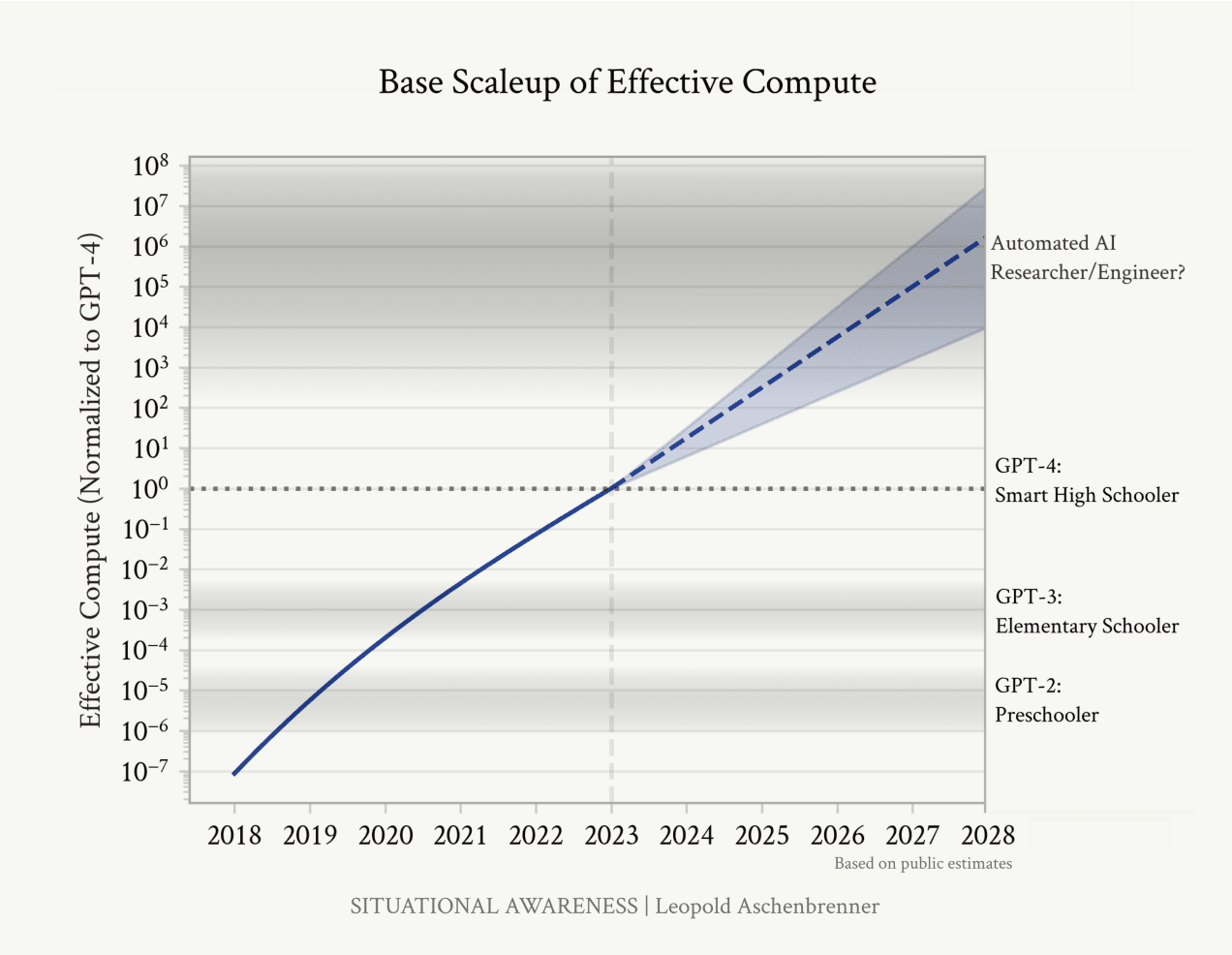
It’s hard to argue with the accuracy of this thesis thus far, nor the likelihood that it remains on track in the coming years.
If it is even partially correct, the investment implications are profound:
- AI infrastructure emerging as the big winner.
The first implication is that investors should think less about AI stocks and more about AI infrastructure.
Historically, the greatest wealth in technological booms has often accrued to those supplying the enabling systems. During the California gold rush, it was frequently the businesses selling picks and shovels who generated the highest returns.
AI appears to follow the same pattern.
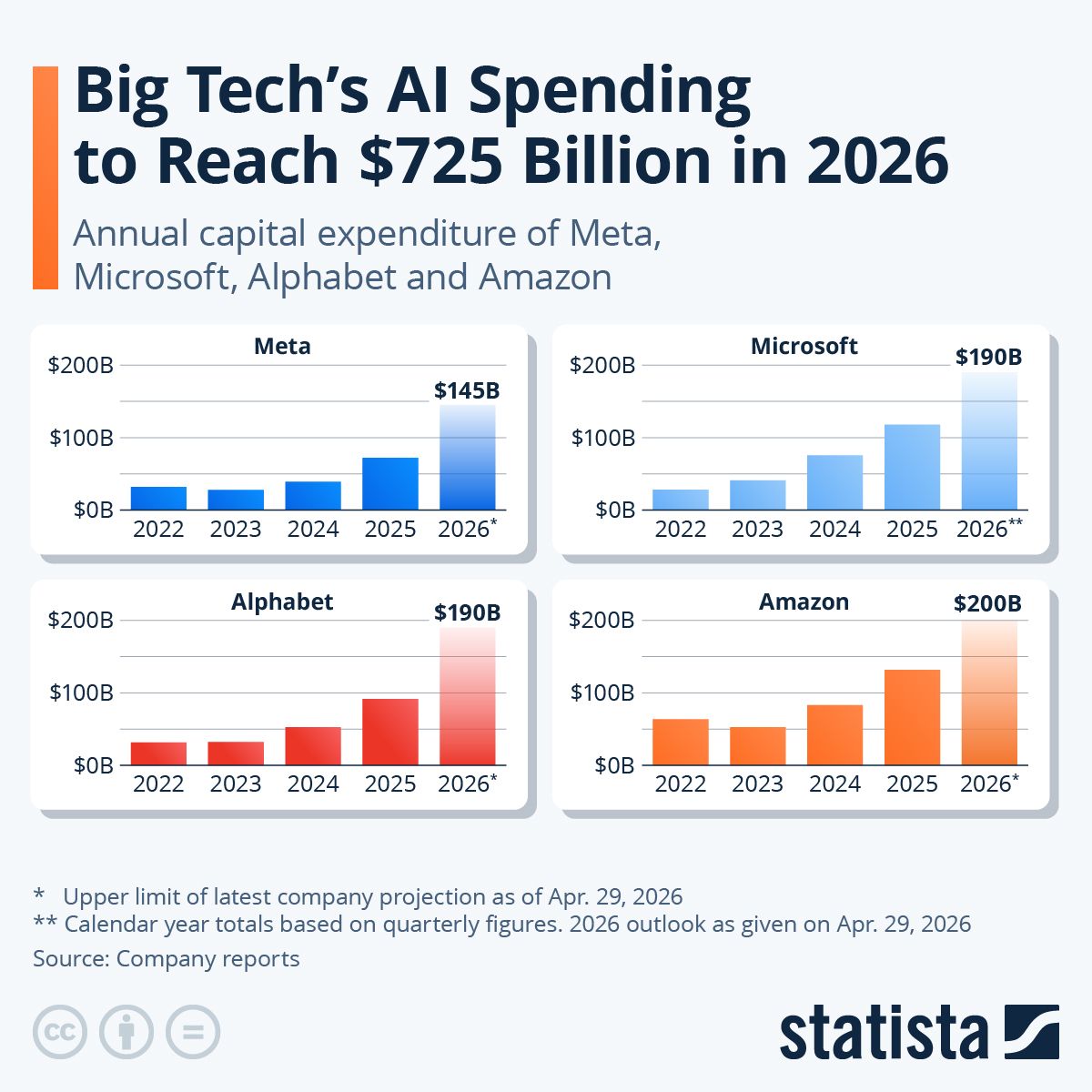
Globally, capital expenditure on AI infrastructure is exploding. Broader AI infrastructure spending by Meta, Microsoft, Alphabet, and Amazon alone is expected to exceed US$700 billion this year.
Australian investors can gain exposure to the AI infrastructure theme through Global X Artificial Intelligence Infrastructure ETF (ASX: AINF) which offers targeted exposure to the physical and operational backbone enabling AI’s global expansion.
- Energy demand set to skyrocket.
Aschenbrenner’s thesis implicitly assumes abundant compute capacity. But compute capacity requires power.
This creates a powerful second-order investment theme.
AI adoption may increase structural demand for renewable generation, battery storage, and grid modernisation across developed economies.
On that note, the CEFC estimates that supporting Australia’s future data centre expansion could require an additional 3.2GW of renewable generation and 1.9GW of battery storage by 2035.
Investors can access this theme through BetaShares Energy Transition Metals ETF (ASX: XMET) which provides exposure to a portfolio of global companies in the energy transition metals industry which are essential for the transition to a less carbon-intensive economy.
The Global X Battery Tech & Lithium ETF (ASX: ACDC) is also a powerful play as it provides exposure to the energy storage and production megatrend that Aschenbrenner has identified as core to the AI rollout.
- Avoid over-concentration risk.
The other major lesson from Situational Awareness concerns portfolio resilience.
Periods of technological disruption often produce extraordinary returns alongside extreme volatility. Investors frequently overestimate short-term winners while underestimating long-term structural shifts. During the dot-com bubble, many early internet leaders disappeared entirely even though the internet itself transformed the global economy.
That distinction matters today.
Concentration risk in big tech is rising. Much of the global equity market’s recent performance has been driven by a small number of mega-cap technology companies whose valuations increasingly embed optimistic AI assumptions.
Investors should therefore focus not only on participating in AI upside, but also on avoiding excessive thematic concentration.
Diversification across regions, asset classes, and investment styles remains more important than ever.
Subscribe to InvestmentMarkets for weekly investment insights and opportunities and get content like this straight into your inbox.
Some Chilling Words from Leopold Aschenbrenner
Before concluding, given Leopold Aschenbrenner’s superior understanding of the AI opportunity, the conclusion of his whitepaper is particularly noteworthy:
‘What if we’re right? At this point, you may think that I and all the other SF-folk are totally crazy. But consider, just for a moment: what if they’re right? These are the people who invented and built this technology; they think AGI will be developed this decade; and, though there’s a fairly wide spectrum, many of them take very seriously the possibility that the road to superintelligence will play out as I’ve described in this series. Almost certainly I’ve gotten important parts of the story wrong; if reality turns out to be anywhere near this crazy, the error bars will be very large. Moreover, as I said at the outset, I think there’s a wide range of possibilities. But I think it is important to be concrete. And in this series I’ve laid out what I currently believe is the single most likely scenario for the rest of the decade—the rest of this decade. Because—it’s starting to feel real, very real. A few years ago, at least for me, I took these ideas seriously—but they were abstract, quarantined in models and probability estimates. Now it feels extremely visceral. I can see it. I can see how AGI will be built. It’s no longer about estimates of human brain size and hypotheticals and theoretical extrapolations and all that—I can basically tell you the cluster AGI will be trained on and when it will be built, the rough combination of algorithms we’ll use, the unsolved problems and the path to solving them, the list of people that will matter. I can see it. It is extremely visceral. Sure, going all-in leveraged long Nvidia in early 2023 has been great and all, but the burdens of history are heavy. I would not choose this.
But the scariest realization is that there is no crack team coming to handle this. As a kid you have this glorified view of the world, that when things get real there are the heroic scientists, the uber-competent military men, the calm leaders who are on it, who will save the day. It is not so. The world is incredibly small; when the facade comes off, it’s usually just a few folks behind the scenes who are the live players, who are desperately trying to keep things from falling apart. Right now, there’s perhaps a few hundred people in the world who realize what’s about to hit us, who understand just how crazy things are about to get, who have situational awareness. I probably either personally know or am one degree of separation from everyone who could plausibly run The Project. The few folks behind the scenes who are desperately trying to keep things from falling apart are you and your buddies and their buddies. That’s it. That’s all there is. Someday it will be out of our hands. But right now, at least for the next few years of midgame, the fate of the world rests on these people. Will the free world prevail?’
Hear, hear. Let’s hope AI can be used as a force for good over the coming decades.
In the meantime, it’s likely to remain one of the main themes investors have to navigate.
Transformational Change Rewards Adaptability
The investors who benefit most from structural shifts are rarely those making dramatic all-or-nothing bets. More often, they are those who, like Leopold Aschenbrenner, recognise emerging trends early, diversify intelligently, and remain emotionally disciplined while narratives swing between euphoria and panic.
AI may ultimately reshape the global economy more profoundly than the internet itself. But for investors, success will still depend on the familiar principles of diversification, valuation discipline, tax awareness, and patience.
Situational awareness in investing is about recognising when the world is changing faster than consensus expects.
Funds Mentioned
Disclaimer: This article is prepared by Simon Turner. It is for educational purposes only. While all reasonable care has been taken by the author in the preparation of this information, the author and InvestmentMarkets (Aust) Pty. Ltd. as publisher take no responsibility for any actions taken based on information contained herein or for any errors or omissions within it. Interested parties should seek independent professional advice prior to acting on any information presented. Please note past performance is not a reliable indicator of future performance.
Simon Turner is an ex-fund manager with 20 years investing experience gained at Bluecrest, Kempen and Singer & Friedlander who now writes educational content about investing and sustainability. He's also the published author of The Connection Game and Secrets of a River Swimmer.