-drhkgsdwk8x3oqxim0go.png)
How to Invest Like the Super Rich
The rich just keep getting richer. In Australia, the top 10% now control over 58% of national wealth, while the top 1% own almost half of the nation’s wealth.
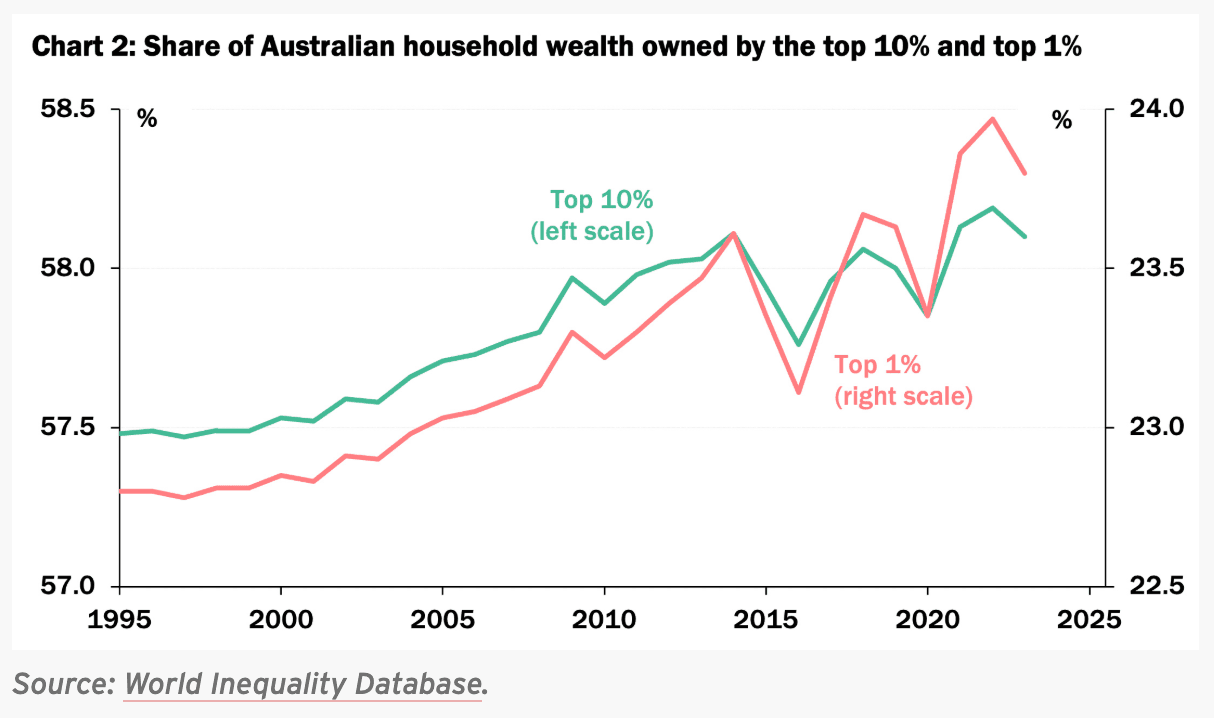
Inequality is even more extreme in the US where the top 10% control nearly 70% of American wealth.
If you can’t beat them, join them. Rather than feeling envious of the super rich, maybe the more empowered response is to learn from them with a view to following in their footsteps.
The Good News: The Playing Field is Flatter in Some Ways
The super rich still have inherent advantages over mere mortals in the form of family offices with expertise in private equity, private credit, direct real estate, tax advice, and global stock picking.
But the good news is that access to a much wider range of investment opportunities has democratised the investment playing field in recent years.
The ETF universe, in particular, now includes a vast range of options including broad-market ETFs, sector ETFs, fixed income ETFs, thematic ETFs, commodity ETFs, infrastructure ETFs, active ETFs, complex ETFs, geared ETFs, short ETFs, the list goes on.
That means individual investors now have more tools at their disposal to invest like the super rich.
Explore 100's of investment opportunities and find your next hidden gem!
Search and compare a purposely broad range of investments and connect directly with product issuers.
Where to Start?
The starting point is replicating the super rich’s structure, discipline, and exposure using the tools that are now widely available.
Here are a few guidelines for that journey:
1. Own Growth Assets Relentlessly
The super rich are structurally and decisively overweight equities.
According to the World Inequality Database, the wealth accumulation of the top 1% has been driven overwhelmingly by ownership of productive growth assets, particularly equities and private businesses, rather than by tactical trading or short-term positioning.
The UBS Global Family Office Report found that family offices allocate 53% of their portfolios to equities, with private equity forming a significant portion of that exposure. Cash allocations, by contrast, typically sit below 10%.
By comparison, Australian household portfolios remain heavily skewed toward residential property and cash, with relatively lower direct exposure to listed equities outside of superannuation.
This gap is an opportunity for Australian investors.
Broad market ETFs such as those tracking the ASX 200 or global indices allow investors to systematically build their exposure to assets with the same underlying drivers of wealth as the super rich: corporate earnings, productivity growth, and innovation.
The key takeaway is to ensure that equity funds and ETFs form the structural core of your portfolio with a long-term mind-set. That means holding them through bull and bear markets, and not reacting to volatility.
2. Diversify Your Portfolio Globally
Wealthy investors have a global mindset and their portfolios reflect that.
The UBS Family Office Report highlights that North American family offices hold 60% of their equity exposure globally, while European and Asian investors also maintain significant international allocations.
These family offices also tend to use currency diversification as a form of deliberate risk management. That means ensuring they are diversified across currencies that have the potential of strengthening versus their home currency.
Australian investors, by contrast, tend to exhibit a strong home bias, with particularly heavy exposure to banks and resources, and the Aussie dollar as a result.
This can limit portfolio returns since the Australian market represents just 2% of global equity market capitalisation.
The vast range of available ETFs removes this constraint.
Global equity ETFs, hedged and unhedged, allow investors to access the gamut of global growth opportunities including US technology, European industrials, and emerging market growth within a single portfolio framework.
So, to follow in the footsteps of the super rich, diversify globally to ensure your portfolio is exposed to the world’s best growth opportunities.
3. Use Real Assets as Structural Inflation Protection
One of the more consistent features of wealthy portfolios is meaningful exposure to real assets.
The reason is simple: infrastructure, real estate, and commodities are long-duration assets with embedded inflation protection. Assets such as toll roads, airports, and utilities often benefit from regulated or contracted revenue streams that rise with inflation.
For example, listed infrastructure has historically delivered stable cash flows with lower volatility than broader equities, while it exhibits monopoly-like characteristics and high barriers to entry, which support long-term pricing power.
Australian ETF investors can access real asset exposure through listed infrastructure ETFs and funds, property ETFs and funds, and commodities ETFs and funds. While these are not identical to direct ownership of toll roads or ports, they capture the same underlying economic drivers.
4. Rebalance Systematically, Not Emotionally
One of the least discussed advantages of the super rich is behavioural, rather than informational.
Family offices operate under formal investment policies. Their rebalancing is rules-based, not reactive. And their assets are trimmed or added based on allocation thresholds rather than headlines.
This stands in stark contrast to retail investor behaviour.
Data from Dalbar’s Quantitative Analysis of Investor Behaviour consistently shows that individual investors underperform the market due to poor timing decisions, particularly buying after rallies and selling during drawdowns.
Annual rebalancing between equities, bonds, and real assets at predetermined intervals forces investors to sell high and buy low, counteracting their natural behavioural biases.
The lesson is simple but difficult: discipline, not insight, is the difference that makes the difference.
5. Be Selective with Alternatives
Some investors assume that the defining feature of wealthy portfolios is access to hard-to-access alternatives such as private equity and private credit.
There is some truth to this. The Capgemini World Wealth Report 2025 indicates that high-net-worth investors allocate 15% of portfolios to alternative assets.
However, this allocation is often misunderstood. Alternatives are not inherently superior; they are often illiquid, fee-intensive, and dependent on manager skill.
Academic research, including work from Harvard Business School and Preqin, has shown that while top-tier private equity funds can outperform, the median outcomes are far less compelling once fees are considered.
For listed investors, the more robust approach is to replicate these types of exposures rather than structures.
Global equity funds and ETFs capture much of the same growth as private equity. Infrastructure ETFs provide access to similar cash flow characteristics as direct assets. Commodities ETFs offer exposure to inflation-sensitive sectors.
The insight here is that the super rich benefit from access and scale, not from a fundamentally different set of economic drivers.
6. Adopt a ‘Through-the-Cycle’ Mindset
Perhaps the most defining characteristic of wealthy investors is their time horizon.
Founders don’t tend to sell their businesses because of quarterly volatility. Family offices don’t dismantle portfolios in response to short-term macro data. Their wealth is built on assets held through multiple cycles.
This is supported by research from Morgan Stanley Wealth Management, which emphasises that long-term investors benefit disproportionately from compounding and avoid the costs of frequent repositioning.
For individual investors, this long-term mindset must be self-imposed.
Start thinking through the cycle, and your long-term investment outcomes are likely to improve.
Subscribe to InvestmentMarkets for weekly investment insights and opportunities and get content like this straight into your inbox.
The Real Takeaway
The super rich are not operating with a secret playbook. The evidence suggests something far less mysterious and more difficult to execute.
They own productive assets. They diversify globally. They include real assets with durable cash flows. They rebalance with discipline. They minimise unnecessary costs. And most importantly, they hold their positions long enough for compounding to do the heavy lifting.
The main barrier to overcome in following in the footsteps of the super rich is behavioural. That’s where the real edge lies.
Disclaimer: This article is prepared by Simon Turner. It is for educational purposes only. While all reasonable care has been taken by the author in the preparation of this information, the author and InvestmentMarkets (Aust) Pty. Ltd. as publisher take no responsibility for any actions taken based on information contained herein or for any errors or omissions within it. Interested parties should seek independent professional advice prior to acting on any information presented. Please note past performance is not a reliable indicator of future performance.
Author

Simon Turner
Head of Content (CFA), InvestmentMarkets
Related Articles
-uo4eg7ge0ysewqkveu92.png)
-qn47nb2t9h7iuvyq9ohf.png)
Recent Articles
View all articles-cjojn8hw3e0gc4lk8069.png)
-91mhtehskiukrsa930g2.png)
-t5z4ob41uwrlwil2guow.png)