-biy2kjxbgtb4uoevomc0.png)
Could AI Become the Next Strait of Hormuz for Investors?
Just when you thought the Trump administration had surprised investors into a state of expecting anything, they went and restricted foreign access to Anthropic’s advanced AI models due to national security concerns. Whilst those restrictions were later lifted, the incident highlighted how trigger-happy the US Government has become when it comes to interpreting what’s in the country’s national interests, including across the free markets the US used to advocate for.
Could this be an early reveal of the US Government’s hand when it comes to connecting AI access with sovereignty? Could AI soon move from a growth story to a control story?
It’s certainly a risk worth contemplating. It may move the question from which companies generate the most profit from AI to where the geopolitical chokepoints are within the global AI ecosystem.
Could AI Access Be a Risk?
In the energy markets, the closure of the Strait of Hormuz had long lurked as a left-tail risk which was unlikely to play out, but which would have a drastic impact if it did. After all, it’s a narrow waterway carrying upwards of twenty per cent of the world’s seaborne oil, so any disruption is certain to quickly impact energy prices, inflation expectations and equity markets.
AI may be heading toward its own version of that same challenge.
The backdrop is eerily similar. There’s a concentrated supply chain controlled by a small group of companies and infrastructure providers, mainly in the US.
This risk became tangible a few weeks ago, when the US Commerce Department temporarily restricted foreign access to Anthropic’s advanced Fable 5 and Mythos 5 models because of ‘national security concerns.’
Those restrictions were later lifted after Anthropic implemented stronger safeguards, but the episode revealed how quickly access to a critical AI tool could be interrupted by government policy rather than free markets.
This happened at a time when best-in-class AI like Anthropic’s latest model is already deeply embedded within the global economy.
Global productivity assumptions, cloud spending, cybersecurity, software development and data centre investment is now very dependent upon access to AI continuing uninhibited.
Hence, if the risk of US Government intervention is more than a one-off aberration, the AI trade may be evolving into a question of who controls the essential infrastructure.
Why the Anthropic Episode Surprised Investors
The Anthropic case was short-lived, but it revealed how the US Government appears to be viewing the country’s AI advancements.
The reported concern at the time was that Anthropic’s advanced models could be misused for cyber purposes. That made the model not only a commercial product, but a dual-use technology.
That’s a key change.
Frontier AI models are increasingly being viewed by the US Government as sensitive infrastructure, rather than ordinary software.
The US Government has a history of intervening in this space.
The Biden administration’s January 2025 AI diffusion rule created a framework covering advanced computing chips and AI model weights, with delayed compliance requirements from May 2025.
Biden’s AI Diffusion Rule Categories
-srch54dk8zcvafilkjdi.jpg?_a=BAMAAAhM0)
Source: Bloomberg
The Trump administration’s June 2026 executive action on advanced AI security went further in tone, by effectively admitting advanced AI capabilities strengthen America’s position while also raising national security considerations requiring coordinated government action.
This is why investors should view this development as part of a broader shift in which AI capabilities are increasingly viewed as sovereign assets rather than a one-off regulatory scare.
The AI Supply Chain is More Concentrated Than It Looks
The next question is: where are the obvious AI chokepoints investors should be aware of?
The obvious bottleneck is chips.
Nvidia’s almost ten-fold revenue rise over the past four years is evidence of the exponential growth in this essential part of the AI ecosystem.
Nvidia Financials
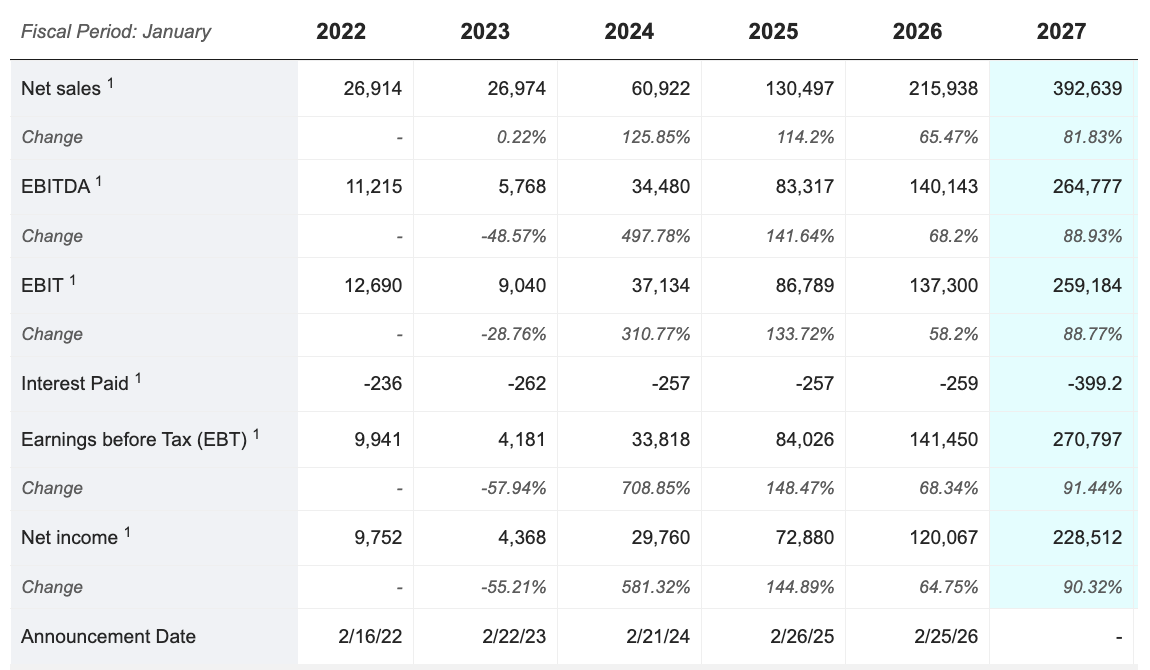
Source: MarketScreener
But the bottleneck is not just silicon.
It also covers best-in-class AI model access, cloud platforms, data centres, power, cooling, fibre networks, skilled labour and export licences.
The numbers at stake are astronomical.
Goldman Sachs estimates there will be US$7.6 trillion of AI-related capital expenditure between 2026 and 2031 across compute, data centres and power.
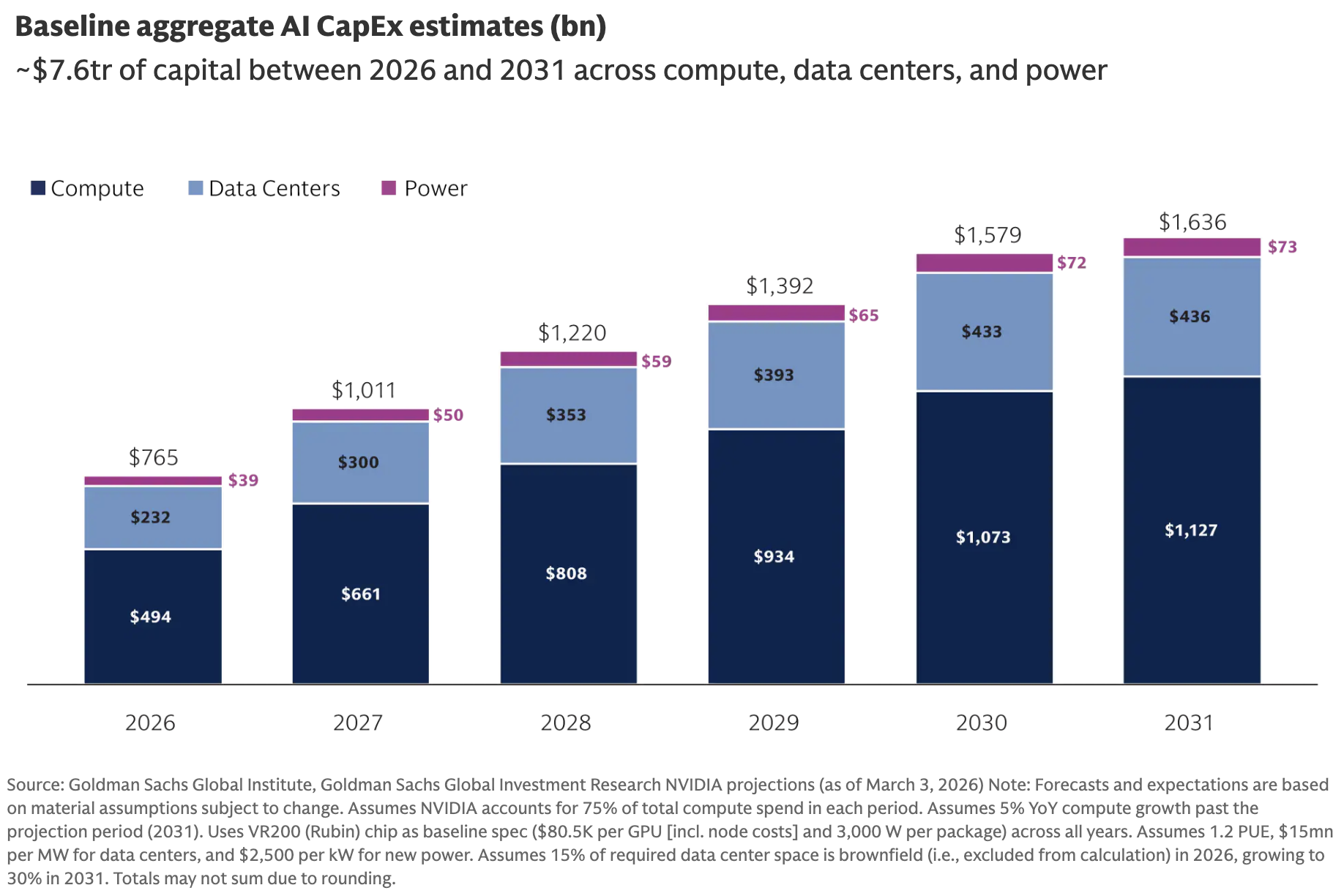
This is an enormous evolving ecosystem comprising many sectors and sub-sectors.
In fact, it’s the less visible parts of this ecosystem which may expose investors to some of the biggest risks for the simple reason they are less obvious.
For example, power availability, planning approvals, water usage, government permissions and foreign policy could all play major roles as the global AI rollout gathers pace.
Australia’s Uncomfortable Position
In the context of AI sovereignty, it’s worth mentioning Australia’s position.
It’s hard to argue the country is an emerging AI leader at this stage.
That leaves Australia increasingly vulnerable in a world in which the keys to future productivity improvements are effectively in the hands of the US.
In the words of Dave Lemphers, Chief Executive of Australian AI company Maincode:
‘Whether it’s the US Cloud Act, export controls or restrictions like this, it puts Australia in a position where a foreign country can effectively dictate our access to productivity and cutting-edge tools.
Access to strong, state-of-the-art models that are available, governable and operated locally becomes a national productivity issue.’
Adam Barty, Managing Director of AI consultancy Revium, agrees this is a growing risk:
‘Having no real agency or leverage over decisions about our access to these sorts of advanced tools is just a taste of the future we are headed towards. As the coming wave of AI disruption continues to crash into the global economy, access to frontier models like Mythos will be foundational to our ability to innovate and ensure our nation’s ongoing prosperity.’
It’s not all bad news. Australia does boast a skilled workforce, significant renewable energy potential, trusted institutions and growing data centre investment.
That’s not gone unnoticed by the American tech behemoths leading the AI charge.
In June 2025, Amazon revealed its plan to invest $20 billion in Australian data centre infrastructure. This followed Microsoft’s $5 billion AI expansion plan in the country, and Firmus’s potential Project Southgate expansion of up to $73.3 billion.
Still, Australia’s challenge is that it’s more a user of frontier AI than a builder of the models the country increasingly depends upon.
It’s this growing dependence which exposes the country to significant risks posed by a US Government that’s increasingly focused upon protecting and leveraging its home-grown advantages.
Key Takeaways
- AI access has become a geopolitical risk, not just a technology risk.
- Investors should be wary of assuming that AI capability will always be available on neutral commercial terms.
- If AI access becomes more geopolitical, investors may start paying a premium for companies with trusted-jurisdiction infrastructure, secure supply chains and resilient access to compute.
- The biggest AI beneficiaries may not be limited to software. Chips, cloud, data centres, power networks and cybersecurity all sit inside the same investment ecosystem.
- Sovereignty risk may favour companies and funds with resilient infrastructure, multiple suppliers, strong governance and exposure across the AI value chain rather than a single point of failure.
- As a result of the above points, now may be the time to ensure your AI fund and ETF exposure is truly global.
Be Ready for the Unexpected
The Anthropic foreign restrictions were lifted, but the message behind them can’t be ignored. If the US Government can restrict access to a frontier AI model at short notice like this, then AI has already evolved into strategic infrastructure with sovereign overtones.
The implication is that it’s time to be aware of strategic value in the global AI ecosystem. It’s time to ask questions like: Where is your AI exposure located? Is it concentrated in a handful of US mega-cap stocks which may have their market opportunity curtailed by the US Government? Does your AI exposure rely on a narrow part of the global AI value chain? Are the infrastructure, energy and governance risks that you’re exposed to visible?
AI may not become the next Strait of Hormuz in the literal sense. But parts of the AI ecosystem are already evolving into market chokepoints. The investors best placed to navigate what’s coming will be those who look beyond the headline excitement and understand the plumbing underneath.
Disclaimer: This article is prepared by Simon Turner. It is for educational purposes only. While all reasonable care has been taken by the author in the preparation of this information, the author and InvestmentMarkets (Aust) Pty. Ltd. as publisher take no responsibility for any actions taken based on information contained herein or for any errors or omissions within it. Interested parties should seek independent professional advice prior to acting on any information presented. Please note past performance is not a reliable indicator of future performance.
Author

Simon Turner
Head of Content (CFA), InvestmentMarkets
Related Articles
-5pmpvmd2nrv3novymh6d.png)
-vke5r81en85n0lawxvqo.png)
Investments You May Like

Newmark Warrnambool Property Trust
The Trust is a fixed term, unlisted property fund that is forecasting a distribution yield of 8% pa and targeting an IRR of 11% to 15% pa (not guaranteed). (For Wholesale Investors Only)
Global X S&P World ex Australia GARP (Currency Hedged) ETF (ASX:GHRP)
Invest in global companies with strong earnings growth, solid financial strength, and reasonable valuations.
Recent Articles
View all articles-qn47nb2t9h7iuvyq9ohf.png)
-01xhfy3zxeb8rav1zavf.png)
-6xblbfxg17ij0ex7hwqw.png)