-drhkgsdwk8x3oqxim0go.png)
When Barriers Fall: What Easier Access Means for ETF and Fund Investors
Over the past decade, we’ve witnessed the barriers to investing falling one after another thanks to technology, regulatory change, and product innovation. As a result, a space that was once dominated by institutions and high-net-worth individuals has become radically accessible.
The upshot is a profound shift in the way markets behave. This change carries both opportunity and risk with it. Awareness is the key to using it as a tailwind rather than facing it as a headwind.
A Dramatic Evolution
Historically, investing required effort, capital, and patience. Opening an account involved paperwork, delays, and often minimum investments that precluded the masses from gaining access. Trading costs were high (remember the days of 2% commissions?), and access to information was uneven.
Today, those frictions have largely disappeared. Investors can open an account in minutes, deploy capital immediately, and automate their contributions, rebalancing and dividend reinvestment with ease.
This democratisation has led to widespread change.
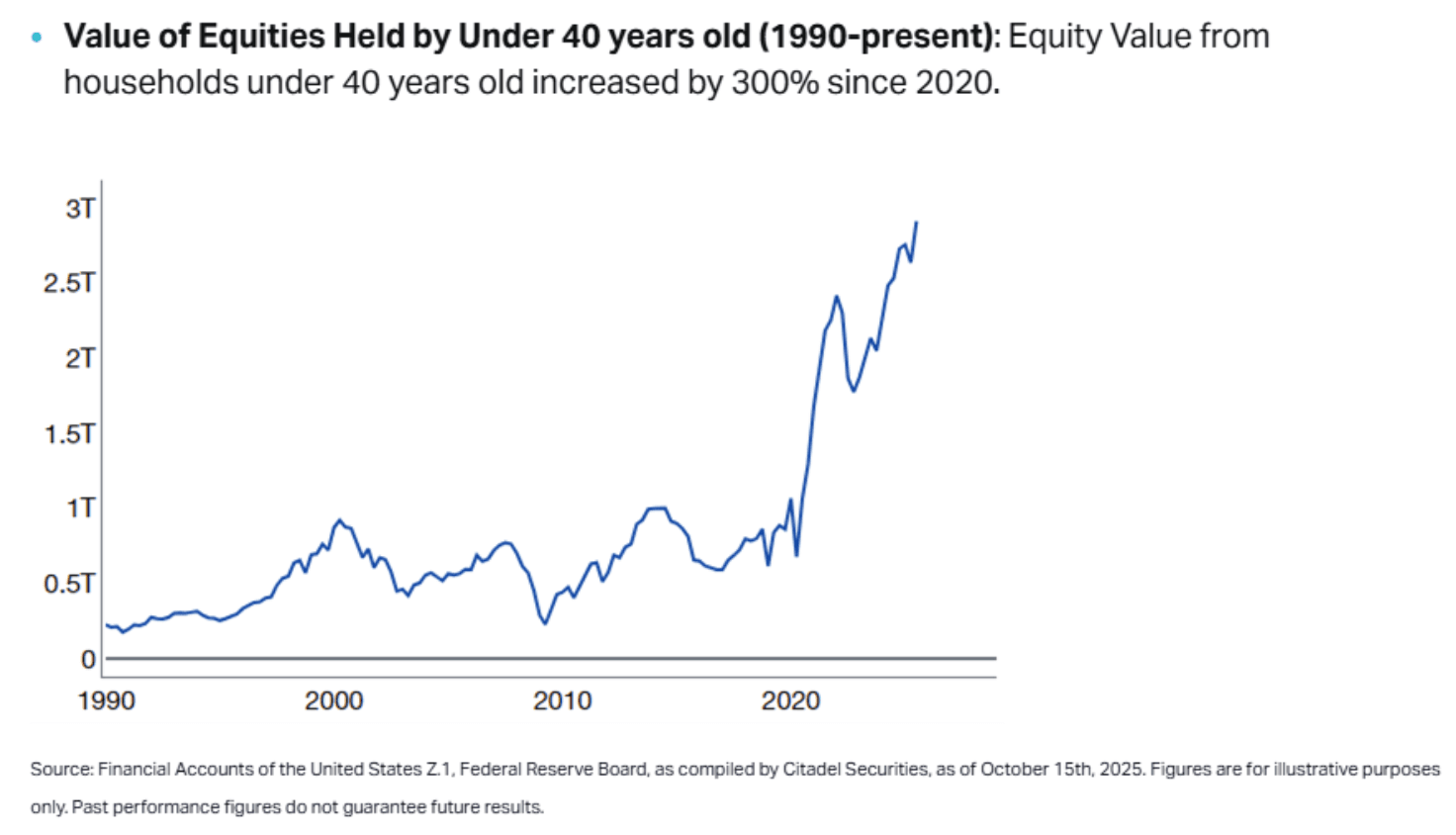
Participation in equity markets has broadened across income levels and age cohorts. More households are invested than ever before, and importantly, younger investors are entering the market earlier in their financial lives.
Check out the recent shift in equity ownership by younger Americans below.
In Australia, this same trend is reinforced by the compulsory superannuation system, the proliferation of low-cost ETFs, and the rise of digital platforms that simplify portfolio construction.
This shift is generally positive for the market. Lower barriers mean more Australians can access long-term wealth creation through professionally managed portfolios. Products such as broad-market ETFs and diversified managed funds have made it possible to achieve institutional-grade exposure with relatively small amounts of capital.
In asset classes such as property, vehicles like listed and unlisted REITs have similarly reduced the cost of entry while providing diversification and professional management.
Explore 100's of investment opportunities and find your next hidden gem!
Search and compare a purposely broad range of investments and connect directly with product issuers.
Broader Implications
That’s the good news, but there are some more nuanced implications worth being aware of, particularly changes in investor behaviour.
One of the bigger consequences is the rise of what might be described as always-on investing.
Regular contributions via superannuation, salary sacrifice and automated investment plans mean that capital is consistently flowing into markets, regardless of valuation or macroeconomic conditions.
This structural bid for assets tends to result in higher market valuations over time. When millions of investors are buying every fortnight, the marginal buyer becomes less sensitive to price.
For ETF investors, this dynamic is particularly relevant.
Passive strategies, by design, allocate capital based on market capitalisation rather than fundamental valuation. So, as more money flows into these vehicles, the larger companies receive a disproportionate share of the inflows, reinforcing their dominance.
The removal of investing frictions has also introduced an uncomfortable paradox into investors’ lives: while investing has become easier, it has also become easier to do the wrong thing.
The same platforms that enable disciplined, long-term investing also enable rapid trading, speculation, and behavioural mistakes.
Even in highly liquid ETFs, turnover can be surprisingly high, implying that many investors are holding their positions for far shorter periods than intended. For many, what was designed as a passive, long-term vehicle has evolved into an instrument for short-term trading.
This tension between access and discipline has evolved into a defining feature of modern investing.
Lower barriers to entry improve access, but they also expose investors more to their own worst enemies: their emotions.
Another important shift lies in the nature of information. In short, the barriers to learning have fallen alongside the barriers to investing.
Investors now have access to an unprecedented amount of data, research, and analysis that investors of yesteryear could only have dreamt of. The rise of AI is accelerating this trend, making it possible to generate an ever-expanding world of insights in real time.
This may seem like a powerful advantage, but it’s also compressing informational advantages.
In a world where everyone has access to the same tools and data, it has become harder to generate excess returns through the interpretation of information alone. Quantitative techniques, alternative data, and portfolio construction tools that were once the preserve of large institutions are now widely available to individual investors.
As a result, competitive advantage has shifted from information access to interpretation.
As this trend has accelerated, the persistence of alpha has become more elusive.
This is reinforcing the importance of active manager selection.
In this new world, the durability of an actively managed fund’s edge needs to be backed up by evidence of long-term outperformance, including in recent years when the democratisation of investing has shifted the goalposts.
How to Stay Ahead of the Curve
So, what does all of this mean in practice?
- Information access is no longer a differentiator.
These days, the ability to invest cheaply and efficiently should be treated as a baseline, not an advantage. The real value lies in how that access is used.
- Structure matters.
The rise of passive investing, regular contributions, and automated flows has altered market dynamics. Investors should be aware of how these forces influence valuations, sector concentration and risk exposures within their portfolios. In particular, the tendency for larger companies to become overvalued appears to be here to stay.
- Investor behaviour is now the critical determinant of performance.
The removal of friction has increased the importance of self-imposed constraints. Long-term investing requires resisting the temptation to trade excessively, chase performance or react to short-term volatility. The rules of successful investing haven’t changed, even if the market structure has.
- A broader perspective on portfolio construction is needed.
With lower barriers to entry, investors can access exposures that were previously difficult to obtain, from global equities to private credit and real assets. That’s positive and should be leveraged. But awareness is needed. The need for thoughtful allocation has rarely been greater.
Subscribe to InvestmentMarkets for weekly investment insights and opportunities and get content like this straight into your inbox.
Take the Good from the Nuanced Opportunity
In many ways, the modern investor operates in a more favourable environment than any generation before. Costs are lower, access is broader, and information is abundant. But these advantages come with a trade-off.
When everyone can freely invest like this, edge no longer comes from information or trading access. It comes from behaviour, discipline, and the ability to navigate a market shaped by the very accessibility that defines it.
Disclaimer: This article is prepared by Simon Turner. It is for educational purposes only. While all reasonable care has been taken by the author in the preparation of this information, the author and InvestmentMarkets (Aust) Pty. Ltd. as publisher take no responsibility for any actions taken based on information contained herein or for any errors or omissions within it. Interested parties should seek independent professional advice prior to acting on any information presented. Please note past performance is not a reliable indicator of future performance.
Author

Simon Turner
Head of Content (CFA), InvestmentMarkets
Related Articles
-uo4eg7ge0ysewqkveu92.png)
-qn47nb2t9h7iuvyq9ohf.png)
Investments You May Like

Exceed Capital FS Property Trust
An institutional-grade, 16-level CBD office tower in the heart of Adelaide's core corridor. Comprehensively refurbished and completed in 2025 with $10.7 million in CAPEX. Positioned to deliver an average projected cash return of 8% P.A.
Categories
Recent Articles
View all articles-4hhyyp4m13i0mn7am7nu.png)
-cjojn8hw3e0gc4lk8069.png)
-91mhtehskiukrsa930g2.png)