-nuj3y9ztroe1189o2bcd.png)
Finding Opportunities Beyond the AI Euphoria: The Case for Diageo
Readers may have noticed a shift in the Contrarius Global Equity Fund’s Top 10 holdings compared to a few months ago. We have previously noted that we are finding attractive value in selected companies that we believe to be AI-Winners and those that we believe to be AI-Proof, while attempting to avoid those we believe to be AI-Threatened. Over the last several weeks we have narrowed the Fund’s holdings in AI-Winners to those we have the highest confidence in (stocks such as Tesla, EchoStar, and Alphabet) while increasing our exposure to those we believe to be relatively immune to disruption. In this regard you will note that the Fund’s Top 10 at quarter-end includes several Consumer Staples stocks (tobacco, beverage, and food) which we believe are trading at extremely attractive valuations. The shift in the portfolio can be ascribed to various reasons, including:
- Many of the AI-Winners previously held as meaningful positions by the Fund (including certain semiconductor-related stocks) had increased significantly in price.
- We believe that AI may disrupt many large-capitalisation companies across multiple sectors.
- Defensive stocks (specifically those that are also AI-Proof) are offering compelling long-term value at current levels, with many trading at or below where they were ten years ago.
- Potential credit risks in the financial system (including private credit and risks from coming AI-related job losses).
- Heightened geopolitical risks in an environment where the MSCI World Index is trading at an above normal earnings multiple on relatively high earnings.
Given the above, we believe that some of the most compelling opportunities today lie in companies whose products and business models are likely to endure regardless of how the technological landscape evolves. These are businesses rooted in enduring human behaviours. This quarter, we focus on a relatively recent addition to the Fund’s Top 10 holdings. A company that has been in the business of celebrating life for the better part of three centuries.
DIAGEO
The 9,000-Year Lease
In 1759, a 34-year-old Arthur Guinness walked into the disused St James's Gate brewery in Dublin and signed a lease. Not for ten years, or even for a hundred. But rather for nine thousand years, at an annual rent of £45. It was either an act of extraordinary foresight or extraordinary recklessness. Two and a half centuries later, Guinness remains one of the world’s most recognised brands and the brewery at St James's Gate is still in operation. Arthur Guinness, it seems, knew what he was doing.
This same long-term conviction runs through Diageo, the company that today owns Guinness. Since its formation in 1997 through the merger of Guinness plc and Grand Metropolitan, Diageo has become the world's leading premium spirits business. Its portfolio reads like the back bar of every great establishment: Johnnie Walker, Smirnoff, Tanqueray, Don Julio, Crown Royal, Baileys, and of course, Guinness. Thirteen of its brands each generate more than a billion dollars in annual revenue. The company operates in nearly 180 countries, employs 29,000 people across 110 manufacturing sites, and generates revenues in excess of $20bn.
Diageo holds the number one position globally in whisk(e)y, tequila, vodka, gin, liqueurs and non-alcoholic spirits. In terms of retail sales value, its market share is more than 1.4x that of its nearest international competitor. It is the dominant force in a large global industry.
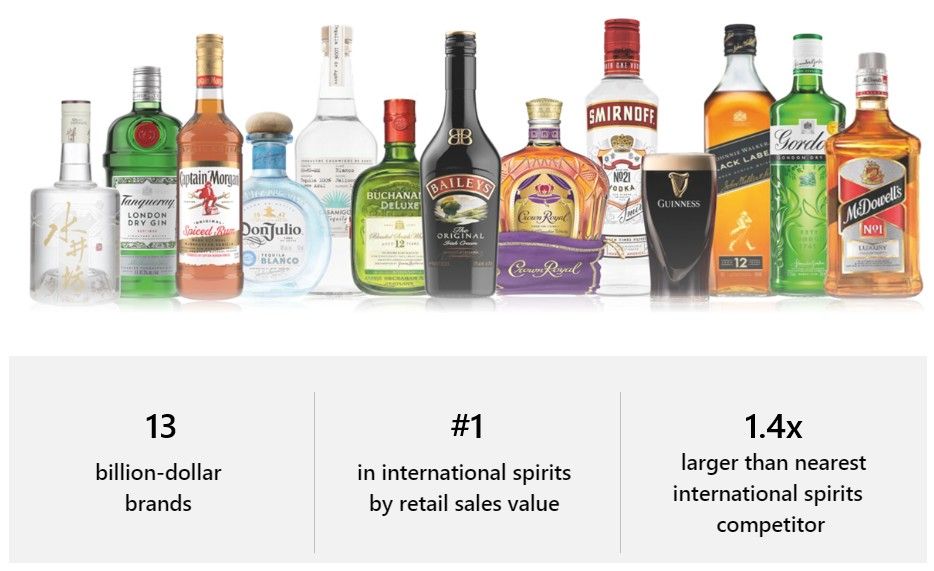
Note: Figures based on IWSR 2024 report. Sources: Diageo, Contrarius Research
Explore 100's of investment opportunities and find your next hidden gem!
Search and compare a purposely broad range of investments and connect directly with product issuers.
On the Rocks
And yet, Diageo's share price has declined more than 65% since its early 2022 peak and trades at levels last seen in 2012. Over a period where the S&P 500 has surged to new highs, Diageo shareholders have endured a drawdown typically reserved for businesses in significant distress.
The headwinds, however, are real. The US market, which accounts for roughly 40% of group revenues, has faced mounting consumer caution as higher interest rates and persistent inflation have squeezed discretionary spending. The growing prevalence of GLP-1 medications—and early evidence that some users naturally moderate their alcohol consumption—has also weighed on investor sentiment across the sector. It is however worth noting that Diageo's expanding non-alcoholic portfolio, led by Guinness 0.0, positions it better than most peers should these consumption trends prove durable.
The company’s interim results for 2026 laid these headwinds bare: North American organic sales fell 6.8%, with US tequila sales down 23% as competition intensified in a softening category. As the price-tier chart below illustrates, Diageo's US portfolio is heavily skewed towards the premium end—53% of its tequila sales sit at $50+ per unit versus just 25% for the market. In a strong consumer environment that skew is a margin advantage. In the current climate, however, it means there is little in the portfolio to capture trade-down demand, amplifying the impact on earnings. Management has acknowledged this, signalling a pivot towards broader price-packs and smaller formats—an attempt to bridge these gaps without compromising the company’s core premium brand exposure.
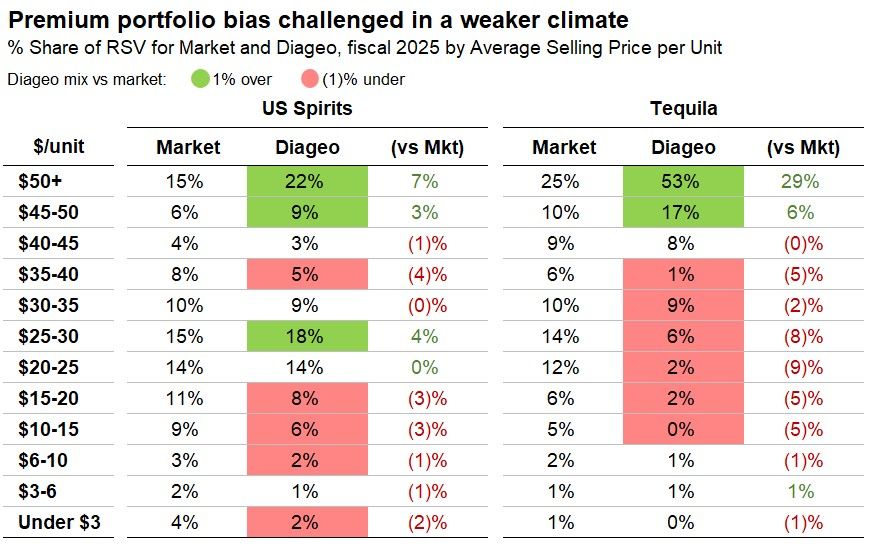
Sources: Diageo, Contrarius Research
Beyond the US, China—once a key growth driver—has been weighed down by economic uncertainty and policy-driven curbs on extravagant entertainment spending, with sales plunging 42% in the first half. US tariffs have added a further layer of risk. Diageo estimates an annualised $200m hit to operating profit based on levies of 10% on UK imports and 15% on European imports, with only around half expected to be mitigated through supply chain adjustments. Any removal of USMCA exemptions for Mexican and Canadian spirits—which represent nearly half of Diageo's US import base, including Don Julio and Crown Royal—would materially increase that figure.
Investors have not been forgiving. The share price decline has pushed Diageo's valuation to levels that appear to assume permanent impairment—its PE ratio is currently 11x (on what we would consider to be depressed earnings) against a long-term average in excess of 20x. Our view on Diageo is very different to the market.
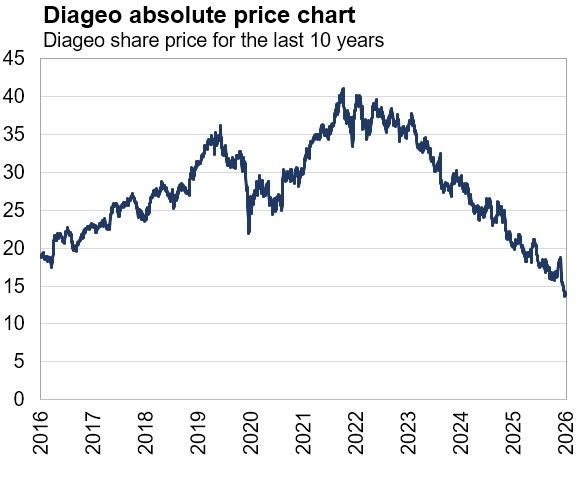
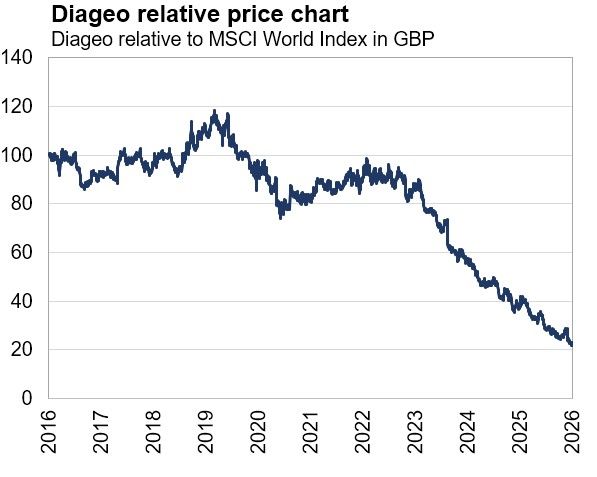
Source: Bloomberg, Contrarius Research
A New Broom
In January 2026, Sir Dave Lewis took the helm as CEO. Investors in UK consumer staples will know the name. Lewis is the man who turned around Tesco. When he arrived at the beleaguered British supermarket in 2014, it was engulfed in an accounting scandal, haemorrhaging market share, and drowning in debt. Over six years, he cut costs, reduced debt by over £5bn, rebuilt trust, and restored the company to health. He brings 27 years at Unilever before that, with deep experience in supply chains and emerging markets.
His early actions at Diageo have been characteristically pragmatic. The interim dividend was halved—a clear signal that balance sheet integrity takes priority over short-term optics. A $2bn productivity programme is underway, targeting $625m in efficiencies from the ‘Accelerate’ initiative alone. This is a CEO who has done this before and knows the playbook.
While the market's reaction to the dividend cut was predictably negative, we believe this is precisely the kind of decisive, long-term thinking that creates value. A company with Diageo’s cash-generative capacity can afford to prioritise its balance sheet for a period and emerge stronger. Perhaps underappreciated too is that Diageo's inventory—over $10.5bn as of December 2025—is somewhat different to traditional inventory; a significant portion represents maturing Scotch whisky and aged spirits that typically appreciate in value over time.
Strategic transactions are also gathering pace. The disposal of the company’s low-margin, capital intensive African beer operations to Asahi for approximately $2.3bn, simplifies its portfolio and directs proceeds to debt reduction. In addition, United Spirit Limited (USL), in which Diageo holds a 55.9% stake, has agreed to sell the Royal Challengers Bengaluru cricket franchise—inherited through a 2012 acquisition—to a consortium led by Blackstone and Aditya Birla for $1.78bn. It is expected that Diageo would receive its share of proceeds as a special dividend. With these actions, we believe Diageo has a credible path to its target of 2.5-3.0x net debt to adjusted EBITDA, down from 3.4x today.
Aged to Perfection
The near-term challenges, while real, risk obscuring what Diageo actually is: one of the finest collections of consumer brands ever assembled.
Diageo’s competitive moat is built on more than just marketing, it is built on time. Johnnie Walker was first blended in 1820. Guinness has been brewed since 1759. Tanqueray dates to 1830. These are not brands that can be easily replicated. Their value is rooted in centuries of heritage and on cultural rituals that are deeply embedded in how people socialise, celebrate, and unwind. A robot may one day pour your drink, but the liquid in the glass is likely to remain one of Diageo’s many enduring brands.
The premiumisation trend is a powerful structural tailwind. Premium and super-premium spirits account for over 60% of Diageo's sales. Globally, super-premium spirits are growing 50% faster than other price tiers in the category. As incomes rise, particularly in emerging markets, consumers tend to trade up. They drink less, but they drink better. This is precisely the territory where Diageo's brands are strongest.
The demographic picture is equally compelling. By 2035, an estimated 600m new consumers will reach legal drinking age worldwide, the vast majority in markets like India, Africa, and Latin America where Diageo already has a significant presence. In India, per capita spirits consumption remains a fraction of Western levels. The runway is enormous.
And Diageo is not standing still. Guinness 0.0, the largest and fastest growing non-alcoholic beer now accounts for 12% of total Great Britain Guinness brand sales, and Diageo's non-alcoholic spirit business is four times larger than its nearest competitor. These are not just defensive moves. They are category-expanding innovations that cater to new consumers and new occasions. For the patient investor, this combination of irreplaceable heritage and forward-thinking innovation is a compelling proposition.
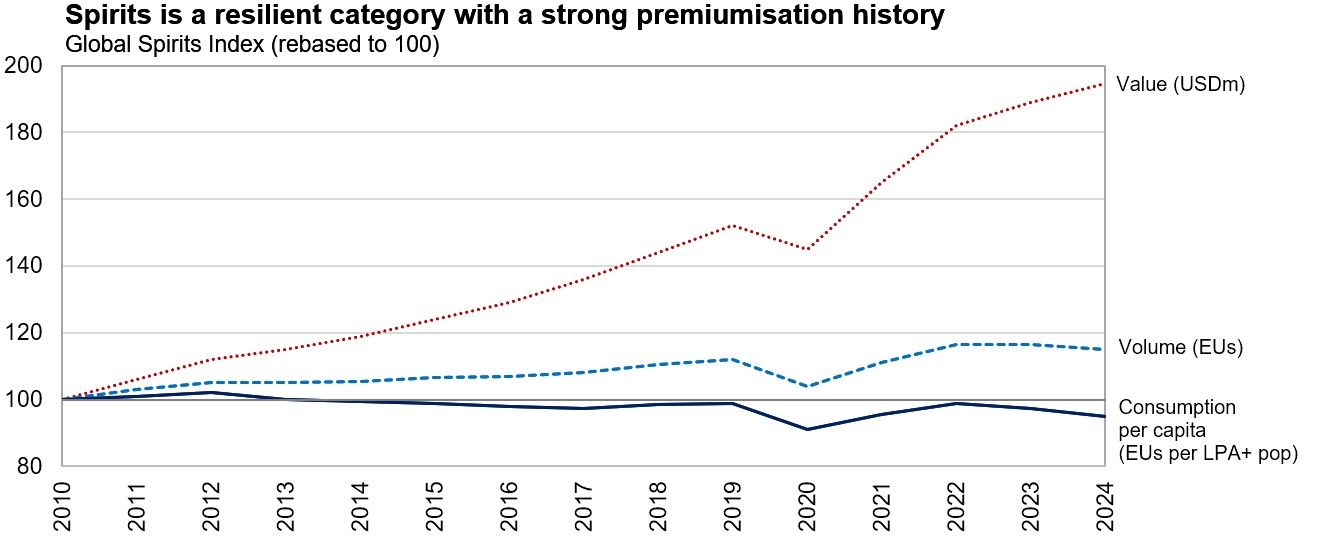
Sources: Diageo, Contrarius Research
Moët Hennessy
Diageo also has a significant asset that is easy to overlook. The company holds a 34% stake in Moët Hennessy, the wines and spirits division of LVMH. This is not a minor investment. Moët Hennessy is one of the crown jewels of the luxury goods world, home to Hennessy cognac, Dom Pérignon, Moët & Chandon, and Veuve Clicquot. We believe that it is likely to command a premium multiple to the rest of Diageo.
Subscribe to InvestmentMarkets for weekly investment insights and opportunities and get content like this straight into your inbox.
Proof Positive
Why does Diageo belong in our AI-Proof bucket? We view Diageo as a business that is structurally insulated from technological disruption. Drinking is not a problem to be optimised. It is a ritual. The experience of a Guinness in your favourite local pub, a Don Julio margarita on a warm evening, or a glass of Johnnie Walker Blue shared to mark an occasion remains a fundamentally human, social, physical experience. These moments are rooted in ingrained behaviours that AI disruption is unlikely to displace.
Rather than a threat, we believe that AI may serve as a meaningful tailwind for Diageo. In a recent earnings call, the new CEO indicated that 60% of Diageo orders are still entered manually. Supply chain optimisation, demand forecasting, personalised consumer engagement—these are areas where technology enhances the business without threatening the product. Diageo is already investing in data analytics and digital route-to-market capabilities.
In this respect, Diageo sits naturally alongside the other AI-Proof holdings held by the Fund. Physical products, enduring brands, and deeply ingrained human behaviours. These businesses are not immune to cyclical pressures, but we believe that they are structurally insulated from the existential threat that AI poses to so many industries.
Summary
At less than 12x forward earnings and an attractive dividend yield, Diageo trades at a meaningful discount to its historical averages. Notwithstanding the headwinds, we believe that Diageo could generate cumulative free cash flow exceeding $20bn over the next five years. Their brand portfolio is irreplaceable. The new CEO has a proven track record and we see multiple levers for value creation.
The market is pricing Diageo as though the current challenges are permanent. We believe they are cyclical. Arthur Guinness took a 9,000-year view. We don't need quite that long—but we are happy to be patient.
Diageo is one of the Fund's largest holdings and we believe, at current valuations, it offers an exceptionally attractive opportunity for long-term investors like ourselves.

Disclaimer: This article is based on a commentary prepared by Contrarius Investment Advisory Pty Limited (“Contrarius Australia”, AFSL 506315), distributor of the Contrarius Global Equity Fund (Australia Registered) (ARSN 625 826 075). The investment manager of the Fund is Contrarius Investment Management Limited. Equity Trustees Limited (“Equity Trustees”) (ABN 46 004 031 298), AFSL 240975, is the Responsible Entity for the Fund. Equity Trustees is a subsidiary of EQT Holdings Limited (ABN 22 607 797 615), a publicly listed company on the Australian Securities Exchange (ASX: EQT). Information is valid as at 31 March 2026. This information is general in nature and has been prepared without taking into account your personal objectives, financial situation, or needs. Before acting on this information, you should consider its appropriateness and should read the relevant Financial Services Guide (FSG), Product Disclosure Statement (PDS) and Target Market Determination (TMD) available at www.contrarius.com.au. The article is for educational purposes only. While all reasonable care has been taken by the author in the preparation of this information, neither Contrarius Australia, Equity Trustees, nor any of their related parties, directors or employees, nor InvestmentMarkets (Aust) Pty. Ltd. as publisher, provide any warranty of accuracy or reliability in relation to such information, or accept any liability to any person who relies on it. Interested parties should seek independent professional advice prior to acting on any information presented. Past performance is not a reliable indicator of future performance. Funds managed or distributed by Contrarius Australia may have a position in any of the securities referred to in this article, and such positions are subject to change at any time without notice.
Chris Watson
Director at Contrarius Investment Advisory Pty Limited.
Chris joined Contrarius Australia in January 2021. Chris was previously a director of Contrarius Investment Advisory Limited ("CIAL") in the United Kingdom from June 2017 until June 2018. He was employed by CIAL as an investment analyst from April 2012 until June 2018. Chris also previously worked for Allan Gray Ltd, South Africa’s largest privately-owned investment firm. He holds a Bachelor of Business Science (Quantitative Finance) from the University of Cape Town, and is a CFA and a CMT charterholder.
Simon Raubenheimer
Director at Contrarius Investment Management Limited.
Simon joined the Investment Manager in March 2019. He is a director of the Investment Manager and Contrarius ICAV, an Irish UCITS fund to which Contrarius Investment Management Limited is the Investment Manager. Simon has over 16 years’ previous investment experience with Allan Gray Ltd, South Africa’s largest privately-owned investment firm. Simon completed a BCom (Econometrics) Degree at the University of Pretoria and a BCom (Honours) (Financial Analysis and Portfolio Management) Degree at the University of Cape Town. Simon is a CFA charterholder.
Author

Chris Watson & Simon Raubenheimer
Contrarius
Related Articles
-37f8do9xthqpg80ohvuf.png)
-s5c0uf81il26meg3icyx.png)
Investments You May Like

Contrarius Australia Equity Fund - Class A
The Fund employs Contrarius’ valuation-based, contrarian investment philosophy and aims to achieve long-term returns higher than the benchmark.
Contrarius Australia Balanced Fund
An actively managed asset allocation fund that invests in a portfolio of equities, fixed income and commodity-linked investments from Australia and globally. The Fund employs Contrarius’ valuation-based, contrarian investment philosophy.

Contrarius Global Equity Fund
The Fund employs Contrarius’ valuation-based, contrarian investment philosophy and aims to achieve long-term returns higher than the benchmark, without greater risk of loss.
Categories
Recent Articles
View all articles-i82z8jgd73dc3exohzr9.png)
-r09ipwlhjo36f8j3osln.png)
-0h3zq8uq8ku929lsj9b8.png)