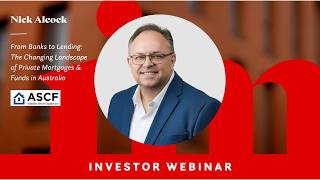
Coming next, we have Mr. Greg Schillerfeld, Head of Investment from Payton Capital.
Payton Pooled Investment Fund is a pooled mortgage fund, suitable for investors who prefer a managed investment experience, giving you access to a diversified pool of investments chosen and managed by Payton.
The Patent Select Investment Fund is a non-pooled mortgage fund suitable for investors who prefer to take a self-directed approach, allowing them to choose investments and reasonably tailor for their portfolio.
Welcome, Greg.
Thank you, Angelina.
So I'll start by telling you a little bit about Patent Capital.
patent capital for over 55 years has been our clients and most recently as a dedicated commercial real estate private debt manager.
In our history we've funded successfully over two and a half billion dollars in projects and currently manage a little over 1.1 billion dollars AUM.
We have offices in Melbourne and Sydney and a bit of an exclusive we've just launched an office in Brisbane.
We have over 50 people, currently about 53, but every day we seem to be growing.
And something different about Peyton is we call ourselves a for-purpose organization.
And what I mean by that, it pertains back to our ownership structure.
We're 40% owned by the Peyton family, 40% owned by our own staff, and 20% of our business is owned by our own charitable foundation called the Peyton Foundation.
This foundation partners with 16 charities, both in Australia and around the world.
And we use this to give back to the communities we work in.
So what is commercial real estate debt?
Commercial real estate private debt is where commercial real estate loans are made to commercial borrowers to fund real estate acquisitions or property development.
The loans may be used to purchase improved or what we call completed product.
developable or vacant land or property that is completed or under construction.
The land or property provides the security for the loans via a registered mortgage.
The income is generated from the borrowers paying their interest and fees on loans, which we then return to investors.
The Australian commercial real estate market in Australia is estimated to be somewhere between 50 and 60 billion and offers private investors the opportunity to take part in the fixed income arena and diversify their portfolio.
Oh, jumping here.
So why does commercial real estate debt exist?
It really started after the GFC led to a liquidity crunch worldwide.
And largely through America, where banks weren't lending between each other, the private market saw this as a key opportunity to step in and fill the gap that the banks led.
In Australia, more broadly, the Basel III regulations, which came in through 2016 onwards, meant that banks in Australia had much tighter lending obligations imposed on them by APRA.
and where they're lending to commercial borrowers, they have to hold what's called a certain amount of tier one capital ratio.
This becomes very expensive for banks and therefore they've chosen to step back from a lot of the traditional lending that they were doing.
This therefore meant that private investors could step in and fill this gap and take advantage of a key opportunity to leverage a fixed income opportunity with fantastic risk adjusted rewards.
More recently, what we're seeing across the banking world is that clients or developers are getting frustrated with what we call the age of the slow no.
And that's where developers are getting frustrated with banks who are coming with them on the journey, but throughout the course of a loan approval, getting further and further away from an approval and eventually coming to a no or a slow no, as we call it, where clients get left without a loan at the last minute.
That's given a key opportunity as well for the private debt market to step in and fill this gap.
Finally, a lot of developers come to the private real estate debt market because they're happy to trade off price for speed and certainty, which our market offers them.
So that leads to why would investors choose to invest in commercial real estate debt?
And certainly it's a growing asset class in Australia.
and as outlined earlier, it started in America, it's led to Europe and now certainly maturing in Australia.
What it provides for investors is stable and regular monthly income, attractive risk-adjusted returns through all market conditions, capital preservation as all loans are secured against Australian real property mortgages.
It gives clients property exposure without the risk of ownership,
and very low volatility and low to no correlation to public markets.
Now, how do you choose a manager when you are looking to invest?
And with any asset class, but particularly this asset class, it's very important to choose a manager who will provide you with transparency and integrity in dealing with your investment.
So what you should look for is an experienced team at Peyton,
Our lending or origination team has over 150 years of Big Four bank experience within it.
A track record.
At patent capital within our funds, we've never lost any capital for our clients, and we intend not to lose any capital for our clients for a long time.
You should have a risk management focus.
and really look at what are the key risks that you're taking on when you're lending to any clients, and how are you going to mitigate these risks?
And you should be able to easily articulate this in any investment.
Direct origination.
So where do the loans come from that you are lending your funds to give out to these developers?
Does your team go out and directly originate the loans with the borrower themselves?
Or is there an intermediary sitting between?
And finally, a specialist in their field.
Within patent capital, there's a number of items that we look at that we think that we're a specialist in our field.
And I'll quickly jump into them.
One, we feel that we're a mid-market manager.
And that means that we focus on debt sizes of typically five to $50 million.
And at that size, we feel that it's less complex than the larger size deals.
And that therefore lowers risk for our clients.
So what does patent capital offer for our clients and what are the investment options?
And Angela, you jumped into that earlier.
Thank you.
There's two distinct options that we have the patent pooled investment fund, which is a managed fund that allows clients to choose a pooled option or, or a, um, uh, a pool of, uh, investments that clients can choose to invest in, which allows them to spread their risk and diversify across a number of different items.
One being,
the investment type, the asset that they're lending against, the duration of the investment, the geography that they're lending to, and the developer that we're ultimately lending to at the end of the day.
The benefit of this is that you get simplicity and diversity and allow patent capital as your expert manager to choose an optimal portfolio, maximizing return and minimizing your risk.
The second option is the patent select investment fund.
And this is where clients
have the ability to self-direct their investment portfolio, choosing their risk profile and return via contributory mortgages.
And a contributory mortgage is where it's a single mortgage on a single asset, which has multiple investors.
The benefit of this is that clients get to directly pick each and every loan that they enter into.
And they have more power to
choose their investment portfolio, managing their own risk appetite.
Quick overview of the pooled funds.
There's three distinct options.
The cash plus is a combination of cash and first registered mortgage.
And it's really more of a holding account for our clients.
It's got a very low target portfolio LVR, including cash and returns clients at the moment, somewhere between five to 6%.
Income is distributed monthly.
And the liquidity of this fund is at call of 48 hours.
With our core fund, this is our flagship first mortgage fund.
And this is where it holds cash, some term deposits, but mainly first registered mortgages.
The target portfolio OLVR is still at 55%, so quite low relative to some funds.
And the target investor return is somewhere between eight to 9%.
Again, income is distributed monthly and there's a six month initial term on this fund with quarterly redemptions.
Finally, the opportunity fund is our fund that holds a little bit more risk in that it carries first and second mortgages.
It carries a target portfolio LVR of 65% and it has target investor returns of somewhere between 10 to 11%.
Again, monthly income distributions.
And in this fund, there's an initial term of 12 months
and post that 12 month term, six month rolling redemptions.
Quickly running through our capital select fund, we have capital secure as our first risk category or five risk categories if you like, capital secure, stable, balanced, growth and high yield.
I won't run through all of these given our time, but the first three are first mortgage categories and you can see the asset types.
The most secure is improved or completed property.
Moving through to capital stable that might hold some land
and then finally balanced is an active property or construction site.
Finally, growth and high yield are second mortgage categories, growth being an improved or completed property and high yield being an active property or construction site.
With Clayton Capital, we offer our clients a client portal, which means that they can log on and choose to view the value of their investment performance
they can see their average weighted return and their average weighted LVR across their portfolio at any time.
We have both an online and an app that clients can choose to use.
We're also listed for those advisors and clients that use direct the NetWealth platform.
And we have both our cash plus product as well as our core product available for wholesale clients on the NetWealth platform.
it.
Thank you very much.
Thanks Craig.
I've got a couple questions for you.
The first question is, in this growing non-bank lending environment, this landscape in Australia is growing, what sets Peyton Capital apart from its competitors in this market?
Thank you, I touched on that slightly and I was very conscious of time in my presentation but
You know, the patent capital is what we call a mid-market lender.
So our typical debt size is between five and 50 million.
At Paton, we focus on the Eastern seaboard.
So our deals that you'll see from us are Victoria, New South Wales and Southeast Queensland based.
Again, we see these markets having a deep pool of buyers if we ever need to realise an asset.
We also see less volatility across these property markets.
Finally, at Paton, we have a distinct focus on residential.
And when I say residential within the subclass of property, that means a mix of greenfield land with development approval or greenfield land under construction for housing lots, infill land sites within city boundaries, apartment construction or townhouse or housing development.
The final part to our fund that you'll see is commercial or industrial business parks.
We certainly have a few of those within our fund and we still are very bullish on that asset class as we continue to see growth in the sector.
Finally, at Peyton, you'll see shorter duration across our deals.
So typically 12 to 18 months is a duration that you'll see across a Peyton Capital Deal.
Well, given the heightened resource, various asset classes in this, you know,
current economic climate's way in.
How does patent capital effectively address and mitigate its risk within, let's say, the commercial real estate private debt space?
That's where you're playing.
Yeah, thank you.
Well, like most asset classes, there's many factors that contribute to risk.
And within property itself, there's many subclasses.
You've got residential, commercial, you've got hotel, industrial, retail, specialist retail.
There's many subclasses of property.
And the way we look at it is that we see the current environment certainly more challenging for borrowers with many uncertain factors to consider.
Construction costs are starting to come off.
Delays are certainly still there.
There is still some supply issues and the availability of the mBuyer to afford the product that they're building is now more than ever making feasibility is difficult to stack up in this cost environment.
Having said this, the fundamentals of our book made up in 85% residential
property certainly gives us some tailwinds because of the factors that are supporting residential property.
Across these sub-markets, residential property, we feel, has the greatest ability to pass on some of these increasing costs that make property segments less stable as we look at increased rents, therefore increased yields on direct property or residential property.
the lack of supply of residential property coming through in all of the three markets I mentioned, and certainly increased demand given the 900 odd thousand new Australians that will be landing on our shores over the next couple of years.
And we know of those Australians, 70% will fall into Melbourne, Sydney, Brisbane markets.
So certainly for us, when we look at risk within the subclasses, we feel that residential property is well positioned to weather some of the storm that we've seen.
What I will say for the listeners is that we feel that a well-positioned first mortgage investment with a great manager will always provide investors an amazing risk-adjusted return to consider in any portfolio.
Well, thank you, Craig.
Have a good night.
Take care.
Cheers.
Payton Pooled Investment Fund is a pooled mortgage fund for investors who prefer a managed investment experience, with access to a diversified pool of investments chosen and managed by Payton. Payton Select Investment Fund is a non-pooled mortgage fund suitable for investors who prefer to take a self-directed approach, allowing them to choose investments and tailor their portfolio. Craig Schloeffel has more than 15 years’ experience working across banking, financial markets, private wealth, lending, and residential construction. After establishing a career in financial planning, Craig gained valuable wealth management experience before transitioning into leadership roles for the CBA across their retail bank, private wealth and private bank divisions.
Disclaimer