Newer investors looking for managed investments traded on the ASX may be less familiar with the concept of listed investment vehicles (LIVs). It may even surprise some to know that there was a time where interest in these types of investments far outweighed interest in ETFs, and they offered the only form of tradable access to professionally managed investments for decades.
In fact, the oldest LIV in Australia is over 100 years old – a listed investment company (LIC) called Whitefield Ltd (ASX: WHF) which has traded since 1923.
Many highly experienced fund managers still use this structure for any funds they offer listed on the ASX, so it is highly valuable to understand them as you may find you end up using them within your portfolio.
The biggest mistakes investors tend to make when using LIVs surround a lack of understanding of them – or even simply assuming they are the same as ETFs. In this article, I’ll go through some of the key things investors should know about LIVs before they invest.
1. Back to basics: LIV structures
LIV is a broad term the ASX uses to group two different types of investments – which operate in a largely similar way but have a different legal structure.
Listed Investment Companies (LICs) which use a corporate structure with a board of directors and paying corporate tax of 30% on its earnings. This structure can select how much of its earnings (income and realised capital gains) to distribute each year. It can attach franking credits to its distributions as it pays corporate tax.
Listed Investment Trusts (LITs) which use a trust structure with a fund manager and not paying tax itself – investors pay tax on their earnings from the trust. All earnings must be distributed to investors annually. Franking credits are only available if underlying assets held in the trust have them attached.
Both these structures are closed-ended. This means that there is a fixed number of units or shares available when the product is launched through an initial public offering. The amount doesn’t change.
By contrast, an open-ended structure means that the amount of units available is based on demand – the fund expands to allow for additional units and contracts if investors leave and aren’t replaced with new ones. ETFs are open-ended structures.
One of the key mistakes investors can make when using these structures relates to a misunderstanding of tax implications – particularly franking credits.
As LICs pay corporate tax and attach a franking credit, the initial return may look less than that paid by a LIT. LICs don’t need to pay out all their earnings either, so they may choose to hold earnings for future years to smooth out dividend payments.
A LIT may still have some franking credits attached from underlying assets but otherwise tax hasn’t been paid on the earnings prior to the investor being paid. As LITs need to pay out all their earnings annually, dividends may potentially look less consistent when compared with LIC structures.
Some LICs will specifically target zero-tax investors, like retirees, who use franking credits and report their total returns in that way. Some examples are Plato Income Maximiser Ltd (ASX: PL8) and WAM Income Maximiser Ltd (ASX: WMX) which target the use of franking credits within the strategies.
You can also find income-focused LITs, which may use other asset classes like credit to generate income distributions.
2. LIVs can trade at a discount or premium to net tangible assets (NTA)
Net tangible assets (NTA) refers to the physical value of the underlying holdings within an investment, like shares or bonds – what you’d need to pay if you had to buy each of the holdings outside of the investment structure.
To put it simply, if an investment includes equal holdings of company A, B and C which are trading at $100, $80 and $30 respectively, you would tally the NTA as being $210.
ETFs typically trade close to their NTA due their open-ended structure which allows them to reduce or increase units reflecting demand.
By contrast, LIVs being closed-ended structures can fluctuate and trade at either a discount or a premium to the value of the underlying holdings.
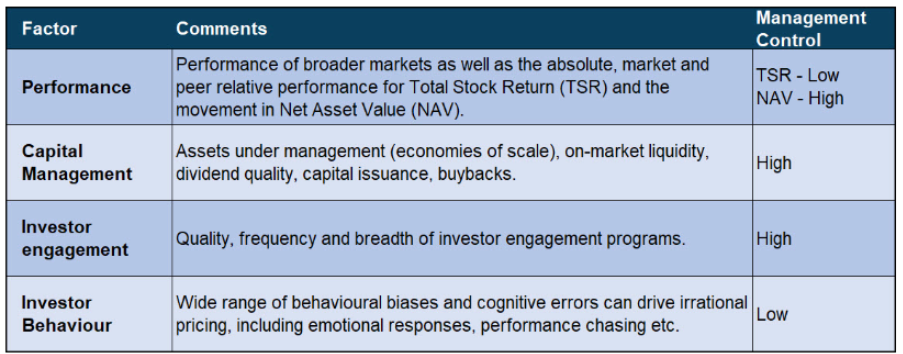
Where a LIV trades at can be influenced by a range of factors, such as performance or investor behaviour. The management team of a LIV has control over some of the factors, but not others as you can see outlined in the below table from Zenith Investment Partners:
Where a LIV trades compared to its NTA is something that investors should monitor as part of researching whether or not to invest – or if they have already invested and intend to sell. For example, if there is an ongoing pattern of a LIV trading at a significant discount to its NTA, and this is getting deeper, this could be a sign of manager underperformance, poor investor relations or illiquidity in the underlying assets rather than a value opportunity.
On the other side, if you can see that a LIV typically trades close to its NTA or at a premium and is suddenly trading at a discount, it could warrant further research to see if this might be temporary and a value opportunity.
Larger LIVs often trade closer to NTA than smaller ones, as there is a better market for them.
3. Professional management can come with extra costs
LIVs are actively managed and there are costs involved with this.
Much like investing in unlisted managed funds, you’ll need to consider fees beyond the brokerage of your trading app when you invest. These can chip into your returns from the investment too so you’ll need to consider them as part of your research and comparison with other investment options.
A performance fee (commonly 15-20% of returns above a set benchmark)
Not all LIVs charge a performance fee but you’ll need to check product disclosure forms or indirect cost ratios to help you determine the full extent of fees you may be paying.
Investors often compare LIVs to ETFs so it’s worth bearing in mind that ETFs also have fees and the levels of these can vary depending on whether they are actively or passively managed, and if passive, depending on the type of index used.
4. Management Matters
Just as with any professionally managed investment, the management is important. Consider the track record, length of time working together and expertise of the management team for a LIV as part of your decision to invest.
Affluence Funds Management suggests looking for alignment of interests with the strategy of the LIV such as ownership or significant personal investment in the LIV or having a long history with the company.
LIVs can be internally or externally managed – it doesn’t necessarily mean different performance but is something to keep in mind. It is more common for LICs and LITs to be externally managed.
An internally managed LIV means it appoints its own internal investment and management teams and does not pay fees to external parties. It can be a simpler structure and easier for investors to analyse and understand the fees. LIVs using the company structure can use internal or external management.
An externally managed LIV is where the board or trustees appoint an external fund manager as part of an agreement and pay a fee to them. It can be a more complex structure. While LICs can be either internally or externally managed, LITs are externally managed.
LICs and LITs have been popular with investors for decades as an option for diversified exposure and professional management. Though they are similar in some ways to another highly popular vehicle – ETFs – they also have differences and investors should be conscious of performance and the liquidity of LIVs so that they can sell them if they need to.
Understanding the two key structures of LIVs and doing the research on the fundamentals and the management teams involved can go a long way towards avoiding some of the challenges investors face in using them.
Plato Income Maximiser Limited (the ‘Company’, ASX:PL8) offers Australian investors the opportunity to invest in an actively managed, diversified portfolio of Australian shares with an income focus.
WAM Income Maximiser aims to provide monthly franked dividends and capital growth to shareholders by investing in Australia’s highest quality companies and corporate debt instruments. These companies are selected for their strong capital management and ability to sustain or grow their distributions over time, primarily in the form of franked dividends and share buybacks.
Metrics Income Opportunities Trust seeks to provide investors exposure to a portfolio of private credit investments. The Investment Objective of the Trust is to provide monthly cash income, preserve investor capital and manage investment risks, while seeking to provide potential for upside gains through investments in private credit and other assets
Argo Investments is one of Australia's oldest and largest listed investment companies (LICs). Offering investors low-cost, conservative and diversified exposure to Australian listed companies.
Future Generation Australia (ASX: FGX) is a listed investment company that aims to deliver a combination of income and capital growth over the medium-to-long term by investing in Australian equities.
RF1 provides investors with exposure to a selection of alternative investment strategies, with an objective to produce attractive risk-adjusted returns over a period of more than five years with limited correlation to equity markets.
Disclaimer: This article is prepared by Sara Allen. It is for educational purposes only. While all reasonable care has been taken by the author in the preparation of this information, the author and InvestmentMarkets (Aust) Pty. Ltd. as publisher take no responsibility for any actions taken based on information contained herein or for any errors or omissions within it. Interested parties should seek independent professional advice prior to acting on any information presented. Please note past performance is not a reliable indicator of future performance.
A passionate writer and reader across finance (primarily investments and superannuation), lifestyle, literature and travel. I have more than fifteen years' experience in content and marketing covering writing, editing, strategy development and execution, budgeting, events coordination, project management, web content management, seo and social media channels and stakeholder management across all levels.
As contrarian investors, we often find ourselves in unloved areas of the market. Eighteen months ago, lithium miners fell squarely into the ‘unloved’ category. In fact, it would have been difficult to find a more out-of-favour area of the market at the time.
A portfolio stress test applies past market shocks, such as the Global Financial Crisis (GFC), to your current asset allocation to estimate how much your portfolio could fall. It is a simple way to check whether your strategy, diversification and cash buffer would hold up in a downturn.
Every loss in Australian private credit seems to be reported as a failure of the asset class. We think that is misleading, and it does little to help investors understand the risk-reward proposition they are actually signing up for

-l41u2ptkx9onbqj7pipi.png)
-4hhyyp4m13i0mn7am7nu.png)
-cjojn8hw3e0gc4lk8069.png)