-t5z4ob41uwrlwil2guow.png)
What the DEI backlash means for ESG investing in 2025
Does going woke mean going broke in 2025?
ESG investors have certainly had their challenges to contend with in recent years, not least of which has been the global pushback against diversity, equality & inclusion (DEI) as a core ESG strategy.
We investigate why the DEI backlash has happened and what it means for ESG investors looking forward.
A more challenging period for ESG fund flows
Firstly, let’s check in on global ESG fund flows for a little context.
The ESG glory years of a few years ago have been a distant memory of late. As shown below, global ESG inflows have been relatively weak throughout 2024, and there have been gradual flows out of the asset class over the past couple of years in the US.
Global ESG fund flows
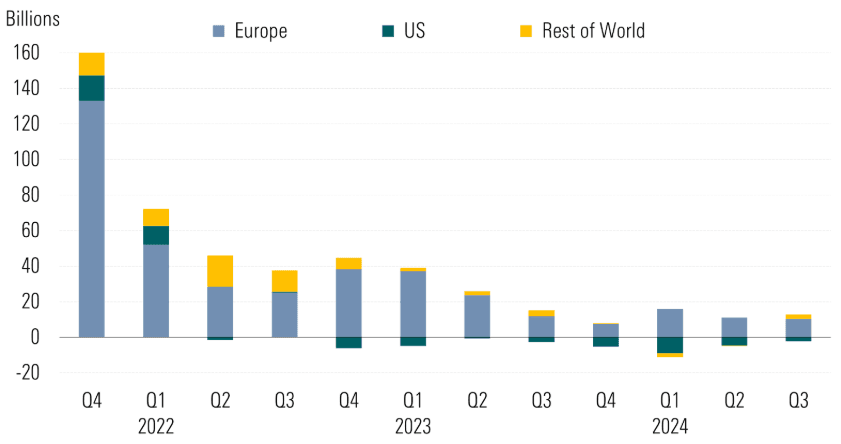
Source: Morningstar
Those ESG outflows in the US are surely related to the DEI backlash.
Explore 100's of investment opportunities and find your next hidden gem!
Search and compare a purposely broad range of investments and connect directly with product issuers.
The lowdown on the DEI backlash
The backlash against DEI has been centred in the US where issues of race, gender, and diversity are charged to say the least.
Trump’s re-election has clearly added fuel to this fire. Case in point: Trump stated that he intends to use his second term as president to address a ‘definite anti-White feeling’.
In Australia, the backlash against DEI mainly relates to gender rather than race and is generally coming from men who believe DEI is disenfranchising and disadvantaging them. This is despite the fact that there are no female chairs of ASX20 companies and the vast majority of ASX200 chief executives are male.
A recent global survey by Work180 concurs with this local backdrop. It found that 21% of men who said they supported gender diversity felt they were actually being discriminated against by it. And 22% believed gender equality strategies were leading to resentment and division amongst their fellow employees.
These are not insignificant issues.
So, what happens next with DEI is important for ESG investing as an asset class.
Some companies are pivoting away from DEI
In response to the backlash, some companies have clearly begun winding back their DEI initiatives.
For example, Walmart announced it will avoid using the acronym DEI, end all DEI training, and will stop considering gender and race when selecting its suppliers.
The numbers confirm change is afoot amongst a portion of the corporate world.
Recent Egon Zehnder research showed that the number of new directors appointed to S&P 500 boards who are classified as people of colour fell from 34% two years ago to 24% in 2024.
Most companies remain committed to DEI, with a caveat
Despite the backlash, most global companies, at least publicly, remain committed to DEI as a core ESG strategy.
However, there’s a caveat. The lesson many management teams are taking from the DEI backlash is that workplace diversity shouldn’t come at the cost of meritocracy.
This makes intuitive sense to workers and investors alike.
In the past when companies used DEI quotas aimed at levelling the playing field for historically marginalised groups, it sent out a message to the rest of the workforce that the promoted employees weren’t qualified to compete for the role on their own merits.
As a result, these DEI quotas have tended to lead to resentment amongst employees who believe they are unfair.
However, at the same time, the arguments in favour of gender equality remain as compelling as ever. Recent surveys by McKinsey and Morgan Stanley show that better gender equality tends to lead to higher profitability care of more balanced decision-making and access to a wider talent pool.
So ESG-focused companies are left with the challenging task of enabling gender diversity through fair and transparent hiring policies but not disenfranchising their staff who aren’t benefitting from their DEI policies.
Whilst some would argue this is akin to walking a tightrope, high quality management teams will do what they always do when addressing business challenges: handle it deftly and respectfully to the long-term benefit of the business.
Subscribe to InvestmentMarkets for weekly investment insights and opportunities and get content like this straight into your inbox.
Implications for ESG investors
We believe there are three main implications ESG investors should be aware of:
- ESG is bigger than DEI.
The attractions of the ESG asset class remain structural in nature based on the tendency for companies who excel at their environmental, social & governance strategies to outperform over the long term. This is worth remembering at this juncture. - Don’t focus on recent ESG fund outflows in the US.
The recent ESG fund outflows in the US appear to be related to the DEI backlash. The market’s tendency to throw the baby out with the bathwater has created an unusually compelling opportunity set amongst companies with high ESG standards. - The correlation between high ESG standards and quality is higher than ever.
Whilst DEI is a greater challenge to navigate than it was only two years ago, the highest quality companies will navigate this issue to their advantage. As a result, DEI has arguably further raised the correlation between high ESG standards and high quality management. That’s useful intel for investors to be aware of.
You can check out the ESG funds positioned to benefit from these developments at Investmentmarkets.
ESG is here to stay
ESG-focused investing is here to stay as a mainstream asset class.
The DEI backlash against the asset class requires a careful and nuanced response from the corporate world to ensure it is navigated to the benefit of investors and workers alike. This challenging backdrop creates an opportunity for high quality companies to reveal their quality to global investment markets—and many will.
So, if there’s one key takeaway investors should be aware of it’s that high ESG standards arguably mean even more now than they did when the asset class was booming two years ago.
Disclaimer: This article is prepared by Simon Turner. It is for educational purposes only. While all reasonable care has been taken by the author in the preparation of this information, the author and InvestmentMarkets (Aust) Pty. Ltd. as publisher take no responsibility for any actions taken based on information contained herein or for any errors or omissions within it. Interested parties should seek independent professional advice prior to acting on any information presented. Please note past performance is not a reliable indicator of future performance.
Author

Simon Turner
Head of Content (CFA), InvestmentMarkets
Related Articles
-zpjeccpxe33g6pvf8k4p.png)
-f8oa4fq9aif5m8wvehra.png)
Investments You May Like

Emit Capital Climate Finance Equity Fund
The Fund invests in global listed equities that contribute to a meaningful reduction in climate change. (Wholesale Investors Only)
Categories
Recent Articles
View all articles-4hhyyp4m13i0mn7am7nu.png)
-cjojn8hw3e0gc4lk8069.png)
-91mhtehskiukrsa930g2.png)