-6xblbfxg17ij0ex7hwqw.png)
How Many ETFs Is Too Many? The Diversification vs Dilution Problem
The theory behind diversification makes intuitive sense to most investors: by combining assets that don’t move in perfect synchrony, investors can reduce portfolio volatility without necessarily sacrificing expected returns. This accepted truth reshaped portfolio construction in the twentieth century and continues to underpin institutional allocation frameworks today.
But like most investment concepts, diversification is only helpful up to a point. The challenge is understanding when diversification ceases to add value and begins to dilute outcomes. In a market saturated with ETFs, the question has shifted from whether to diversify to how much diversification is enough.
The Shifting Context of Modern Markets
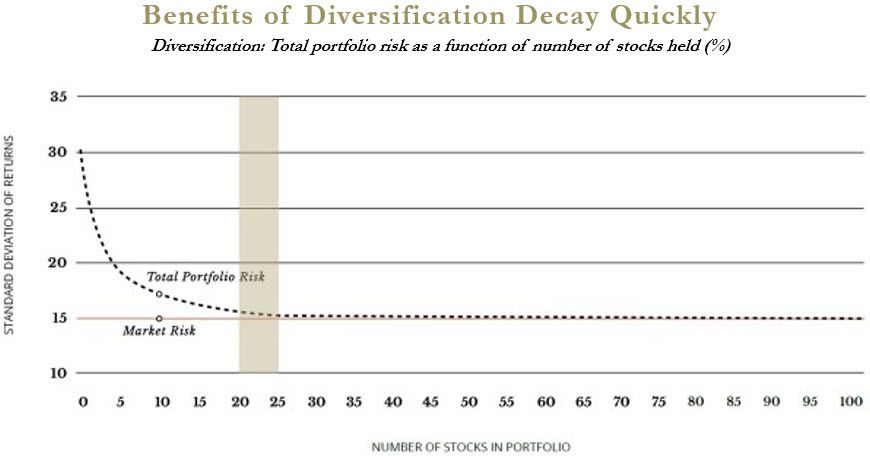
The academic evidence has long suggested that diversification delivers diminishing returns far sooner than most investors assume. It shows that the majority of diversification benefits are achieved with a relatively small number of assets.
Evans and Archer (1968) demonstrated that portfolio risk declines sharply as additional assets are introduced, but that this benefit plateaus relatively quickly. They showed that by the time a portfolio holds twenty to thirty individual securities, most of the available risk reduction has already been achieved. Beyond this point, each additional holding contributes little in terms of volatility reduction.
Source: Intrinsic Investing
Later work by Statman (1987) confirmed similar thresholds.
In the modern ETF-dominated investment landscape, this dynamic is even more pronounced.
A single global equities ETF can provide exposure to hundreds, even thousands, of companies across developed markets, spanning industries, geographies and economic cycles.
Hence, one ETF can embed a level of diversification that would once have required many individual investments.
This arguably implies that a small number of carefully selected ETFs is sufficient for most investors to achieve effective their diversification goals.
Some experts suggest five to ten ETFs as being adequate for broad multi-asset exposure, but even two or three well-diversified ETFs will achieve the maximum diversification goals as per the research.
However, this conclusion rests on a critical assumption: that each fund contributes something genuinely distinct.
In practice, this is where many ETF portfolios fall short. The defining risk in today’s market is not under-diversification but the illusion of diversification created by overlapping ETF exposures.
Explore 100's of investment opportunities and find your next hidden gem!
Search and compare a purposely broad range of investments and connect directly with product issuers.
The Illusion of Diversification
Here’s the thing…a portfolio that appears diversified at the surface level can, upon closer inspection, be highly concentrated.
For example, it’s common to for Australian investors to hold a global equities ETF alongside a US-focused ETF, a technology ETF, and an actively managed growth fund.
While these allocations are labelled differently, their underlying holdings often converge. Mega-cap US companies such as Apple, Microsoft and NVIDIA dominate global indices and thematic strategies alike, meaning that owning multiple ETFs effectively means duplicating the same underlying positions.
The upshot is that investors frequently end up holding the same securities multiple times through different ETFs.
This is concentration masquerading as diversification.
As a result, many investors’ portfolios are more concentrated than intended, particularly in US large-cap tech stocks.
And they’re incurring multiple layers of fees for exposures they already own.
Hence, adding more ETFs often doesn’t improve a portfolio’s diversification benefits. It simply replicates existing positions under different labels for additional cost.
Avoiding Dilution, Excessive Fees & Complexity
The whole point of diversification is to enhance a portfolio’s risk-adjusted returns.
However, as more ETFs are added to a portfolio, particularly those with high correlation, returns tend to converge towards the market average.
‘One of the most vexing problems in investment management is that diversification seems to disappear when investors need it the most.’ — Sébastien Page, CFA, and Robert A. Panariello, CFA, ‘When Diversification Fails’
Research from the CFA Institute underscores that excessive diversification reduces the likelihood of meaningful outperformance by spreading capital too thinly across similar opportunities.
This is amplified by the rising correlation of global stocks over the past few decades:

Source: CFA Institute
Hence, investors who accumulate large numbers of overlapping ETFs often find that their portfolios deliver benchmark-like returns, but with higher complexity and cost.
The fee impact is worth being aware of. While ETFs are widely regarded as low-cost vehicles, the cumulative impact of multiple ETF holdings can be significant.
In particular, thematic ETFs tend to charge higher fees. According to Morningstar: ‘These funds often come with higher costs, increased volatility, and unique complexities that require additional due diligence. To put simply, thematic funds are volatile. The winners reward you handsomely, and the losers can decimate your portfolio.’
When such products are layered on top of core exposures, the result is often an increase in total portfolio costs without a commensurate improvement in diversification or returns.
Higher complexity is another consequence of over-diversification.
A portfolio consisting of fifteen or twenty ETFs is inherently more difficult to monitor, rebalance, and understand than one constructed with a smaller number of carefully chosen exposures.
A complex structure can also obscure an investor’s view of their portfolio risk.
For example, investors may believe they are well diversified when, in reality, high ETF correlations mean their portfolio is heavily exposed to a narrow set of underlying stocks and drivers.
This misperception is widespread, so many portfolios are behaving more like concentrated positions than investors intended.
Subscribe to InvestmentMarkets for weekly investment insights and opportunities and get content like this straight into your inbox.
The Optimal Number
There’s no universally optimal number of ETFs investors should aim for.
It all comes down to your personal goals and risk appetite.
Having said that, you won’t need to own many ETFs to maximise the benefits of diversification. The benefits of diversification plateau once a portfolio reaches a modest number of underlying assets. Given ETFs already bundle hundreds or thousands of securities into a single instrument, even one ETF offers the diversification benefits most investors are aiming for.
Diversification should be assessed at the level of underlying assets, not at the level of funds.
What matters is whether each allocation introduces genuinely distinct sources of risk and return.
As a result, one global ETF and one Australian ETF cover most investors’ equity goals, and one inflation-adjusted bond ETF may cover their fixed income needs.
Diversification Isn’t a Fix All
Diversification remains essential, but its effectiveness depends on the discipline and intention behind it. The objective is to maximise the diversity of underlying ETF exposures while avoiding redundancy. This requires a focus on asset class allocation, an understanding of correlations, and a willingness to maintain simplicity.
The paradox of modern investing is that the abundance of choice has made it easier to construct inefficient portfolios. In seeking to diversify, investors often end up concentrating their risk, increasing their costs, and diluting their returns. True edge now lies in recognising when additional diversification ceases to be beneficial.
Disclaimer: This article is prepared by Simon Turner. It is for educational purposes only. While all reasonable care has been taken by the author in the preparation of this information, the author and InvestmentMarkets (Aust) Pty. Ltd. as publisher take no responsibility for any actions taken based on information contained herein or for any errors or omissions within it. Interested parties should seek independent professional advice prior to acting on any information presented. Please note past performance is not a reliable indicator of future performance.
Author

Simon Turner
Head of Content (CFA), InvestmentMarkets
Related Articles
-vmtf4wo29a20xxj6oknl.png)
-c0r65slb5ciy1qtd4yd3.png)
Categories
Recent Articles
View all articles-uo4eg7ge0ysewqkveu92.png)
-qn47nb2t9h7iuvyq9ohf.png)
-01xhfy3zxeb8rav1zavf.png)