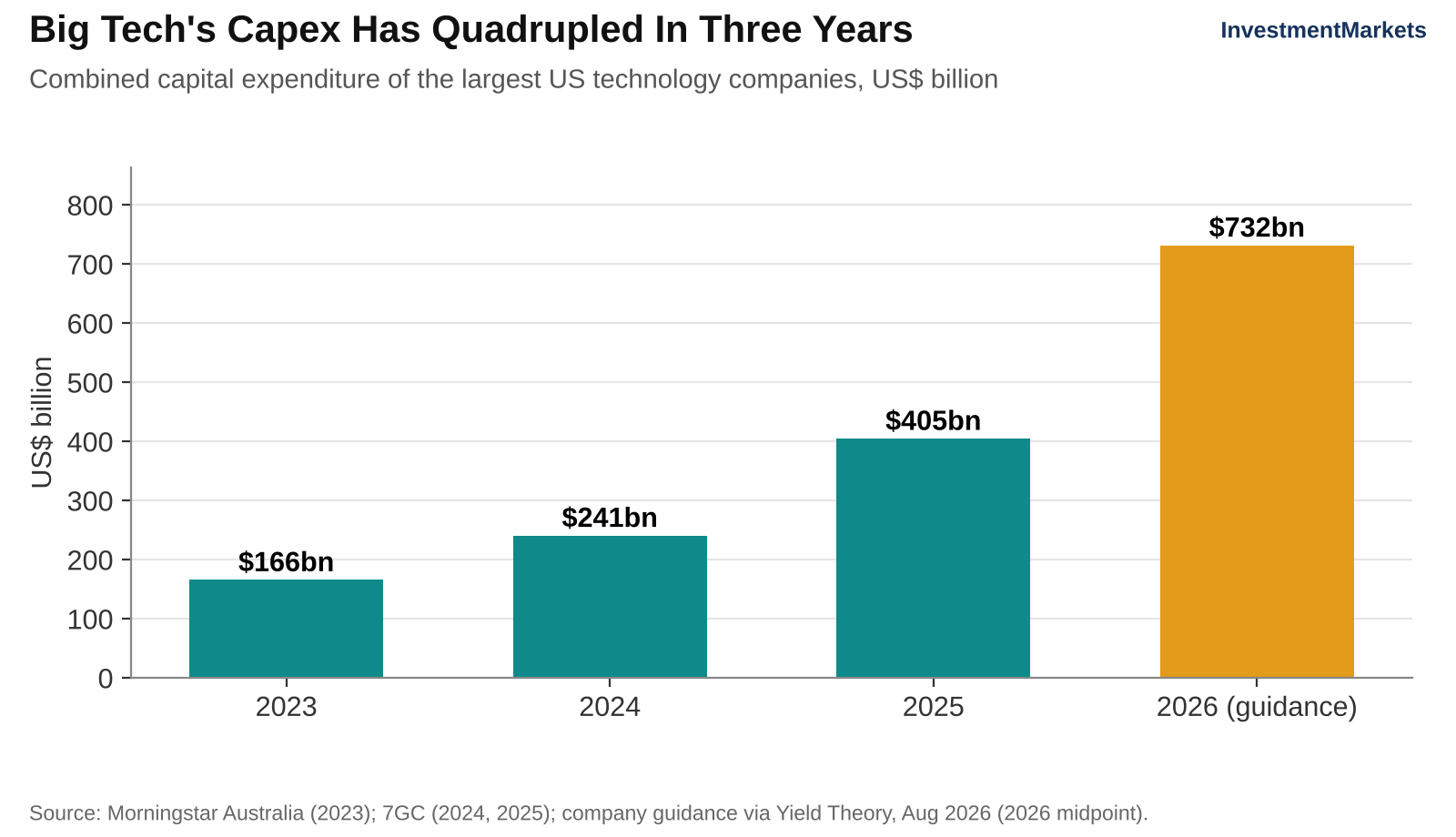
This year, four American mega caps will spend US$730 billion on capex, most of it building out their AI infrastructure. The goal being to leverage AI to dominate their respective markets. Amazon alone has guided to spend US$220 billion. If you own a global ETF or fund, a meaningful slice of your wealth is now riding on whether that spending pays off.
History offers an uncomfortable guide to how this may play out. The AI build-out ticks the historical boxes of a capex boom with the potential to end in a bust. The question for investors is whether the price being paid for AI exposure, and the way the build-out is being financed, will lead to a repeat of a pattern that has burned investors many times before.
Key Takeaways
AI capital spending is on track to reach 3.1% of US GDP by 2027, more than two and a half times the peak of the late-1990s telecom boom.
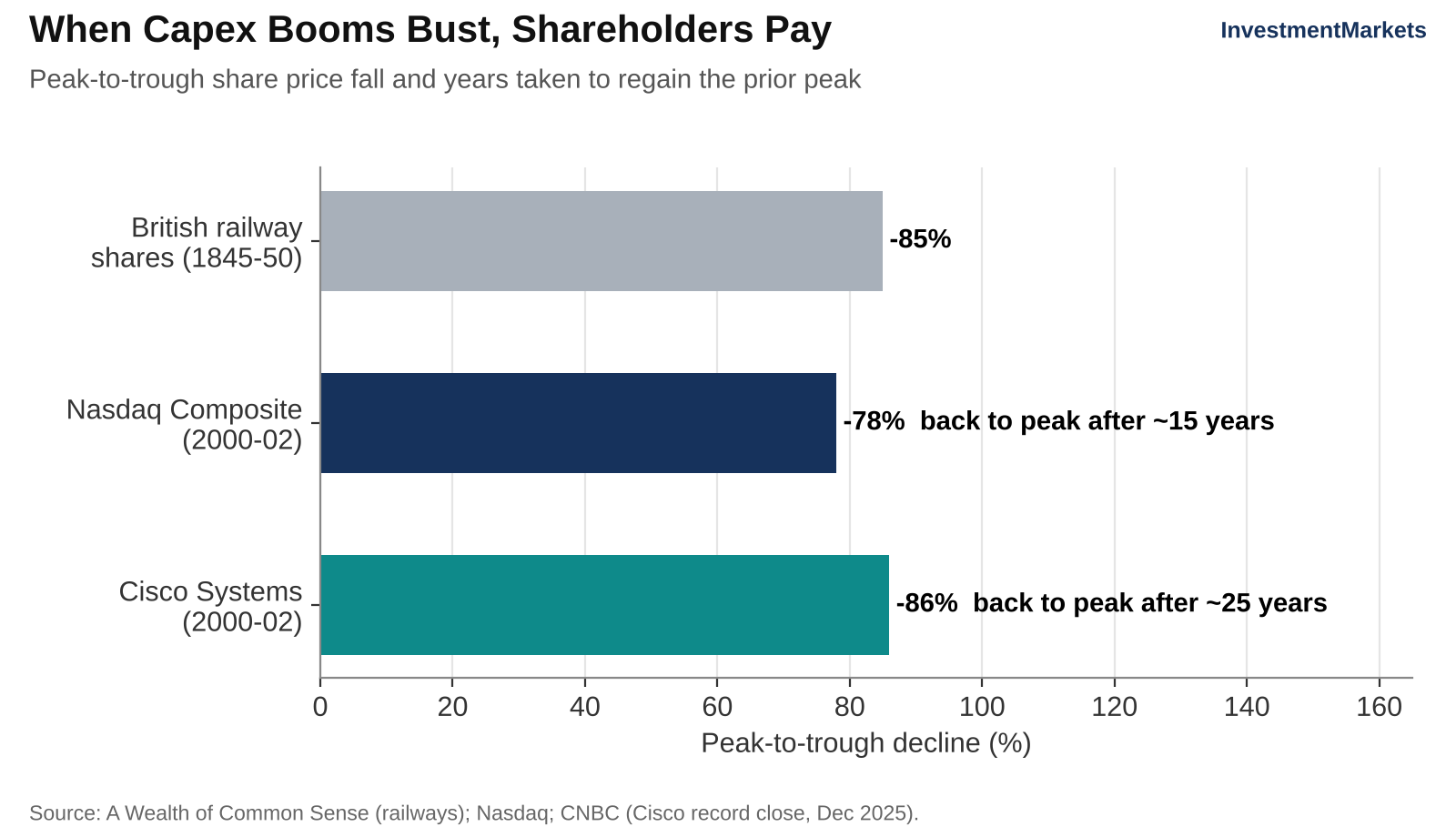
Railways and the internet both changed the world, yet investors who bought near the peak lost 64–86% of their capital.
The shift from cash-funded to debt-funded AI spending is a warning sign to watch.
Yet, unlike the fibre build-out, the AI capex by Amazon, Microsoft and Alphabet is backed by almost US$1.7 trillion of contracted revenue, most of it for cloud services. That substantially reduces the risk for their shareholders.
Australian investors are better served by measuring and diversifying their hidden AI exposure than by trying to time the top.
Explore 100's of investment opportunities and find your next hidden gem!
Search and compare a purposely broad range of investments and connect directly with product issuers.
2026 capex for Amazon, Alphabet, Microsoft and Meta is estimated at US$720–745 billion, up from US$166 billion in 2023.
Big Tech capital expenditure, 2023 to 2026 guidance. Source details shown on chart.
As a result, AI capex is estimated to rise from 0.6% of US GDP in 2023 to 3.1% in 2027, against a telecom peak of 1.2%.
The pace of change has been so rapid, and the absolute numbers so large, that this expenditure alone has been a significant driver of US GDP growth this year.
AI capex as a share of US GDP versus the telecom peak. Source details shown on chart.
If it does reach 3.1% of US GDP next year, it’s fair to say that the American economic outlook will be inextricably linked to the direction AI capex takes thereafter.
Put another way, a return to 2025’s already heavy AI capex level of 1.4% of GDP would remove spending equal to 1.7% of the entire US economy.
What Past Booms Teach Us
Let’s take a trip down memory lane to see how these types of capex booms have played out in the past.
Railways: The Original Tech Mania
In the 1840s, Britain poured £250 million into its railways, close to half its annual GDP at the time.
Everyone was bullish.
However, by April 1850, the railway share index had fallen 64% from its 1845 peak.
By 1855, more than 8,000 route miles were up and running, over 80% of Britain’s network today.
So, it was excellent news from an infrastructure perspective and disastrous news from a shareholder’s perspective.
Fibre, Cisco & The Dotcom Hangover
Fast forward 150 years.
The dotcom boom of the late 1990s followed a similar script.
Carriers spent more than US$500 billion between 1996 and 2000 on the belief that internet traffic was doubling every 100 days.
It was closer to doubling every year, and analysis by 7GC notes that 85–95% of the fibre laid in the 1990s sat unused after the sector’s infamous bust.
The Nasdaq fell 78% between 2000 and 2002 and took 15 years to regain its peak.
Cisco, the Nvidia of its day, fell 86% and only closed at a new record in December 2025.
Peak-to-trough losses in earlier capex booms. Source details shown on chart.
The important takeaway from that episode was that share prices peaked well before capex slowed. That’s proof of the forward-looking nature of global markets.
How Today’s Capex Boom Compares With Two Historical Analogues
2026 is a very different era from the 1840s and 1990s.
Today’s main AI capex spenders are also among the most profitable companies in history.
Six of the Magnificent Seven held more cash than debt in 2025.
Nvidia’s and Amazon’s forward price-to-earnings ratios sit near decade lows because profits have grown faster than their share prices.
That’s the polar opposite of classic bubble behaviour.
The more worrying shift is in their funding mix.
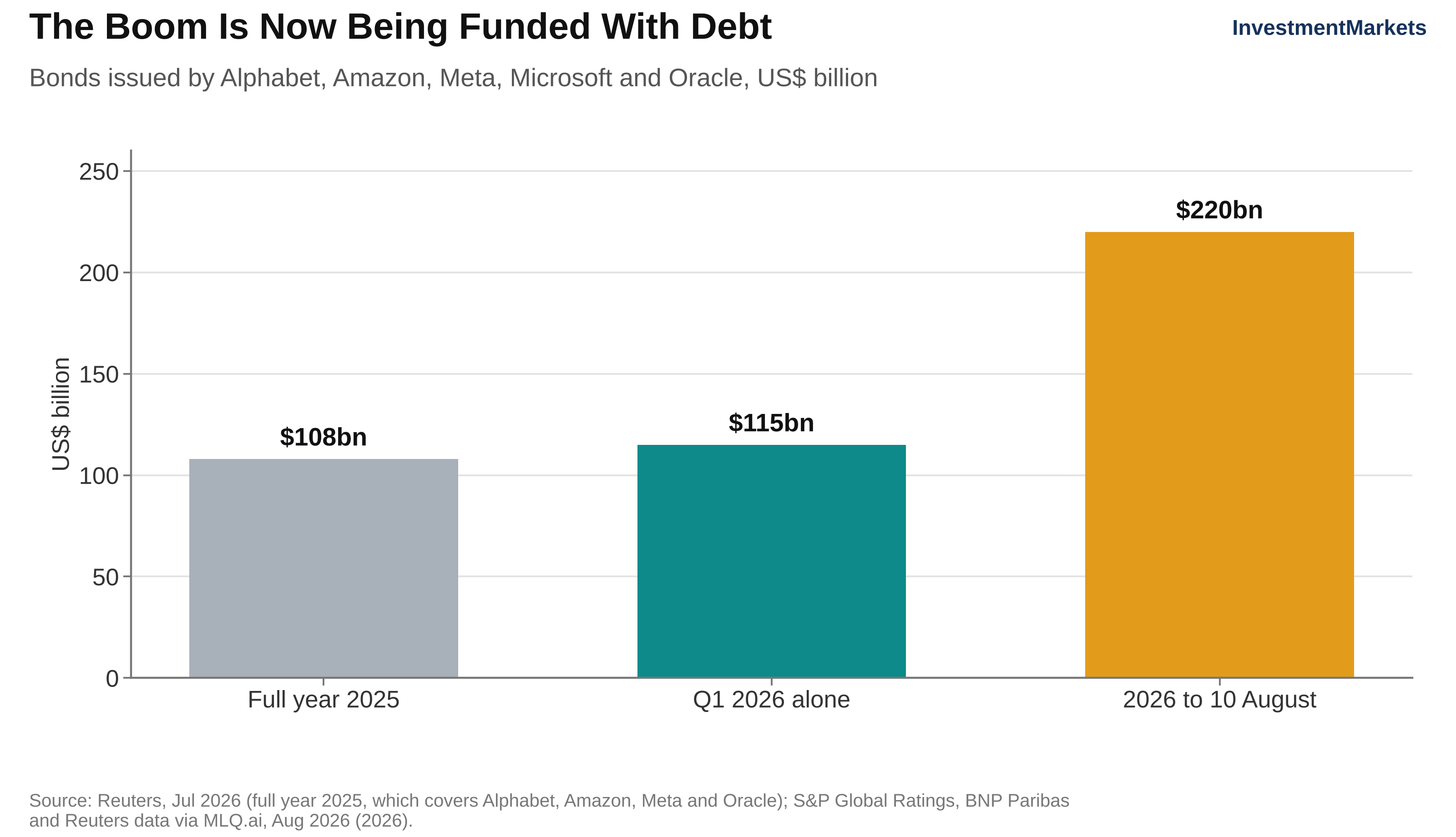
Alphabet, Amazon, Meta, Microsoft and Oracle issued US$220 billion of bonds between 1 January and 10 August this year, double the US$108 billion they issued in all of 2025. At the same time, spreads have widened.
This funding wave has reached Australia’s shores: Alphabet’s A$5.5 billion bond in August was the largest corporate bond ever issued here.
Hyperscaler bond issuance in 2026 has already doubled 2025’s full-year total. Source details shown on chart.
Jeff Bezos himself has called AI ‘a kind of industrial bubble’, although he still insists that society will benefit enormously.
That’s one half of the railway and fibre rollout lesson: an expensive new technology with the potential to transform the economy may well do exactly that.
The other half, often left unsaid, is that if history repeats, investors may still lose money.
Why This Cycle Could Be Different For Some Of The Magnificent Seven
There is, however, a crucial difference between some of today’s biggest AI spenders and the railway promoters and fibre carriers that came before them: they are building to order.
Amazon, Microsoft and Alphabet are adding data centre capacity against customer contracts that have already been signed.
Amazon: Building Against Signed Contracts
Amazon is the clearest example.
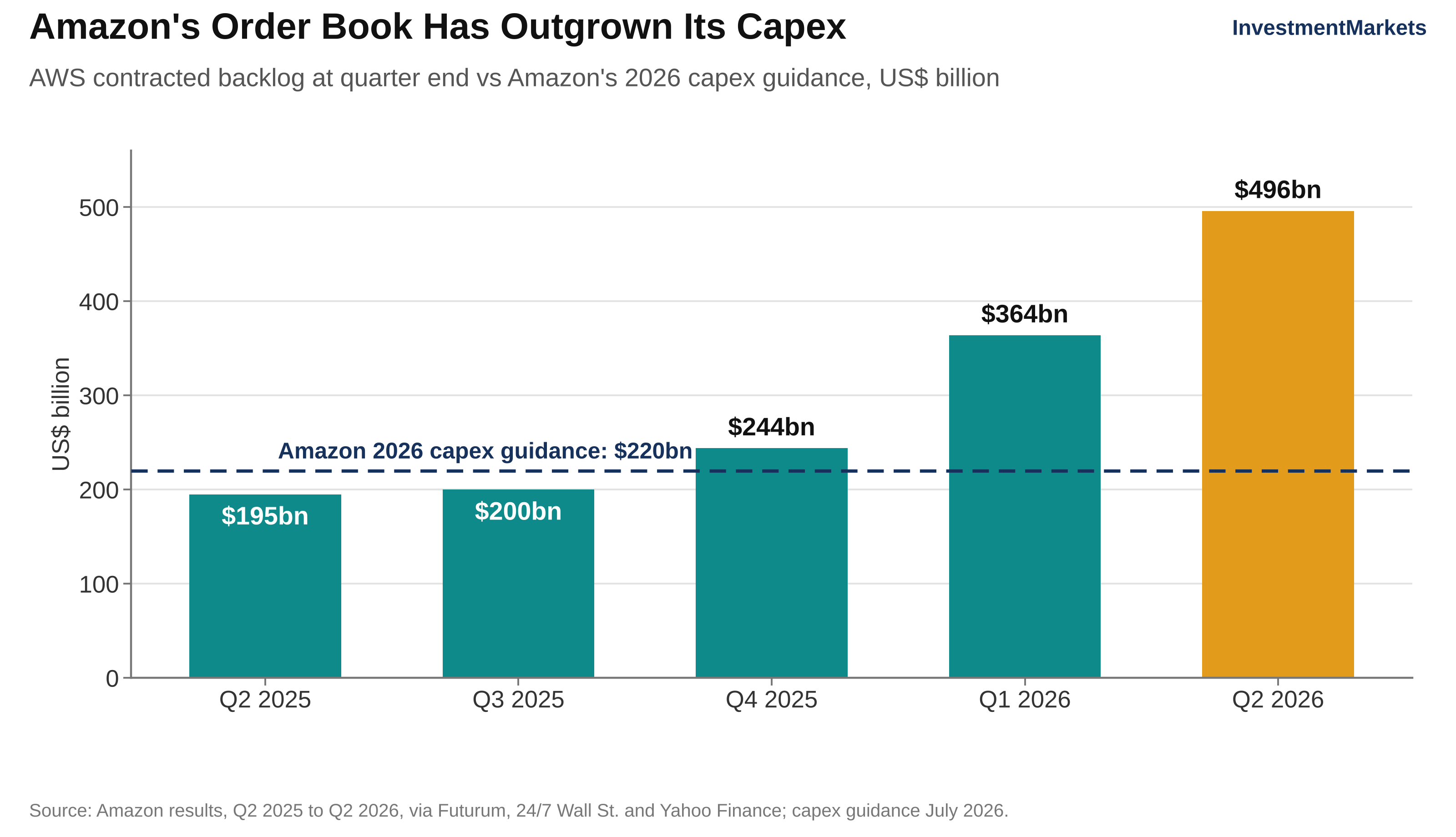
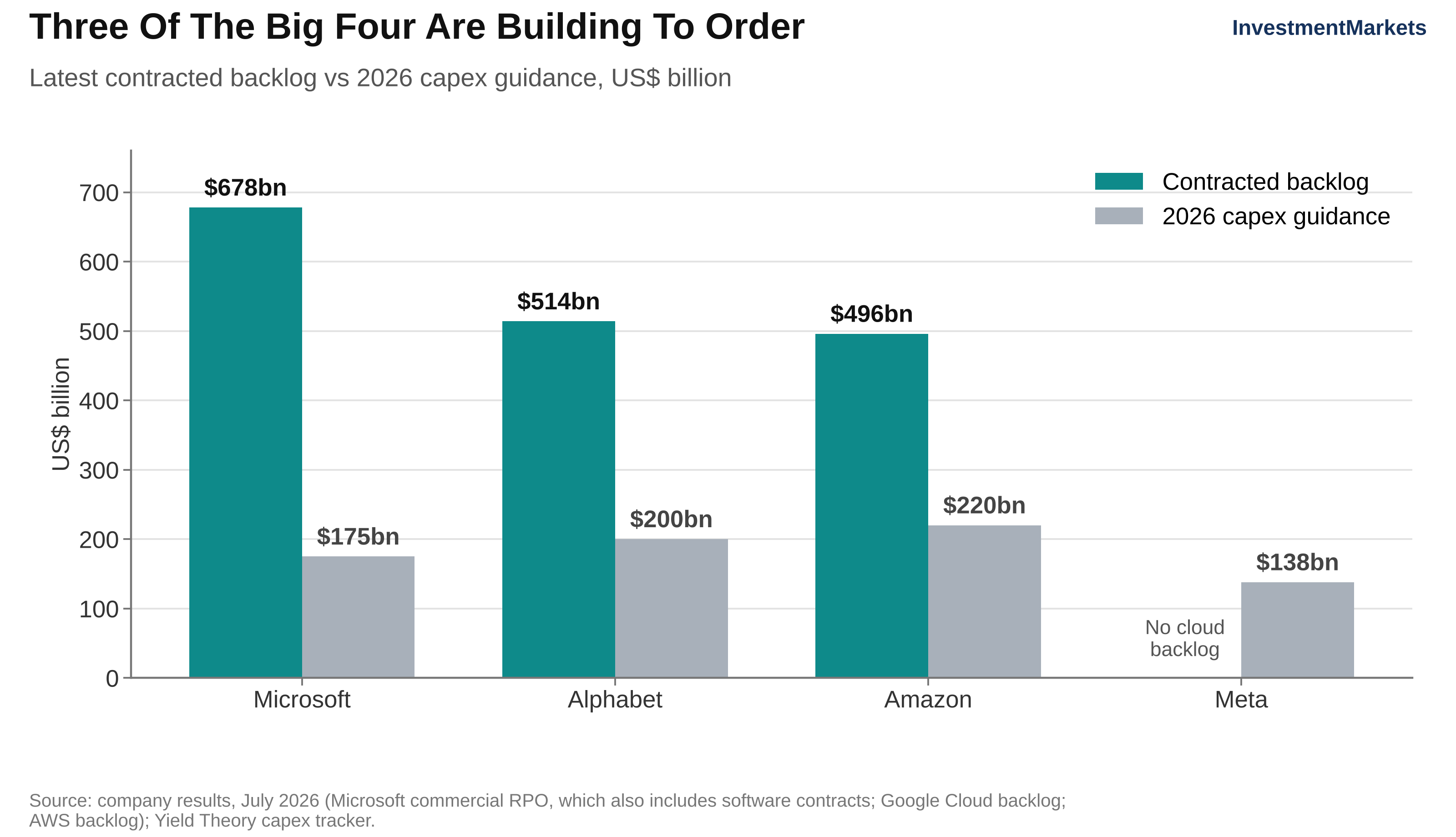
Amazon Web Services (AWS) ended June with a contracted backlog of US$496 billion, more than double the US$244 billion it reported at the end of 2025, and more than double the US$220 billion Amazon expects to spend across its entire business this year.
AWS’s contracted backlog versus Amazon’s 2026 capex guidance. Source details shown on chart.
Much of that order book comes from multi-year, multi-gigawatt commitments.
OpenAI will take some 2 gigawatts of capacity running on Amazon’s own Trainium chips from 2027, while Anthropic has committed to up to 5 gigawatts as part of a deal worth more than US$100 billion. Revenue commitments for Trainium alone exceed US$225 billion.
Chief executive Andy Jassy told analysts in July that Amazon ‘will still not have enough capacity to meet all the demand we have in 2026’, and that the lion’s share of its 2027 capacity is already reserved.
Even the US$20 billion lift in this year’s capex guidance, from US$200 billion, reflected higher memory chip prices rather than a speculative expansion of capacity.
In other words, much of Amazon’s AI spending has been de-risked because its customers have already signed.
Higher growth and returns are already showing up.
AWS revenue grew 37% to US$42.2 billion in the June quarter, its fastest growth in more than four years, at an operating margin of 39%.
The economics of the build also look sound, with one caveat.
The data centre shells and power connections Amazon is paying for can last 30 years or more, and new capacity typically starts earning revenue within 6 to 24 months. However, the chips and servers inside, which account for most of the spending, are typically depreciated over just five or six years, so those returns need to arrive faster.
Microsoft & Alphabet Have Solid Order Books Too
Amazon is not alone in de-risking its AI capex.
Microsoft’s commercial remaining performance obligation, the value of contracted revenue it has yet to recognise, reached US$678 billion at the end of June. That’s up 84% on a year earlier and almost four times its US$175 billion capex plan for 2026, although that figure also includes software contracts, not just cloud capacity.
Alphabet’s Google Cloud is also benefiting from a booming backlog.
That backlog hit US$514 billion, two and a half times the US$195–205 billion the company expects to spend this year, while Google Cloud revenue rose 82% to US$24.8 billion in the June quarter, at an operating margin of 35.6%.
Contracted backlog versus 2026 capex guidance. Microsoft’s figure includes software contracts. Source details shown on chart.
Not All AI Capex Is Created Equal
Whether or not revenue is pre-committed is a big deal at this juncture.
Meta, for example, has no cloud business renting capacity to outside customers, so its US$130–145 billion capex budget relies on AI generating returns from its own advertising platforms.
That may well happen, but it’s a forecast rather than a contract.
Equally, those with pre-committed revenues aren’t totally immune to a downturn.
A large slice of their backlog is concentrated in a handful of AI developers, including OpenAI and Anthropic, and a contract is only as good as the customer behind it.
But a company spending against signed, multi-year contracts at operating margins approaching 40% is a very different proposition from a 1990s carrier speculatively laying fibre.
Hence, for shareholders in Amazon, Microsoft and Alphabet, the capital being deployed looks more like disciplined investment to meet demand that is already in hand than a speculative punt.
Subscribe to InvestmentMarkets for weekly investment insights and opportunities and get content like this straight into your inbox.
For starters, most Australian investors own more AI exposure than they realise.
The top five holdings of the Vanguard MSCI Index International Shares ETF (VGS), namely Nvidia, Apple, Microsoft, Amazon and Alphabet, are all closely tied to the AI build-out, and together make up a combined 19.5% of the fund. Because Alphabet’s second share class is held separately, the true weighting to these five companies is higher still.
Top five holdings of the Vanguard MSCI Index International Shares ETF (VGS). Source details shown on chart.
Similar concentration runs through most global funds and ETFs, and AI exposure now extends beyond shares: into credit portfolios through hyperscaler bonds, and into infrastructure through data centre landlords and power utilities.
So, what to do?
Navigating The AI Boom To Your Advantage
Start by adding up your look-through exposure to the AI rollout across your super, ETFs and funds.
Next, decide whether that exposure is deliberate or not.
Listed infrastructure adds regulated, inflation-linked income, though utilities supplying data centres carry some AI sensitivity of their own.
Rebalancing to sensible target weights across less correlated asset classes doesn’t require picking the top of the market. It just requires an unemotional commitment to your long-term investment plan.
Finally, remember the signals history has taught us to watch out for: rising debt funding, suppliers financing their own customers, falling returns on capital and the first capex guidance cuts.
Back The Technology, Respect The Cycle
This remarkable AI build-out fits the historical template of past capex booms too closely to be ignored, even if its strongest spenders are building on much firmer foundations than their predecessors.
History shows that busts tend to arrive later than sceptics expect, and that the infrastructure left behind often proves to be very valuable.
Hence, the optimal investment response probably sits somewhere between euphoria and panic.
In short, know how much AI you own, be clear about why you own it, and hold enough in assets that don’t depend on hyperscaler capex to sleep through a correction.
As Warren Buffett observed, ‘If past history was all there was to the game, the richest people would be librarians.’
No one knows what’s coming. A portfolio built to thrive in multiple potential scenarios is one built to last.
Frequently Asked Questions
Is The AI Boom A Bubble?
Spending and concentration resemble past bubbles, but today’s leaders are far more profitable than the telecom carriers of 1999. The likelier risk is an ‘industrial bubble’, where the technology succeeds but late investors lose money. Unlike the fibre carriers, Amazon, Microsoft and Alphabet are also building largely against signed customer contracts.
How Big Is AI Capex Compared With The Dotcom Era?
Apollo estimates AI capex will reach 3.1% of US GDP in 2027, against a telecom peak of about 1.2% in 2000.
How Much AI Exposure Does A Typical Australian Investor Have?
More than most assume, because broad global ETFs and growth super options hold large weights in the same few AI leaders.
What Would Signal The End Of The AI Capex Boom?
Heavier debt funding, weaker returns on capital and capex guidance cuts. Share prices have typically peaked before spending slowed.
Vanguard MSCI Index International Shares ETF seeks to track the return of the MSCI World ex-Australia (with net dividends reinvested), in Australian dollars Index, before taking into account fees, expenses and tax.
The Global X Artificial Intelligence ETF (GXAI) seeks to invest in companies that potentially stand to benefit from the further development and utilisation of artificial intelligence (AI) technology.
The Global X Artificial Intelligence Infrastructure ETF (AINF) offers targeted exposure to the physical and operational backbone enabling AI’s global expansion.
Disclaimer: This article is prepared by Simon Turner. It is for educational purposes only. While all reasonable care has been taken by the author in the preparation of this information, the author and InvestmentMarkets (Aust) Pty. Ltd. as publisher take no responsibility for any actions taken based on information contained herein or for any errors or omissions within it. Interested parties should seek independent professional advice prior to acting on any information presented. Please note past performance is not a reliable indicator of future performance.
Simon Turner is an ex-fund manager with 20 years investing experience gained at Bluecrest, Kempen and Singer & Friedlander who now writes educational content about investing and sustainability. He's also the published author of The Connection Game and Secrets of a River Swimmer.
Within a month or so, what may be the largest listing in stock market history is expected to list on the Nasdaq. Anthropic, the company behind the Claude family of AI models, is heading for public markets at a valuation up to US$2 trillion.
AI has quickly established an integral role in fund managers’ investment processes. For most, it has already become an integral part of their investing machinery. Fund managers are using it to read more, screen faster, test risks earlier and monitor their portfolios across larger pools of data.
Most of us have seen ourselves as stock pickers extraordinaire at some point in our investing journeys. The idea of investing in stocks is exciting, seductive even. After all, all you need to do is press buy and sell online and you could make yourself a fortune.
Investment decisions tend to attract attention when they involve buying something. Deciding against an investment is less conspicuous. A well-reasoned “no” rarely provides much material for the fund highlights.






-biy2kjxbgtb4uoevomc0.png)
-5pmpvmd2nrv3novymh6d.png)
-vke5r81en85n0lawxvqo.png)
-uo4eg7ge0ysewqkveu92.png)
-qn47nb2t9h7iuvyq9ohf.png)
-01xhfy3zxeb8rav1zavf.png)