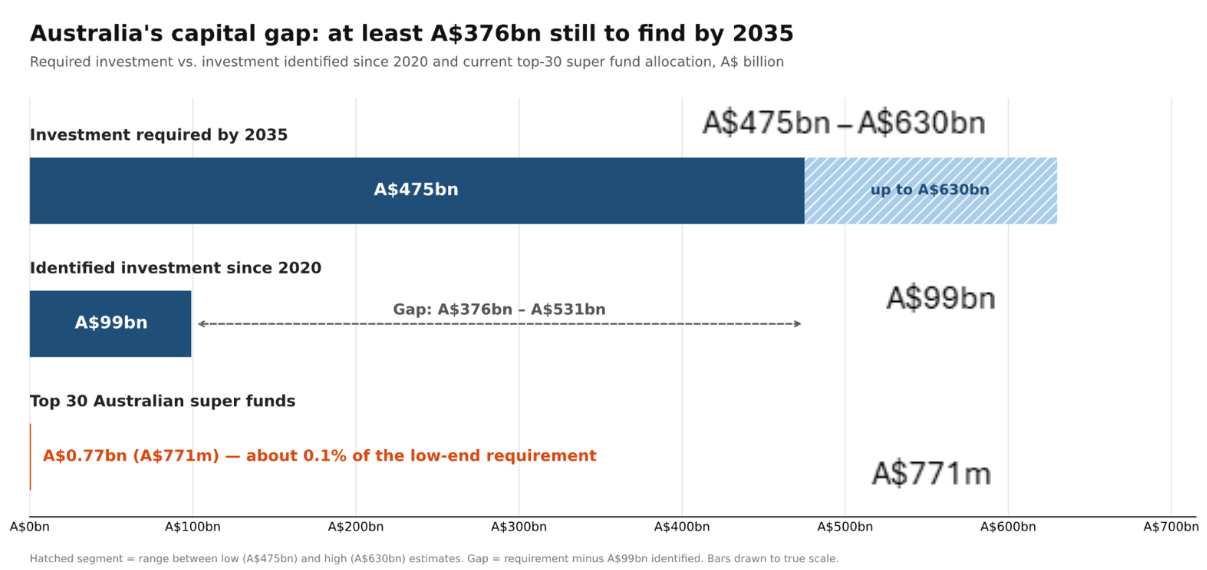
Australia’s environmental transition is becoming one of the country’s largest long-term investment programmes. Boston Consulting Group analysis cited by Climate Change Authority Chair Matt Kean estimates that meeting Australia’s 2035 ambition requires A$475–630 billion over the coming decade, roughly A$1 billion a week. Yet the central challenge is not simply raising capital. As the Investor Group on Climate Change (IGCC) has observed, Australia has substantial pools of savings, including more than A$4.5 trillion in superannuation assets. The challenge is converting that capital into projects offering appropriate risk-adjusted returns.
The need for investment is already visible in the electricity system. The Australian Energy Market Operator’s (AEMO) final 2026 Integrated System Plan identifies renewable generation, storage, transmission and distribution, supported by flexible gas, as the least-cost pathway as coal retires and electricity consumption approaches twice today’s level. Meanwhile, the National Electricity Market (NEM) connections pipeline has expanded 42% in a year to 75.4 GW, with a record 9.1 GW reaching full output in FY26.
For investors, these developments point to a structural opportunity rather than a passing investment theme. Ageing assets must be replaced, demand is expanding and public policy is supporting the transition. But scale alone does not guarantee returns. The opportunity lies in identifying assets that can translate this investment requirement into sustainable cashflows at an appropriate price.
*Note: the NEM includes most of Australia except WA and NT.
A large capital requirement, but limited investable supply
Australia has committed to reducing emissions 62–70% below 2005 levels by 2035. Current-policy projections, however, indicate a reduction of only 48% by that year and cumulative emissions in 2031–35 that exceed the target budget by 20–34%. Electricity is an immediate focus: policy is targeting 82% on-grid renewable generation by 2030, supported by the Capacity Investment Scheme, Rewiring the Nation, Renewable Energy Transformation Agreements and household batteries.
The domestic task is unfolding within a global shift in energy investment. The International Energy Agency (IEA) expects US$3.4 trillion of energy investment in 2026, including US$2.2 trillion in clean energy, almost twice the amount directed to fossil fuels. Its Global Energy Review 2026 records roughly 800 GW of renewable capacity added in 2025, with battery-storage additions increasing around 40%. Australia is competing for investment capital within this much larger market.
Despite the scale of the opportunity, identifiable direct investment by Australia’s largest superannuation funds in local renewable and battery projects remains modest. Market Forces identified A$99 billion of investment activity across 514 projects since 2020, but only A$771 million, or 0.8%, of identifiable direct project investment came from the 30 largest Australian super funds. More than 96% of that super fund capital went towards acquisitions rather than financing new construction. This is a measure of direct participation in the projects examined, not of super funds’ total exposure to the transition.
Explore 100's of investment opportunities and find your next hidden gem!
Search and compare a purposely broad range of investments and connect directly with product issuers.
Sources: IGCC, State of Net Zero Investment 2026; Market Forces, Passing the Buck. The historical investment figures are not a measure of the remaining funding gap.
These figures describe different things and should not be subtracted from one another. The A$475–630 billion estimate concerns the economy-wide transition requirement, while the A$99 billion figure covers a specific historical dataset of renewable generation and storage transactions. The comparison nevertheless illustrates the distance between the scale of investment required and identifiable direct participation by major domestic institutions. The issue is not merely whether capital exists, but whether it can reach suitable projects. That raises a practical question for investors: where are the opportunities worth financing?
Where the investment opportunities extend beyond electricity
Renewable generation, storage and transmission are central to the transition, but they are far from the whole investable universe. A diversified environmental portfolio can also draw on assets and businesses addressing resource efficiency, industrial emissions, transport, waste, water and natural capital.
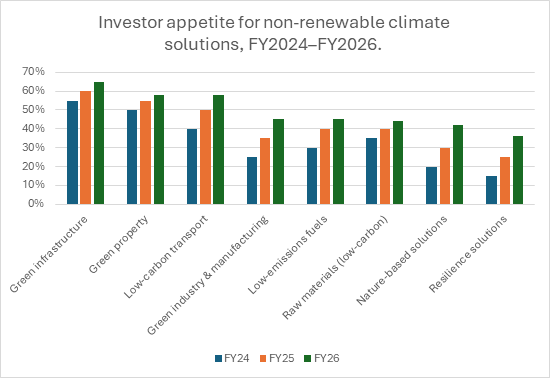
IGCC’s 2026 investor survey shows interest extending beyond clean electricity into green infrastructure, property, low-carbon transport, green industry, low-emissions fuels, raw materials, nature-based solutions and resilience. The breadth of that interest is significant, but investor appetite is not evidence that every sector will deliver attractive returns.
Data source: IGCC, State of Net Zero Investment 2026, Figure 12 (simplified by category).
The Clean Energy Finance Corporation’s (CEFC) remit reflects a similarly broad landscape, spanning transport, property, infrastructure, industry, natural capital and climate technology. For EnviroInvest, this breadth creates a larger opportunity set, not a reason to invest indiscriminately. The critical distinction is between an attractive environmental theme and an investment capable of producing durable cashflows.
In energy, that means favouring assets with strong grid positions, credible counterparties and contracted or diversified revenues. Battery storage can generate revenue from several services, but its economics must be assessed against merchant electricity prices, degradation and technology risk. Capacity alone tells investors little about profitability.
Transmission and essential networks may offer more infrastructure-like cashflows. Industrial electrification and decarbonisation can also benefit from lower operating costs and tightening Safeguard Mechanism baselines, which generally decline by 4.9% annually to 2030 for covered facilities. In each case, the opportunity depends on the economics of the individual project, not simply the policy direction.
The same investment discipline applies outside electricity. Circular-economy and resource-recovery businesses may generate revenue through gate fees, recovered materials and long-term service contracts. Australia’s 2026 Circular Economy Roadmap, with its emphasis on greater reuse and 80% resource recovery, provides a supportive backdrop, but contract quality and commodity-price exposure remain important.
Waste and methane-abatement projects can combine essential-service income with emissions reductions. Water recycling, treatment and efficiency infrastructure may offer defensive characteristics where demand is supported by population growth, industrial use and climate resilience. In transport, fleet-backed charging infrastructure can present a different risk profile from public charging networks that depend on uncertain utilisation.
Natural capital, carbon and biodiversity markets broaden the universe again. Australia’s ACCU Scheme operates within a regulated carbon market, and the Nature Repair Market provides a legislated framework for biodiversity projects and certificates. These investments demand careful assessment of credit integrity, permanence, methodology, liquidity and policy exposure. Environmental benefits do not remove financial or execution risks.
At the higher-growth end of the spectrum, environmental technologies may offer significant upside alongside greater commercialisation, valuation and technology risks. At the more defensive end, green and project debt can provide exposure to similar underlying themes with a different return and risk profile. Together, these options allow investors to consider not only which sectors to own, but how to access them.
Turning a broad opportunity into a diversified portfolio
The environmental need is urgent, but urgency alone is not an investment case. How capital is deployed is as important as the amount committed.
Our approach is to build exposure across different stages and risk profiles. Operating infrastructure can provide a foundation of established cashflows; construction and late-development assets may offer additional returns where risks can be measured and appropriately priced. Project and green debt can contribute income-oriented exposure, while smaller allocations to emerging grid and industrial technologies provide selective growth potential. Due diligence must extend beyond headline capacity to developer experience, grid connections, curtailment, power purchase agreements (PPAs), counterparty strength and stress-tested construction costs.
The central investment case is therefore more specific than a broad conviction that the energy transition will continue. Australia faces a substantial requirement to replace and expand essential infrastructure, while the evidence presented here points to limited identifiable direct project participation from its largest superannuation funds. For investors, this combination makes access, project selection and portfolio construction particularly important.
Waiting until every policy question is settled and every project is operating may reduce some uncertainties, but it may also mean entering after development risks have been resolved and reflected in valuations. Conversely, investing too early or without sufficient scrutiny can destroy capital. The opportunity is not to pursue the transition at any price. It is to provide capital to suitable assets, at the right stage and on terms that adequately compensate investors for the risks assumed.
Disclaimer: This article is prepared by Simon Turner. It is for educational purposes only. While all reasonable care has been taken by the author in the preparation of this information, the author and InvestmentMarkets (Aust) Pty. Ltd. as publisher take no responsibility for any actions taken based on information contained herein or for any errors or omissions within it. Interested parties should seek independent professional advice prior to acting on any information presented. Please note past performance is not a reliable indicator of future performance.
Investment expert specialising in future focused investing, equities analysis, funds management, entrepreneurship, FinTech, market educator, public speaking, media, business development and thought leadership.
Sustainable investing has been through plenty of challenges of late. After a string of political and social backlashes, the return of a US president who appears to be opposed to creating a more sustainable future, a rise in greenwashing cases and a challenging period of relative performance, sustainable investing has become more demanding and, arguably, more useful.
Most investors tend to think of systemic risk as something that arrives with a bang, like a banking crisis, a pandemic, or a war. Increasingly, the more realistic systemic dangers are slower to gauge and harder to price. They are an ominous set of interconnected and interacting stresses that have the potential to degrade the very conditions required for markets to compound at all.
For a growing number of investors, what they own in their portfolios is as important as the returns they generate. Or, at least it’s a much more important consideration for them than it used to be. As a result, the various forms of responsible and value-driven investment have been transitioning from niche to mainstream for some time now. The Responsible Investment Association Australasia (RIAA) estimates that Australian responsible investment assets reached $1.6 trillion in 2023, and accounted for 41% of total managed funds assets.
Most of us have seen ourselves as stock pickers extraordinaire at some point in our investing journeys. The idea of investing in stocks is exciting, seductive even. After all, all you need to do is press buy and sell online and you could make yourself a fortune.

-zpjeccpxe33g6pvf8k4p.png)
-f8oa4fq9aif5m8wvehra.png)
-i6maal4mcg1cpy7514v2.png)

-drhkgsdwk8x3oqxim0go.png)
-uo4eg7ge0ysewqkveu92.png)
-qn47nb2t9h7iuvyq9ohf.png)