The AI Inflection Point: What It Means for Investors

Simon Turner
Sun 1 Mar 2026 8 minutesHow many times have you heard people talk down AI’s role in the future of humanity? We’ve all heard the feedback: ‘It’s unreliable’, ‘It will never replace humans for anything but low-value jobs,’ and ‘It’s all a flash in the pan.’ But what if these excuses are simply defensive responses because the truth is too earth-shattering to accept: the productivity promise of AI is already real.
The ramifications for investing and all areas of life are hard to overstate.
The Inflection Point
Everyone reaches the ‘AI promise is real’ inflection point in their own time. For some, it arrives with a dramatic demonstration. For others, it’s when a meaningful share of their workload moves from being assisted by AI to being substituted by it.
What makes the current phase distinctive is that this shift is no longer anecdotal. It’s becoming measurable, repeatable, and visible across three domains investors and decision-makers can’t ignore: capability metrics, workplace adoption, and capital allocation.
In other words, AI has officially landed.
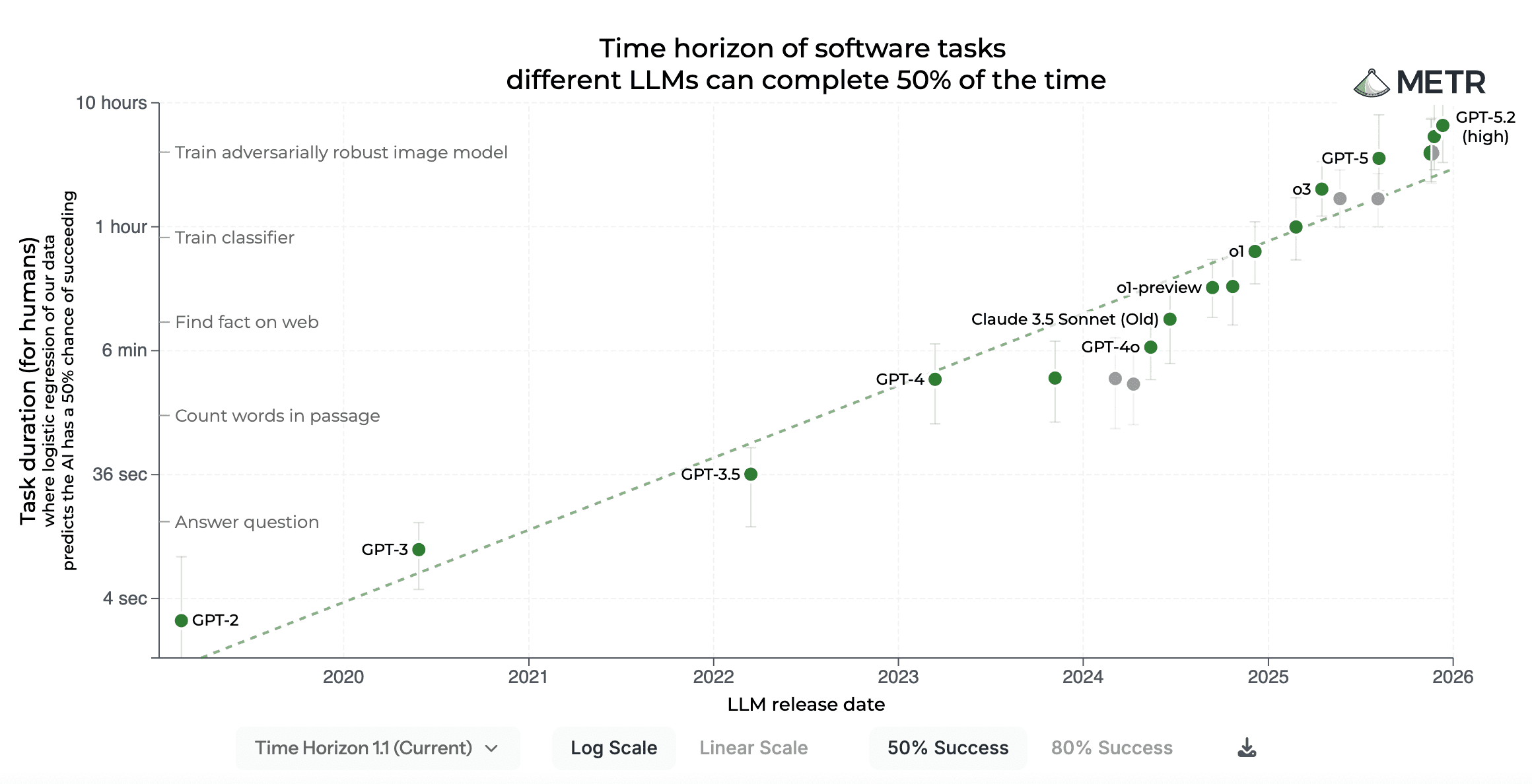
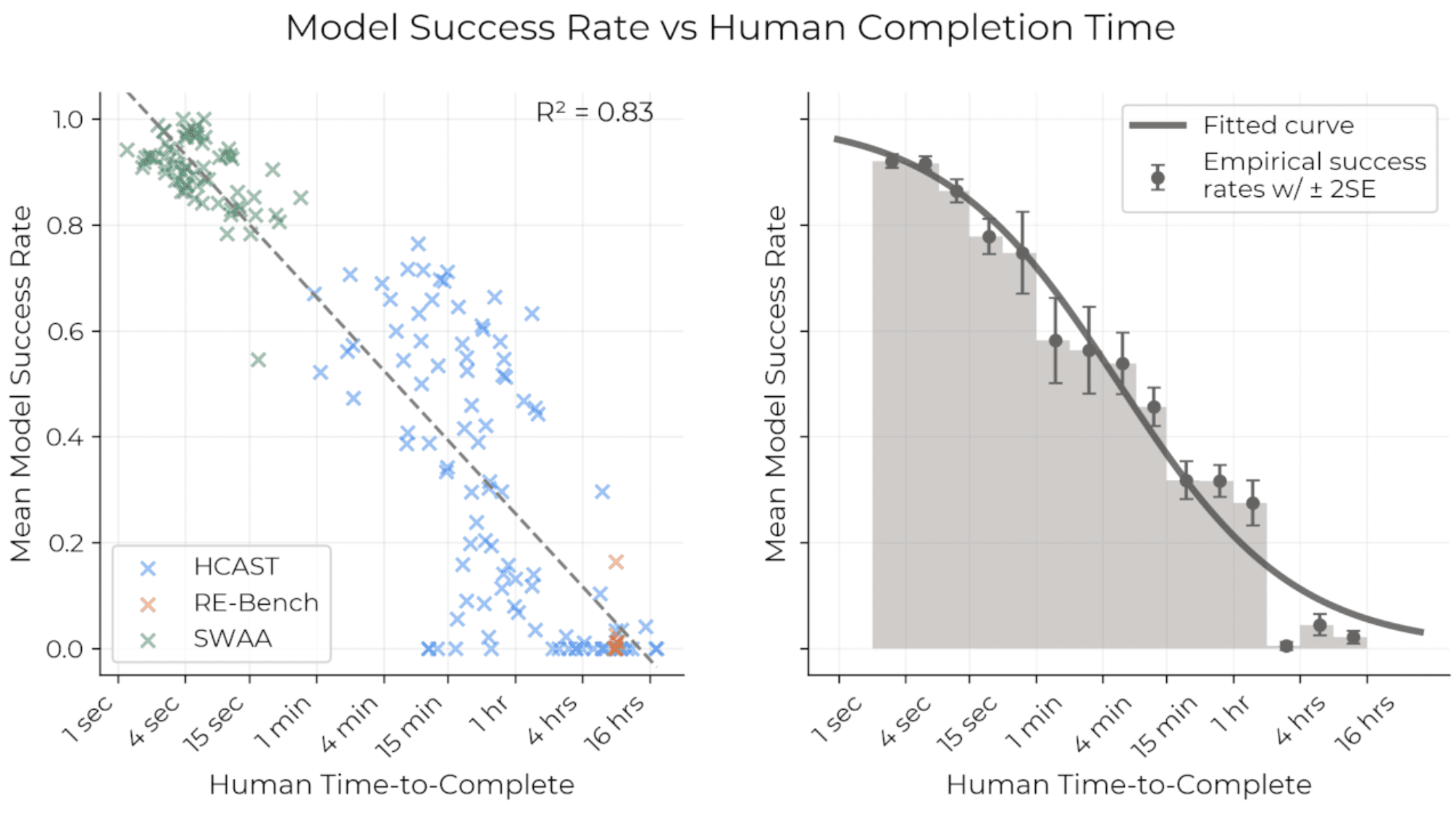
In March 2025, METR reported that AI ‘time horizons’, the length of tasks a model can complete end-to-end without human intervention, was increasing exponentially, with a doubling time of roughly seven months. More recent data has confirmed this evolution.
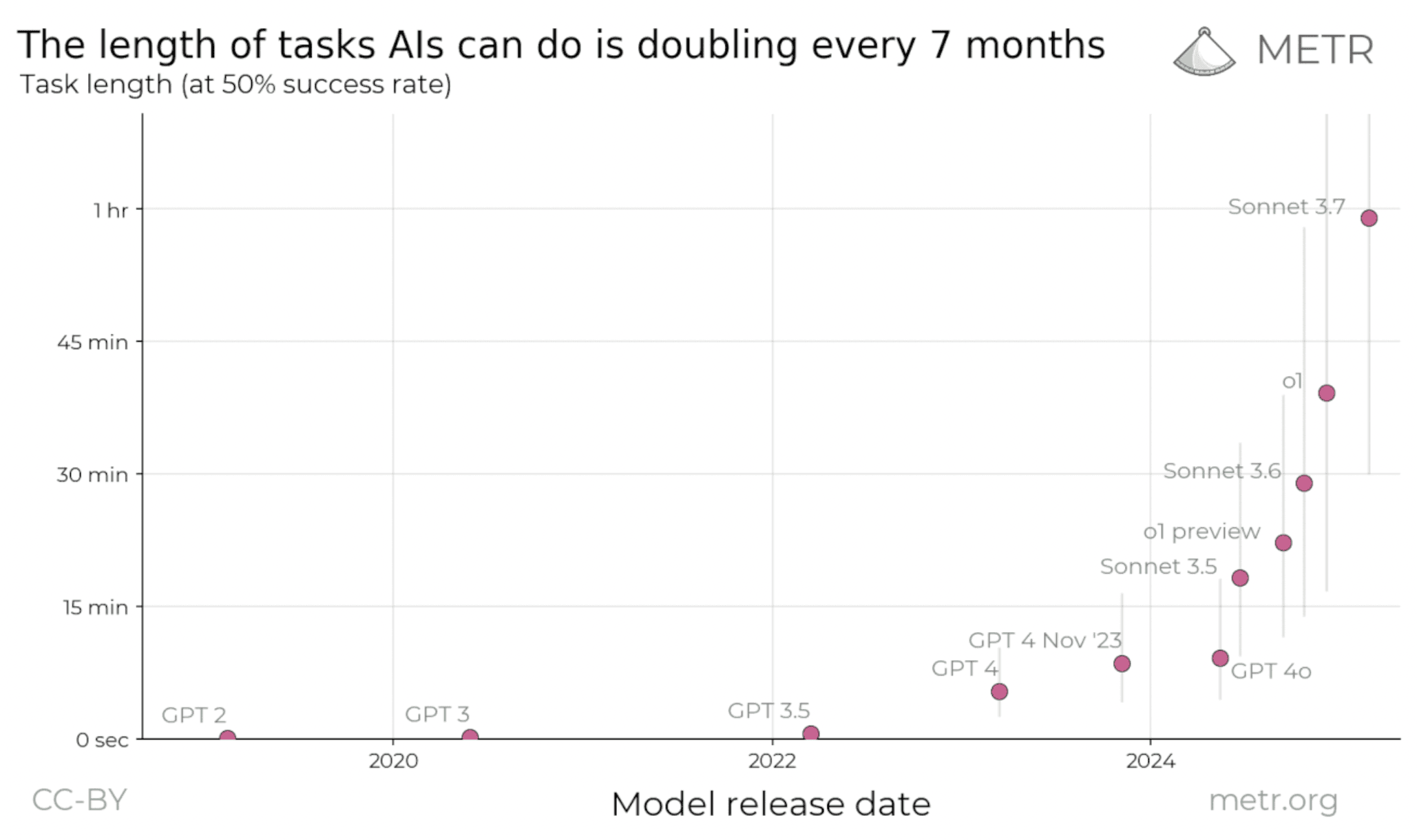
This matters because longer horizons don’t just mean better answers; they mean autonomous execution of entire workflows. Once that threshold is crossed, the economic question shifts from whether AI can do the work to how fast organisations restructure around it.
At the same time, adoption has moved decisively from experimentation to routine use. So this is no longer edge behaviour. AI usage has evolved into mainstream workplace tooling, which is spreading unevenly but persistently across sectors.
The primary reason for AI’s arrival in the mainstream is indisputable for most users: productivity gains. Particularly for shorter tasks, AI is already saving most workers valuable time.
The numbers are hard to argue with, even if they are out of date given how fast AI is improving. Field experiments in customer support show output gains of around 14%, with far larger improvements for less experienced workers. Separate studies on writing tasks report time savings of 40% alongside measurable quality improvements.
These aren’t marginal conveniences. At scale, they affect margins, hiring needs, training costs, and competitive dynamics.
What’s most striking right now, however, is the gap between the majority’s perception of AI’s capabilities and the reality.
Public understanding still frames AI as a clever assistant, while its capabilities are already crossing into substitutive territory.
That gap is where mispriced assets, delayed strategies, and organisational risk tend to accumulate, and where the true inflection point will assert itself.
Explore 100's of investment opportunities and find your next hidden gem!
Search and compare a purposely broad range of investments and connect directly with product issuers.
The Investment Implications
It has to be highlighted that this is a fast-moving feast of change. A few short months ago, the investment implications were very different from today, and that will also be the case in a few months, or weeks.
Here are a few recent implications worthy of investor awareness:
- Bullish for AI picks and shovels
The picks and shovels of AI are obvious short- and long-term winners.
That includes semiconductors, networking, power, data centres, and cloud platforms.
For example, Nvidia’s revenue rose an impressive 114% in 2025 to $US130.5 billion as demand for the chips required by reasoning AI allowed the company’s scaling rate to escalate further.
Tech-focused ETFs and funds such as the Global X Morningstar Global Technology ETF (ASX: TECH) provide exposure to this thematic, whilst most global ETFs and funds have solid exposure to it by virtue of the large weightings held by US large-cap technology stocks.
- The global economy is set to change beyond recognition
As mentioned above, the productivity promise of AI is already real. Moreover, the accelerating pace of improvement suggests it’s hard for most people to imagine how much more is yet to come.
One thing is for sure: we are facing likely mass productivity improvements on a scale that would have been incomprehensible before AI’s recent advances.
The timing of these productivity benefits is harder to fathom, as is their impact on global unemployment.
The IMF has argued that AI will affect almost 40% of jobs around the world, and has warned that the gains will not automatically be shared evenly.
That’s clearly change on a scale the world has never seen before, so the pathway forward is likely to be anything but smooth.
Along the way, there will be winners and losers as the world’s wealth is effectively redistributed to those who benefit most. Inequality is likely to rise significantly.
Defining the winners and losers will become one of the main goals of investors.
Even for the winners, the pathway from AI mastery to aggregate earnings growth will need to transition through organisational redesign, regulation, competitive intensity, and labour bargaining power.
So markets are likely to keep swinging between exuberance and scepticism, even when the earnings upside from AI is real.
- At a process level, AI can help investors dramatically improve their investment plans
It starts with treating AI as an amplifier of your investment process.
Use it to clarify your goals, stress test scenarios, and reduce unforced errors.
For example, you can ask AI to translate your superannuation strategy into plain English, model the trade-offs between concessional contributions and investing outside super, or draft a rules-based rebalancing plan that helps prevent emotion-driven decisions.
AI isn’t an investment oracle, but it can help you interrogate your assumptions, generate counterarguments, and surface missing questions. The result is likely to be a more robust investment plan.
- Best-in-class financial coaching just became available for everyone
Many households leak returns through poor cash flow management, duplicated subscriptions, insurance mismatches, and neglected tax administration.
AI can help you categorise your spending, prepare checklists for EOFY documentation, summarise product disclosure statements, and draft questions for your accountant or adviser.
Having said that, the AI financial planning mantra should be ‘trust, then verify’. AI is excellent at assimilating information and applying it to real-world projects, but it does make mistakes. It also lacks valuable context. Only you know your personal history, what you’re like as a person, your goals, etc.
- AI’s artificiality offers game-changing advantages to investors trying to master their emotional biases
There’s extensive research confirming just how detrimental investors’ emotional biases can be.
For example, while running winners and cutting losers is core to many strategies that outperform over the long term, the disposition effect often sabotages investors’ best intentions by encouraging them to hold on to losers and sell winners too early. That’s often disastrous for long-term investment performance.
What if you could benefit from AI’s lack of human biases during your investment journey?
Thankfully, you can.
Prior to any investment decision, investors can use AI as a check-in tool.
Ask it whether your emotional biases may be driving the decision and how to counteract them.
Ask whether the investment case for a proposed fund or stock has fundamentally changed, or whether it is simply your interpretation of the narrative that has shifted.
Ask for the strongest arguments against your intended move.
Ask it to quantify how much of a proposed return depends on multiple expansion versus earnings growth.
Ask it to map what would need to be true for an AI-themed valuation to be justified.
If it can’t cite sources, make it do so, and then open and read them yourself.
This AI superpower is yet to be fully understood or utilised by the investment population at large, but it could prove to be one of the greatest advantages AI brings to investors.
- As the AI rollout accelerates, the arguments in favour of diversification are stronger than ever
While picking AI winners and losers is undeniably part of the game, it’s easier said than done. The pace of change is accelerating, meaning market evolutions that once took a decade may now play out over a year.
Investors will therefore have less time and less information to make sense of this rapidly evolving landscape.
Against this backdrop, accurately identifying winners and losers may be unrealistic for most individual investors.
There’s one solution that directly addresses this challenge: diversification.
We know corporate productivity is set to rise significantly. That’s likely to be bullish for the global economy and investment markets, at least until the costs of those changes become apparent.
Investors can participate in this evolution through core allocations to well-diversified global funds and ETFs.
Subscribe to InvestmentMarkets for weekly investment insights and opportunities and get content like this straight into your inbox.
When a Promise is Fulfilled
If the AI promise has just become real, as it appears to have done, it has done so in the same way electrification and the internet became real: not when the first demonstration impressed people, but when capability, adoption, and real investment began reinforcing each other.
Investment edge may now derive from building a repeatable process that uses AI to make you more consistent, more informed, and harder to panic.
Disclaimer: This article is prepared by Simon Turner. It is for educational purposes only. While all reasonable care has been taken by the author in the preparation of this information, the author and InvestmentMarkets (Aust) Pty. Ltd. as publisher take no responsibility for any actions taken based on information contained herein or for any errors or omissions within it. Interested parties should seek independent professional advice prior to acting on any information presented. Please note past performance is not a reliable indicator of future performance.

Simon Turner is an ex-fund manager with 20 years investing experience gained at Bluecrest, Kempen and Singer & Friedlander who now writes educational content about investing and sustainability. He's also the published author of The Connection Game and Secrets of a River Swimmer.