-biy2kjxbgtb4uoevomc0.png)
Beyond the Magnificent Seven: Turning Schroders’ Equity Lens into a Money-Making Strategy
Australian investors have spent three years facing an expensive global equity market, and a local one too concentrated in banks and miners to share fully in the technology boom.
This year has muddied the waters further, with markets shifting shape beneath familiar headlines. Schroders’ latest Equity Lens helps make sense of it all.
Key Takeaways
- Big tech is spending more than ever on AI, yet many hyperscalers trade near their cheapest valuations in a decade, so selectivity beats blanket exposure.
- Market leadership has broadened to include value, small caps, Japan, Europe and emerging markets, but US-heavy global index funds haven’t kept pace.
- Earnings, not rising multiples, are driving 2026 returns, although headline emerging market forecasts lean heavily on a few Asian chipmakers.
- Valuations are stretched in aggregate, with relative value in small caps, healthcare, consumer staples and non-US markets.
- Value, quality and low-volatility strategies may help hedge against stagflation, but check the holdings, as many carry more tech than their labels suggest.
What Schroders’ Equity Lens Says
The most recent Schroders’ Equity Lens makes five interesting arguments worth unpacking.
1. The hyperscaler story remains on track, although valuations are lower.
Big tech’s earnings growth remains strong, and its capital expenditure keeps rising.

Source: Schroders
The numbers are extraordinary.
Consensus forecasts have Amazon, Alphabet, Microsoft and Meta spending US$650 billion in 2026, close to seven times their 2020 outlay.
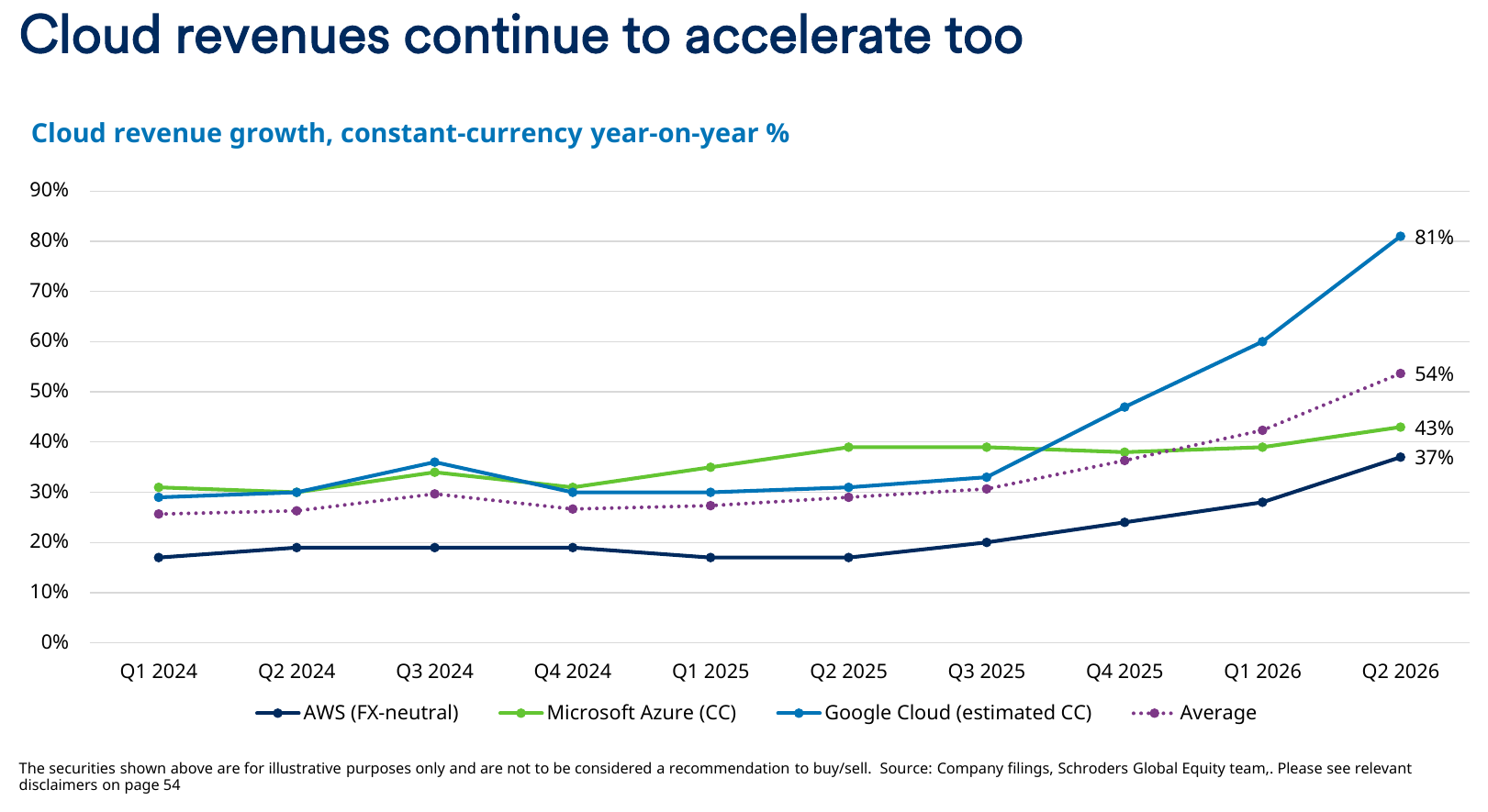
Thus far, demand is keeping pace, with cloud revenue growth averaging 54% in the June quarter.
Source: Schroders
The catch is free cash flow.
Capex is outpacing operating cash flow, roughly halving free cash flow at Microsoft, Amazon and Alphabet from their peaks.

Source: Schroders
What’s changed is the price the market is willing to pay for big tech.

Source: Schroders
‘Valuations for many big tech companies are at or near their cheapest for a decade.’ Schroders
The Magnificent Seven have also stopped moving as a pack.
Amazon returned 18% in the seven months to July while Tesla fell 31%, leaving the group trailing US large caps in general.
-c3ltzs39l2z8mx0gp2u7.png?_a=BAMAAAhM0)
Source: Schroders
Takeaway: This may well be an opportunity in the making. Big tech remains a foundational global growth driver trading at historically attractive prices, but the dispersion rewards selectivity. For Australian investors, a considered global tech allocation is worth revisiting.
Where to Fish for Opportunities:
- Global technology funds, to back the likely AI winners.
- Global technology ETFs, for low-cost sector exposure to the opportunity.
- Technology and AI investments, across the AI value chain.
- Thematic ETFs, including semiconductor strategies.
Explore 100's of investment opportunities and find your next hidden gem!
Search and compare a purposely broad range of investments and connect directly with product issuers.
2. Global leadership has broadened.
A global broadening is bullish, since a broad market stands on firmer footing than one reliant on a few mega caps.

Source: Schroders
Value is beating growth, small caps are beating large caps, and emerging markets (20%) and Japan (17%) have left US large caps (10%) behind this year. Nor is this a one-year wonder, with the US finishing last of the major regions in 2025.

Source: Schroders
Outside the US, value has outperformed growth for years, particularly since 2021.

Source: Schroders
The catch is that EM gains have been historically narrow. Only one in five EM stocks has beaten the index in 2026, with TSMC, Samsung and SK Hynix doing much of the heavy lifting.

Source: Schroders
Takeaway: Broadening global leadership is healthy, although US-dominated MSCI World trackers haven’t kept pace. Adding Japan, Europe, emerging markets and value has helped investors’ portfolios, and is likely to continue doing so.
Where to Fish for Opportunities:
- Emerging markets equity funds, to reach beyond the index heavyweights.
- Emerging markets ETFs, across broad, regional and single-country options.
- Japanese equity funds and ETFs, for exposure to a standout major market.
- European equity funds and ETFs, 2025’s strongest region.
- Value funds and ETFs, this year’s leading style.
3. Global earnings expectations remain high.
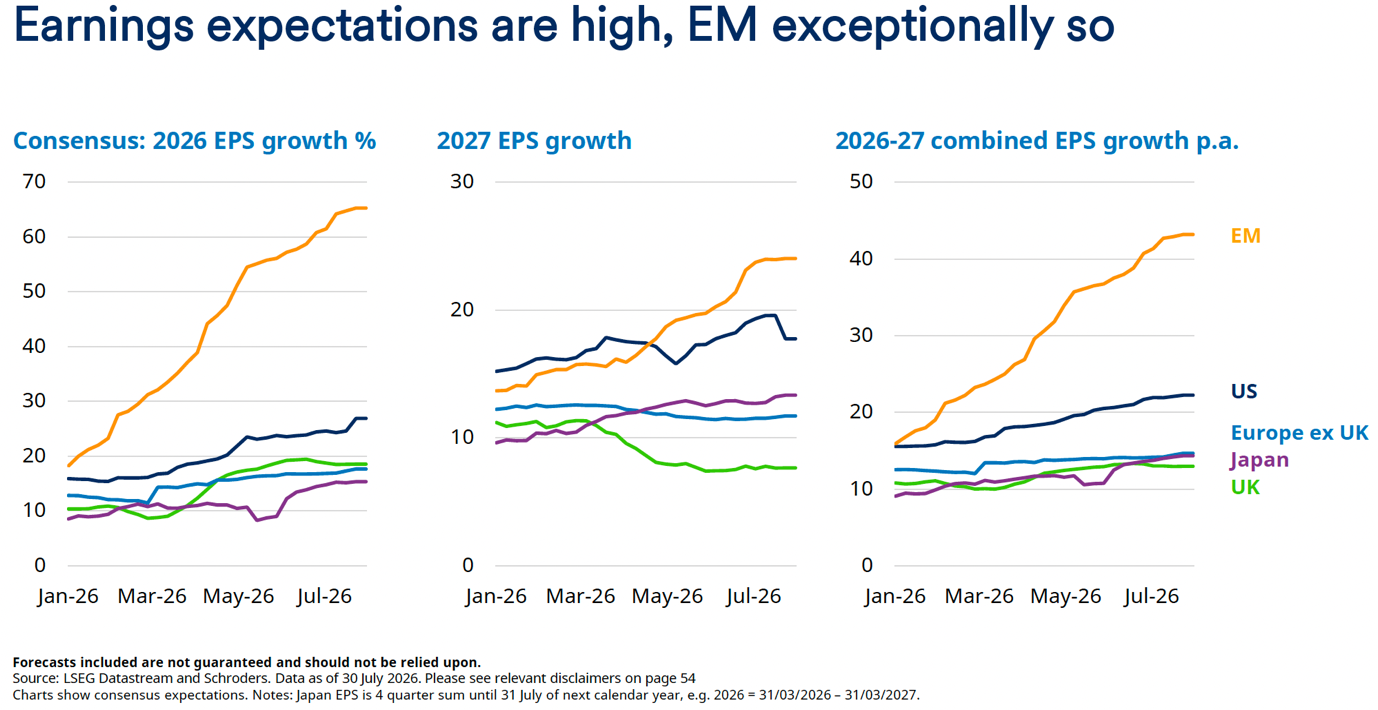
Emerging market (EM) expectations are particularly high.
Source: Schroders
EMs’ forecast 2026 earnings growth has leapt from below 20% in January to 65%.
Importantly, earnings rather than valuations are driving returns, with multiples contracting in the US, the UK and EMs.

Source: Schroders
That’s a far healthier foundation for global markets.
To that point, analysts are upgrading more forecasts than they are downgrading.

Source: Schroders
Headline figures can be misleading, though.
The US index is forecast to grow earnings by 21% over the next year, while the median US company’s earnings are expected to grow by 12%, not far from Europe, the UK and Japan.

Source: Schroders
Takeaway: Earnings growth is the engine of this market, but the boldest forecasts rest on a few companies. EM forecasts are tied to the chip cycle and could fall as fast as they rose, so check how much of your fund’s growth comes from its top holdings. Meanwhile, comparable growth is available outside the US at a lower price.
Where to Fish for Opportunities:
- Asian and emerging markets funds and ETFs, where momentum is strongest.
- Active ETFs, to hunt beyond the index giants.
- Global large-cap funds, for established earnings power.
- Global equity funds, to compare manager positioning.
4. Aggregate valuations remain elevated, even after the mega caps have cheapened.
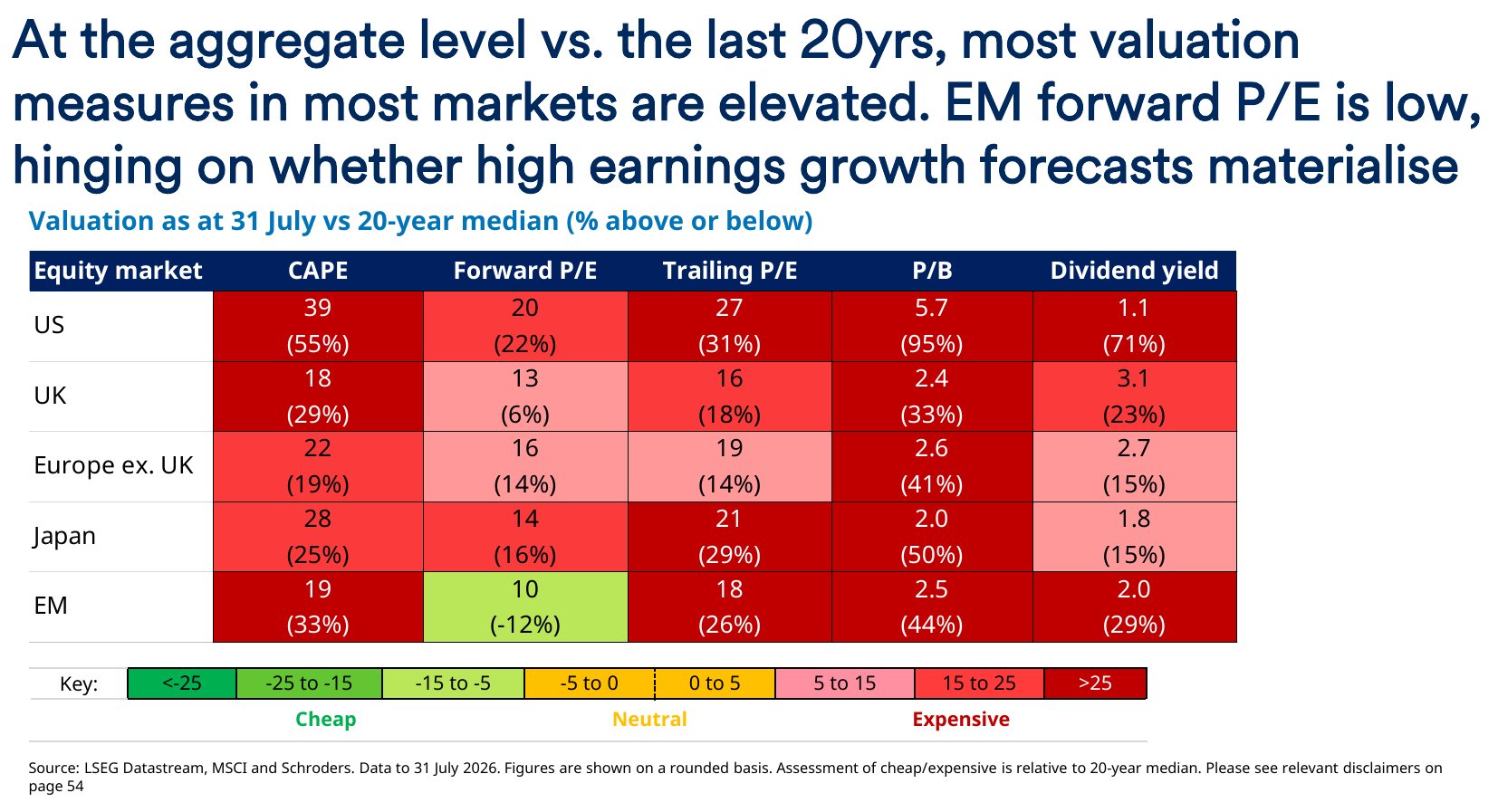
Against 20-year medians, almost every major market looks expensive right now, the US most of all. Its cyclically adjusted P/E (CAPE) of 39 is 55% above its median and roughly double that of the rest of the world.
Source: Schroders
EMs look cheap on forward earnings, but are 26% dearer than usual on trailing earnings.
-r5vennzj8yx2vemvaxv5.png?_a=BAMAAAhM0)
Source: Schroders
Look beneath the aggregates, though, and there is relative value on offer. US small caps trade 10% below their median forward P/E, while US large caps sit 15% above.

Source: Schroders
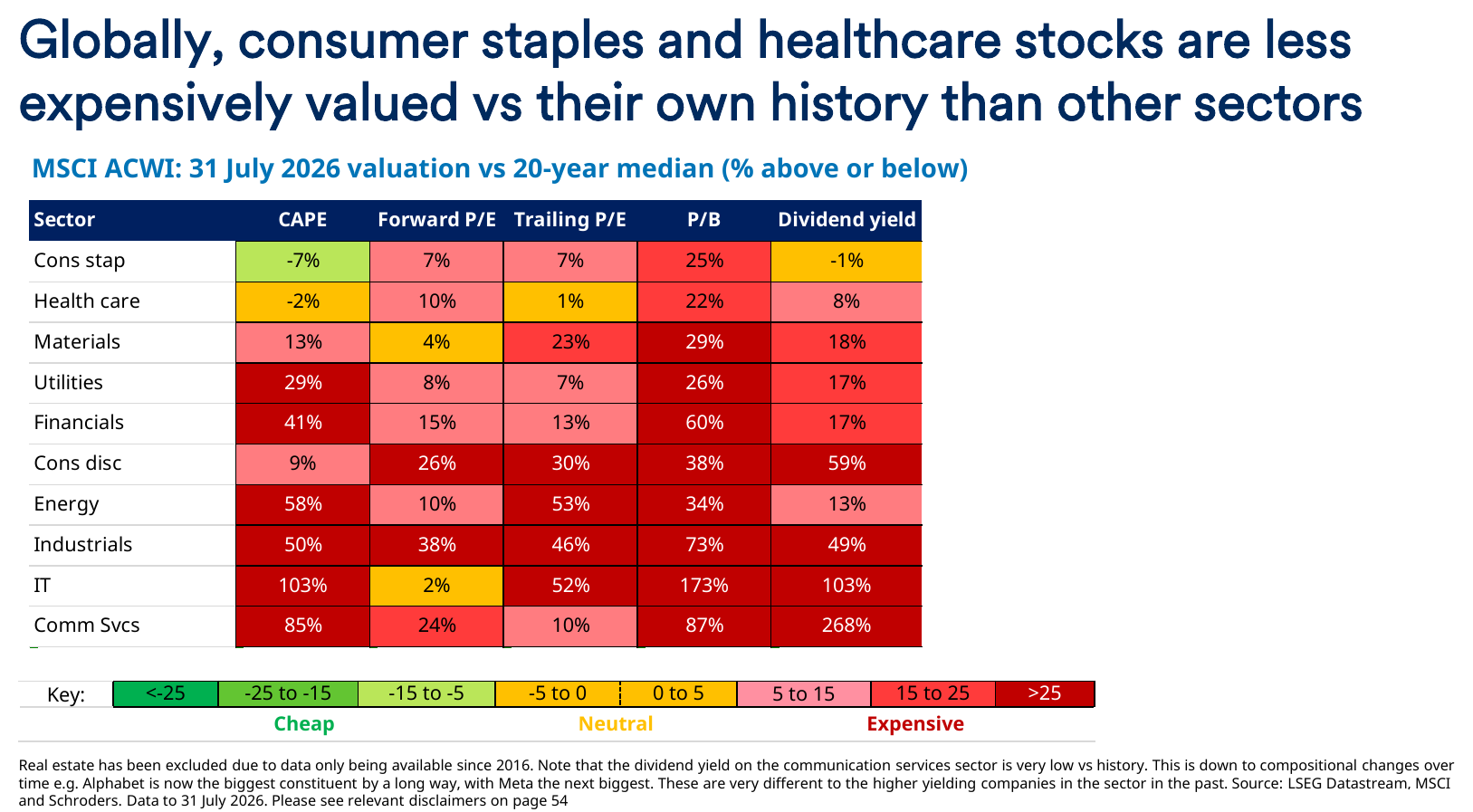
Consumer staples and healthcare are the cheapest sectors relative to history. Technology looks stretched on CAPE but close to normal on forward P/E, provided those forecasts are delivered.
Source: Schroders
Takeaway: Valuation is a poor timing tool but a good guide to long-term returns. Small caps, healthcare, staples and non-US markets offer better starting points than US large caps right now.
Where to Fish for Opportunities:
- Global small-cap funds and ETFs, trading below long-term medians.
- Equal-weight ETFs, to reduce mega-cap reliance.
- Medical and healthcare investments, trading near historical averages.
- Global equity income funds, tilted to lower multiples.
Subscribe to InvestmentMarkets for weekly investment insights and opportunities and get content like this straight into your inbox.
5. For investors worried about stagflation, value and quality may offer some protection.
Schroders favours conservative companies, energy, gold and other defensive sectors, and would avoid durables and consumer discretionary.

Source: Schroders
Its concern is topical.
Energy costs have surged and the US 10-year Treasury yield is at its highest since 2007. Value also provides a hedge against an AI unwind.

Source: Schroders
But buyer beware. Alphabet and Meta top the MSCI USA Value index, and of six value indices Schroders examined, only the S&P 500 Pure Value avoids big tech in its top holdings.

Source: Schroders
Quality indices, meanwhile, hold 42% in technology, more than the broad market. Low volatility is the most defensive style by some distance.

Source: Schroders
Takeaway: Treat stagflation protection as a deliberate tilt and check all prospective fund or ETF holdings prior to investment, because labels can be misleading.
Where to Fish for Opportunities:
- Quality funds and ETFs, after checking sector weights.
- Low-volatility funds and ETFs, the most defensive style.
- Infrastructure funds and ETFs, for utilities exposure.
- Mining and resources investments, for hard assets.
Be Ready for Vol
Rotations are easy to spot in hindsight and expensive to chase.
Emerging markets, Japan and small caps have already rallied, so today’s entry point isn’t January’s.
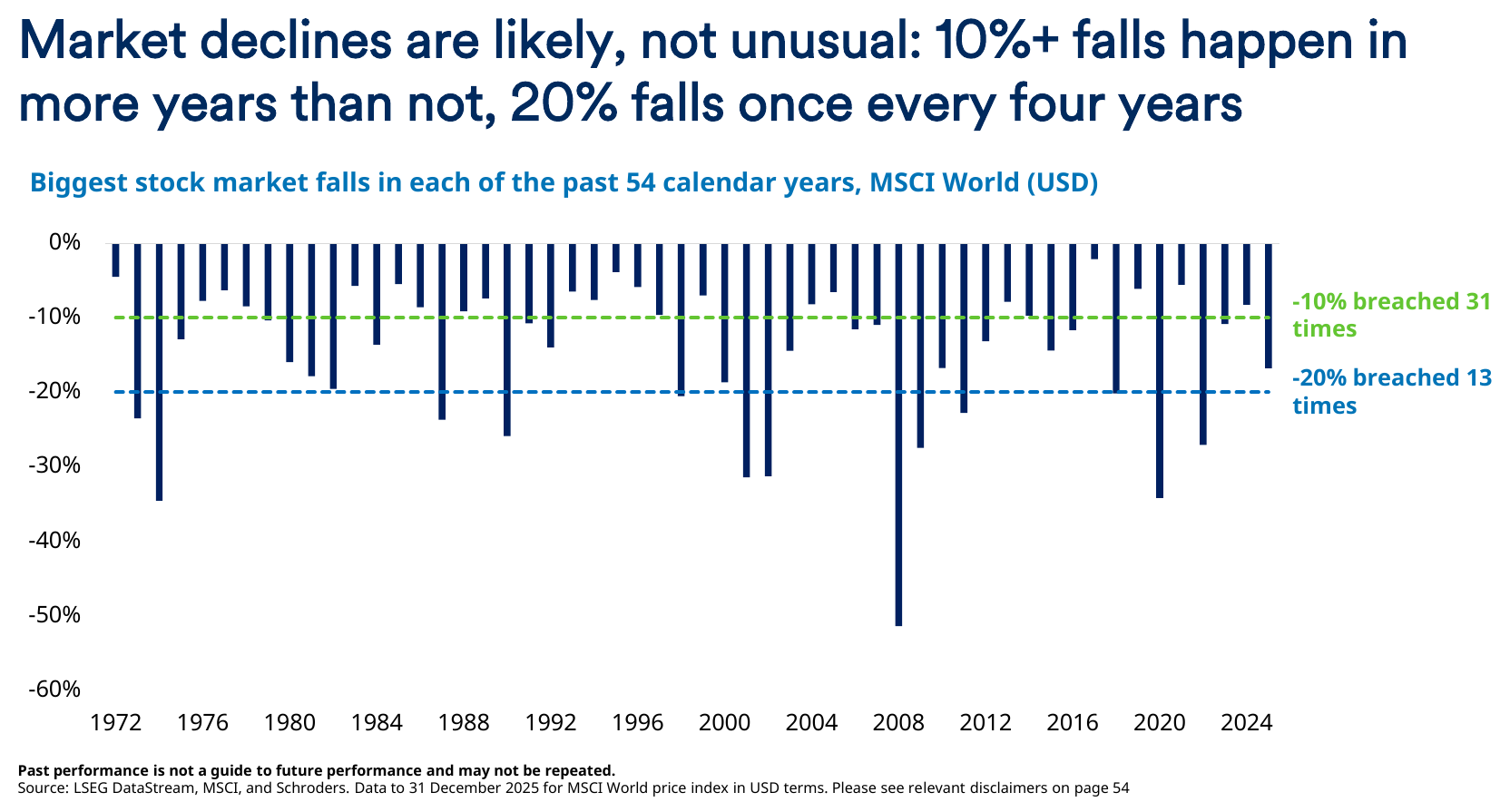
More generally, volatility is part of the deal for all global investors. You should expect a market decline of 10%+ in most years. This is not a reason to sell. Just be ready for it.
Source: Schroders
Useful Intel
Global tech still dominates the conversation, but the most important message within Schroders’ Equity Lens is that the market is no longer paying a scarcity premium for big tech.
In short, the opportunity set has widened while most portfolios haven’t. For investors prepared to look beyond the Magnificent Seven, opportunities abound.
Frequently Asked Questions
What is Schroders’ Equity Lens?
It is a regular chartbook from global asset manager Schroders that tracks performance, earnings, valuations and style trends across the world’s major share markets. The August 2026 edition is freely available on Schroders’ website.
Are the Magnificent Seven still worth owning?
Schroders’ data shows many big tech valuations near decade lows, but returns within the group have diverged sharply. Global technology funds can be selective, while global technology ETFs offer lower-cost exposure. Remember that most global index funds already hold these stocks heavily.
Is a global index ETF diversified enough?
An MSCI World tracker spans over a thousand companies, but it is heavily weighted to the US and its largest names. Investors wanting a more balanced mix can consider equal-weight ETFs, global small caps or dedicated allocations to Japan, Europe and emerging markets.
What is the difference between an active fund and a passive ETF for emerging markets?
A passive, market-cap-weighted EM ETF owns stocks in proportion to their size, which in 2026 means large bets on TSMC, Samsung and SK Hynix. An active EM fund can diversify away from those giants, typically at a higher fee. Active ETFs offer a middle ground.
Should I hedge currency on my global investments?
It depends on your time horizon and your view of the Australian dollar. Hedging removes currency swings in both directions, so it can help when the dollar rises but cost you when it falls. Many investors split exposure between hedged and unhedged versions. Browse currency-hedged global equity options to compare.
How can I protect my portfolio against stagflation?
Schroders suggests value, quality, energy and defensive sectors, with gold equities worth considering. Check holdings before buying, as many value and quality indices carry large tech weights. Low-volatility funds and ETFs, as well as infrastructure, are other options, and Schroders’ stagflation paper goes deeper.
Disclaimer: This article is prepared by Simon Turner. It is for educational purposes only. While all reasonable care has been taken by the author in the preparation of this information, the author and InvestmentMarkets (Aust) Pty. Ltd. as publisher take no responsibility for any actions taken based on information contained herein or for any errors or omissions within it. Interested parties should seek independent professional advice prior to acting on any information presented. Please note past performance is not a reliable indicator of future performance.
Author

Simon Turner
Head of Content (CFA), InvestmentMarkets
Related Articles
-jxn73aex57baxqm0dwu9.png)
-yl671u6drcf32cbl7glf.png)
Recent Articles
View all articles-hsnwn3758qz9m8thqgkv.png)
-pgwt5fmn6wpc1vix1iv8.png)
-omzb66raxn0qmnnqtg60.png)