

Invest in quality and undervalued global technology companies using Morningstar’s expertise.
Objective
Growth
Category
ETFs
Min. Investment
$500
Liquidity
Listed
Availability
Open for investment
Funding Stage
Listed
Structure
ETF
Every technological revolution eventually runs into a physical constraint. For AI, it’s becoming clear that bandwidth and energy are the main barriers the technology needs to navigate. The enormous computing clusters used to train and run modern AI models now consume staggering amounts of electricity and generate unprecedented data traffic between chips, servers and data centres.
The traditional solution to this challenge has been copper wiring. But copper is reaching its limits, not least of which is global supply. So as data volumes surge, electrical interconnects are likely to struggle to deliver the bandwidth and energy efficiency that modern computing demands.
A growing number of engineers and investors believe the next breakthrough will come from a different medium entirely: light. Welcome to the emerging age of photonics.
Photonics is the science of generating, controlling and transmitting information using photons rather than electrons. In practical terms it means moving data using light through optical components rather than electricity through copper wires.

Source: NTT
The advantages are significant. Photons can carry vastly more information while consuming far less power.
When electrical signals travel through wires or coaxial cables, resistance causes some of the energy to be lost as heat. Light travelling through optical fibre faces far less resistance, so much less energy is lost when data is transmitted. As the chart below shows, energy loss rises rapidly as signals become faster and carry more data.

The upshot is that photonics handles higher speeds and larger data volumes far more efficiently. In fact, optical interconnects can reportedly reduce energy consumption for data transmission by more than 80% compared with traditional electrical interconnects.
That efficiency advantage will be critical as AI systems scale.
That time is now. The International Energy Agency estimates that global data centre electricity demand is likely to more than double by 2030 as AI workloads expand.
Modern AI systems rely on enormous networks of GPUs and specialised processors working together across thousands of servers. These systems require ultra-fast connections between chips, racks and data centres.
Traditional electrical connections are struggling to keep up.
Light-based optical links, by contrast, can transmit massive quantities of data with minimal signal loss and dramatically lower energy consumption. Hence, photonics is becoming an essential enabling technology for next generation computing infrastructure.
As a result, McKinsey estimates that global demand for optical transceivers and photonic networking equipment is likely to grow at double-digit rates over the coming decade.
If this sector grows as expected, photonics could well become one of the bigger investment themes of the coming few years.
There are several emerging segments within the photonics ecosystem worth being aware of:
- Advanced semiconductor packaging companies are enabling chips to integrate optical components alongside traditional electronics. Optical hardware firms are producing lasers, detectors and photonic chips that convert electrical signals into light.
E.g. ASE Technology Group, Amkor Technology.
- Networking equipment companies are building the optical switching infrastructure that allows hyperscale data centres to move enormous volumes of data between machines.
E.g. Arista Networks, Ciena Corp, Fabrinet, Nokia.
- Foundries are developing silicon photonics manufacturing processes that allow optical components to be produced using semiconductor fabrication techniques.
E.g. Taiwan Semiconductor, Intel, GlobalFoundries, STMicroelectronics, Tower Semiconductor.
- Specialist connectivity firms are producing ultra-high speed optical interconnects designed specifically for AI data centres.
E.g. Broadcom, Marvell Technology, Credo Technology, Astera Labs, Poet Technologies, MACOM Technology Solutions, Semtech Corp.
- Materials suppliers are providing the highly specialised glass, substrates and optical materials that make photonics possible.
E.g. AXT, Corning, IPG Photonics, Aeluma.
- Test and measurement companies are ensuring these complex optical systems operate reliably at extreme speeds.
E.g. Keysight Technologies, Viavi Solutions.
Although these segments may sound highly specialised, together they form a rapidly expanding industrial ecosystem, which you’ll notice is mainly emerging in the U.S.
Despite its fast-growing importance to the AI revolution, photonics remains relatively unknown outside engineering circles.
Yet some of the world’s largest technology companies are already investing heavily in the field.
Intel has described silicon photonics as a fundamental technology for scaling bandwidth and reducing energy consumption in future data centre architectures.
Similarly, Cisco has highlighted that optical networking is becoming essential as cloud computing and AI push traditional network technologies to their limits.
A growing chorus of industry analysts are also seeing photonics as a core enabling technology for the next phase of digital infrastructure.
It’s easy to see why they’re all so excited by the photonics industry. The global silicon photonics market alone is expected to approach $US10 billion within the next few years, growing at a compound annual rate of almost 30% p.a.
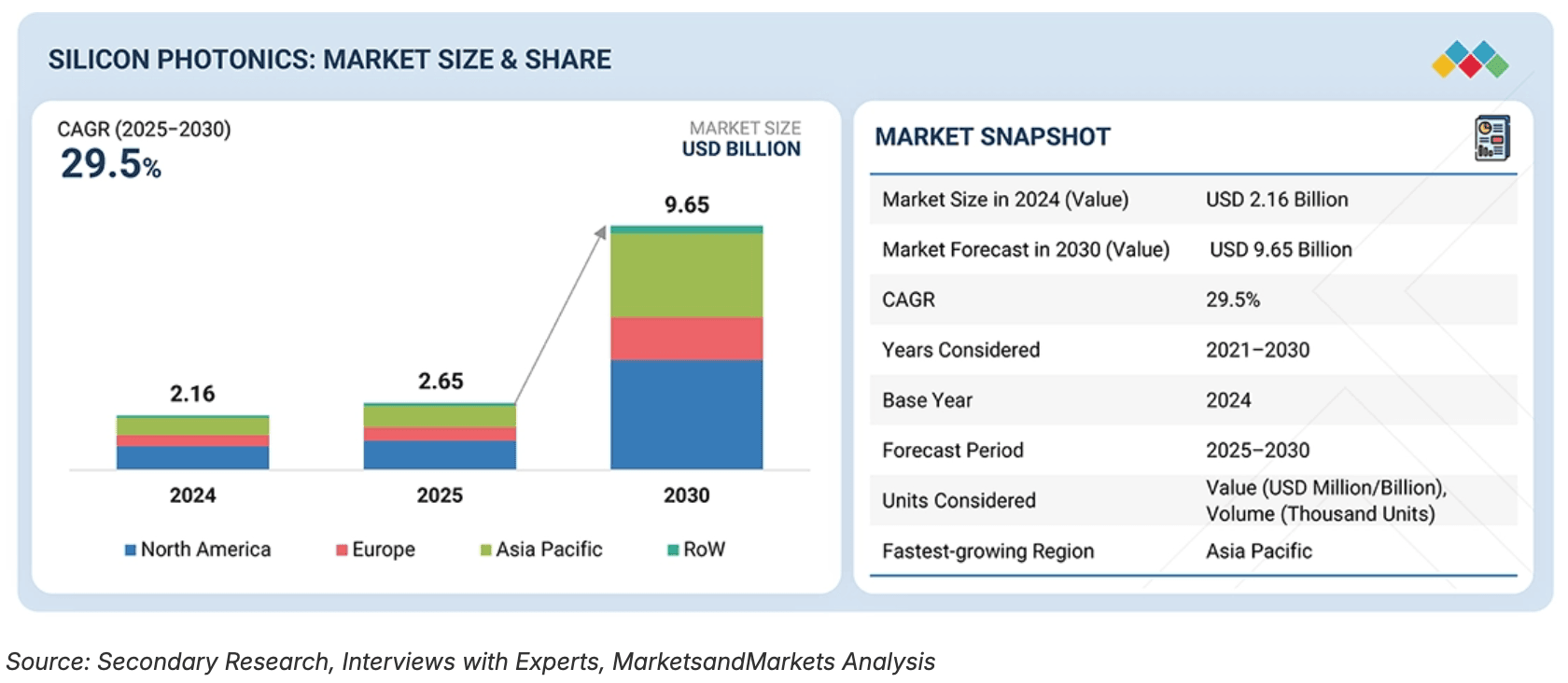
That growth reflects a broader structural shift within computing infrastructure. Just as semiconductors powered the digital revolution of the past fifty years, photonics is positioned to power the data transport layer of the next technology generation.
Search and compare a purposely broad range of investments and connect directly with product issuers.
For investors, the photonics theme sits within the broader semiconductor and technology infrastructure sectors.
Rather than attempting to pick individual technology winners, investors can gain exposure to this emerging theme through diversified technology funds and semiconductor ETFs.
For example, Global X Morningstar Global Technology ETF (ASX: TECH) holds companies involved across the photonics value chain, including semiconductor manufacturers, networking equipment providers and specialised chip designers.
For long-term investors, a prudent means of gaining diversified but balanced exposure is to combine core global equity exposure with satellite thematic technology allocations that capture photonics and other structural innovation trends.
Photonics sits squarely within that second category.
Technological revolutions usually start with obscure components that solve critical bottlenecks.
In the early days of the internet, few investors paid attention to semiconductor lithography or fibre optic networking. Yet those technologies ultimately became foundational to the digital economy.
Photonics may be following a similar path.
As AI systems grow larger and data traffic grows exponentially, the ability to move information efficiently has become as important as the ability to process it. Light, rather than electricity, may increasingly become the medium through which the world’s information flows.
For investors positioning for the next decade of technology infrastructure growth, the age of photonics may already be here.
Invest in quality and undervalued global technology companies using Morningstar’s expertise.
Disclaimer: This article is prepared by Simon Turner. It is for educational purposes only. While all reasonable care has been taken by the author in the preparation of this information, the author and InvestmentMarkets (Aust) Pty. Ltd. as publisher take no responsibility for any actions taken based on information contained herein or for any errors or omissions within it. Interested parties should seek independent professional advice prior to acting on any information presented. Please note past performance is not a reliable indicator of future performance.

-ulhzagvbsmdk2tc72zgj.png)

-8xxoee89iuihbrq61gus.png)
-b4y0oal84e0xcj53yoyy.png)
-qeo43sf8l7viuk3c6oqw.png)
-er8pjw6dhp98wpb4zm31.png)