-vmtf4wo29a20xxj6oknl.png)
Is Stock Investing Dead? Why Most Stock Pickers Can’t Beat ETFs
Most of us have seen ourselves as stock pickers extraordinaire at some point in our investing journeys. The idea of investing in stocks is exciting, seductive even. After all, all you need to do is press buy and sell online and you could make yourself a fortune.
If you suspect you are the next Buffett in the making, you are not alone.
However, whilst your confidence is admirable, it’s possibly misguided in how you can best optimise your investment returns.
Even the professionals struggle to outperform, despite their decades of experience. Case in point: nearly three quarters of professional Australian equities managers failed to beat the ASX 200 in 2025. Over ten years, almost nine in ten did.
So, if these well-paid professionals can’t reliably pick winners, should the rest of us still be trying?
More Australian investors are answering this question with their wallets.
The local ETF market hit a record $372 billion under management in June 2026, and 2.7 million Australians now hold at least one ETF.
So, is stock investing dead? Not for everyone. But the evidence shows that for the vast majority of investors, stock picking is a game worth retiring from. That’s why some of the sharpest investors of our era have done exactly that and never looked back.
Key Takeaways
- Stock ownership via ETFs is thriving globally and locally, while stock picking is in retreat.
- 87.6% of active Australian equity funds trailed the S&P/ASX 200 over the ten years to December 2025.
- Just 2.4% of listed companies globally created all net shareholder wealth between 1990 and 2020, which is why missing a few winners is so costly.
- Former stock pickers who switched to ETFs generally cite better results, less time spent on investing, and far less stress.
- ETFs address cost, diversification and discipline, but not market risk, index concentration or poor behaviour.
Explore 100's of investment opportunities and find your next hidden gem!
Search and compare a purposely broad range of investments and connect directly with product issuers.
The Scorecard Professionals Would Rather You Did Not Read
Professional investors’ performance is the most compelling argument in favour of most investors letting go of stock picking.
The SPIVA Australia Year-End 2025 scorecard from S&P Dow Jones Indices makes sobering reading. In 2025 the S&P/ASX 200 returned 10.3% while the average active Australian share fund, weighted by assets, returned just 5%, less than half the index return. Over 15 years, 86.9% of those funds lagged the index, while for global equity funds the comparable figure was 96%.

Chart 1: Share of active funds underperforming their benchmark.
Source: S&P Dow Jones Indices, SPIVA Australia Year-End 2025.
For context, these numbers are also somewhat flattering to active managers since the losing funds don’t generally stick around to be counted in this data.
Bearing in mind that fewer than half of the Australian equity funds operating 15 years ago still exist (the rest have been merged or closed), this backdrop suggests the true picture for active managers is even worse.
Why Beating the Market Is So Hard
Before you point the finger at the intelligence and experience of active fund managers, know that they aren’t the problem.
The deeper problem is mathematical.
Research by Arizona State University professor Hendrik Bessembinder found that just 2.4% of nearly 64,000 global companies accounted for all the US$75.7 trillion of net shareholder wealth created between 1990 and 2020.
A 2.4% hit rate isn’t quite finding a needle in a haystack, but it reveals the extent of the challenges faced by all stock pickers. They must find those rare winners and hold them for long enough to capture the upside, whereas broad-based ETFs tend to own them automatically.
Add in fees, which are certain while outperformance is not, and the odds tilt further against the world’s stock pickers.
The Converts: Investors Who Stopped Picking Stocks & Never Looked Back
Let’s meet a few reformed stock pickers who crossed to the other side…
Andrew Hallam: Reinvested $700,000 into ETFs
Hallam, who became a millionaire on a teacher’s salary, was a genuinely excellent stock picker.
The investment club he ran from 1999 produced results that ‘make most mutual funds look inept by comparison’, and his personal account did better still.
Yet over 15 years ago, he sold $700,000 of individual shares and moved everything into low-cost ETFs as he realised that luck had played a large role in his success to date, and that luck runs out.
‘I’m definitely not a genius,’ he explained. ‘But I am smart enough to recognise my limitations.’
He has since confirmed that he won’t ever switch back to his stock-picking ways of the past.
JL Collins: ‘A Fool’s Game’
The author of The Simple Path to Wealth started investing in 1975, yet admits he spent most of his investing life picking individual stocks and trying to pick managers.
Working alongside top institutional analysts who often ‘still get it wrong’ changed his mind.
His conclusion: ‘picking individual stocks is a fool’s game’.
He now advocates simple portfolios built on broad-based ETFs.
Warren Buffett: The Bet He Won Without Picking a Stock
Why is the world’s most celebrated stock picker on this list?
It’s because he’s long been an advocate for other investors not trying to follow in his footsteps. He believes most investors should simply invest in a low-cost S&P 500 ETF.
He was so confident in the validity of this advice that in 2008 he bet US$1 million that an S&P 500 index fund would beat five hedge funds of funds chosen by Protégé Partners over a decade.
Fast forward ten years and he won that bet comfortably, as shown below.
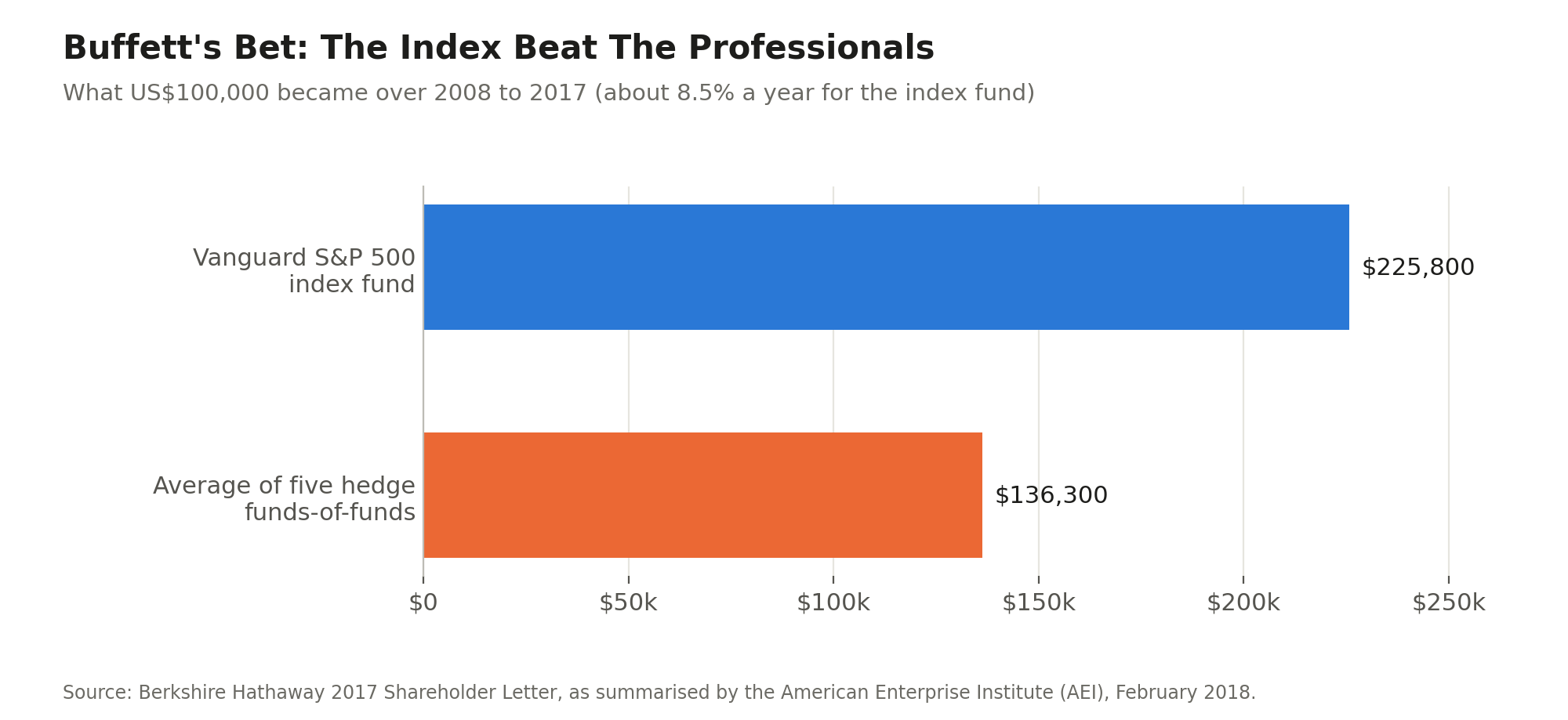
Chart 2: Buffett’s ten-year bet.
Source: Berkshire Hathaway 2017 letter, via AEI.
In Buffett’s words: ‘Performance comes, performance goes. Fees never falter.’
Hence, his instructions for his own estate are to direct 90% of his wife’s inheritance into ‘a very low-cost S&P 500 index fund’.
That’s a powerful message from one of the greatest investors of all time.
Subscribe to InvestmentMarkets for weekly investment insights and opportunities and get content like this straight into your inbox.
Nick Maggiulli & Morgan Housel: The Feedback Problem
Plenty of professional investors have reached a similar conclusion.
Nick Maggiulli of Ritholtz Wealth Management stopped buying individual stocks years ago, arguing that it ‘could take you years, if not decades, before you know if you’re any good.’
Morgan Housel, the former Motley Fool columnist behind The Psychology of Money, agrees. ‘My net worth is a house, a checking account and index funds. If I can earn average returns for an above-average period of time, it’s going to achieve every financial goal that I have.’
A Common Thread
The common thread in all these stories is a sense of relief rather than defeat.
These investors all benefited from (or, in Buffett’s case, advocated) more time, fewer decisions, and no nagging worry that one company could derail their investment plan at any given moment.
They also remained optimistic about the long-term benefits of stock ownership.
The main evolution in their thinking was in the optimal way they now choose to own stocks: via ETFs rather than individual stocks they picked themselves.
After all, a broad-based ETF is just a basket of shares. In that sense, stock investing is very much alive.
What is fading is the belief that individuals can consistently outperform the market by choosing the right handful of winners.
Australia Is Voting with Its Wallet
That brings us to the evidence that this trend is accelerating and its major beneficiary: the ETF universe.
The Australian ETF industry ended 2025 at a record $330.6 billion, up 34.2% in a year.
By June 2026 it had reached $372 billion, with $30 billion of net inflows in six months, matching all of 2024.

Chart 3: Australian ETF industry funds under management.
Sources: Betashares, Money Management.
Around 411,000 Australians bought their first ETF in 2025, and ETFs now make up a record 17% of the average investor portfolio.
We recently investigated where that money is flowing. Broad-based, low-cost ETFs are dominating, as you’d expect.
Stock Investing Is Alive, But the Stock Picker Is Becoming an Endangered Species
Owning global equities remains one of the best ways to accumulate wealth over the long term.
However, owning the whole market is generally a less stressful, more reliable pathway to wealth creation than trying to beat it yourself. Hallam, Collins, Maggiulli and Housel all reached the same conclusion via different roads.
For most investors, a diversified, low-cost core of ETFs is the optimal evidence-based starting point for portfolio building.
So, stock investing is far from dead. For a growing number of investors, it has just become much less work.
Frequently Asked Questions
Is Stock Picking Worth It for Australian Investors?
For most investors, the evidence suggests not as a core strategy. SPIVA data shows 87.6% of professional Australian share funds underperformed the S&P/ASX 200 over the ten years to December 2025. Individual investors face the same odds with fewer resources, though some choose a small stock-picking allocation for interest or conviction.
What Percentage of Active Fund Managers Beat the ASX 200?
In 2025, 26.4% of active Australian equity general funds beat the S&P/ASX 200. Over ten years just 12.4% did, and over 15 years 13.1% did, according to S&P Dow Jones Indices’ SPIVA Australia Year-End 2025 scorecard.
Are ETFs Safer Than Individual Shares?
A broad index ETF reduces company-specific risk because no single business can sink the portfolio. It does not remove market risk: if the share market falls 30%, a share ETF will fall by a similar amount. Narrow or leveraged ETFs can be riskier than a diversified share portfolio.
Can I Hold Individual Shares Alongside ETFs?
Yes. A common approach is core and satellite, where a diversified ETF forms the core and a smaller satellite holds individual shares or specialist strategies. Keeping the satellite modest limits the damage if picks underperform.
Will the Rise of ETFs Break the Share Market?
It’s a live debate. Critics argue passive flows weaken price discovery, yet SPIVA data shows most active managers are still underperforming on average, which suggests that markets remain hard to beat. As passive investing grows, less efficient areas such as small caps may offer active managers more opportunity.
Disclaimer: This article is prepared by Simon Turner. It is for educational purposes only. While all reasonable care has been taken by the author in the preparation of this information, the author and InvestmentMarkets (Aust) Pty. Ltd. as publisher take no responsibility for any actions taken based on information contained herein or for any errors or omissions within it. Interested parties should seek independent professional advice prior to acting on any information presented. Please note past performance is not a reliable indicator of future performance.
Author

Simon Turner
Head of Content (CFA), InvestmentMarkets
Related Articles
-c0r65slb5ciy1qtd4yd3.png)
-w1ik9cv629m15fwry2zl.png)
Investments You May Like

Global X Japan TOPIX 100 ETF (ASX: J100)
The Global X Japan TOPIX 100 ETF (J100) tracks the Topix 100 Total Return Index.
Categories
Recent Articles
View all articles-01xhfy3zxeb8rav1zavf.png)
-6xblbfxg17ij0ex7hwqw.png)
-b0157qfbffa4kd76pbxp.png)