-omzb66raxn0qmnnqtg60.png)
Australia’s Debt Problem is Also an Investor’s Problem. Here’s How to Read It
Australian households are carrying some of the highest debt loads in the developed world, yet the Reserve Bank is still weighing whether to raise rates again. In the event the inflation print due out on July 29th runs hot, a fourth RBA rate rise may become more likely than not.
This backdrop is turning Australian debt levels into a major investment issue, which is likely to shape significant financial parameters ranging from bond yields to bank earnings and property valuations. Here’s how to think about it.
Just How Indebted is the Australian Population?
First, the bad news.
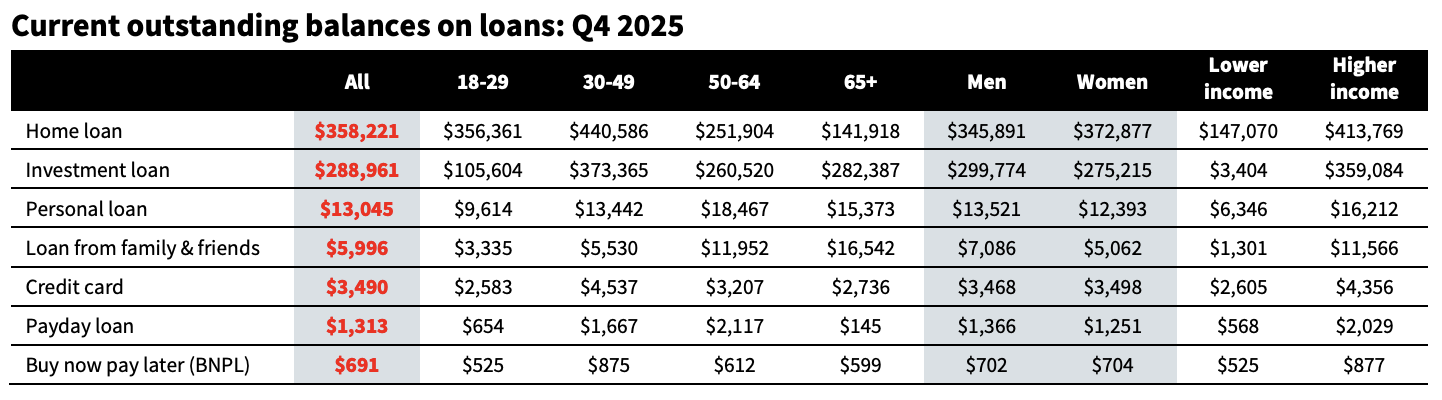
Australian household debt hit a record $3.33 trillion in June 2025, up 6% on the year before. That means the average Australian household now carries $313,633 in total debt, with credit card debt and mortgages representing the lion’s share.
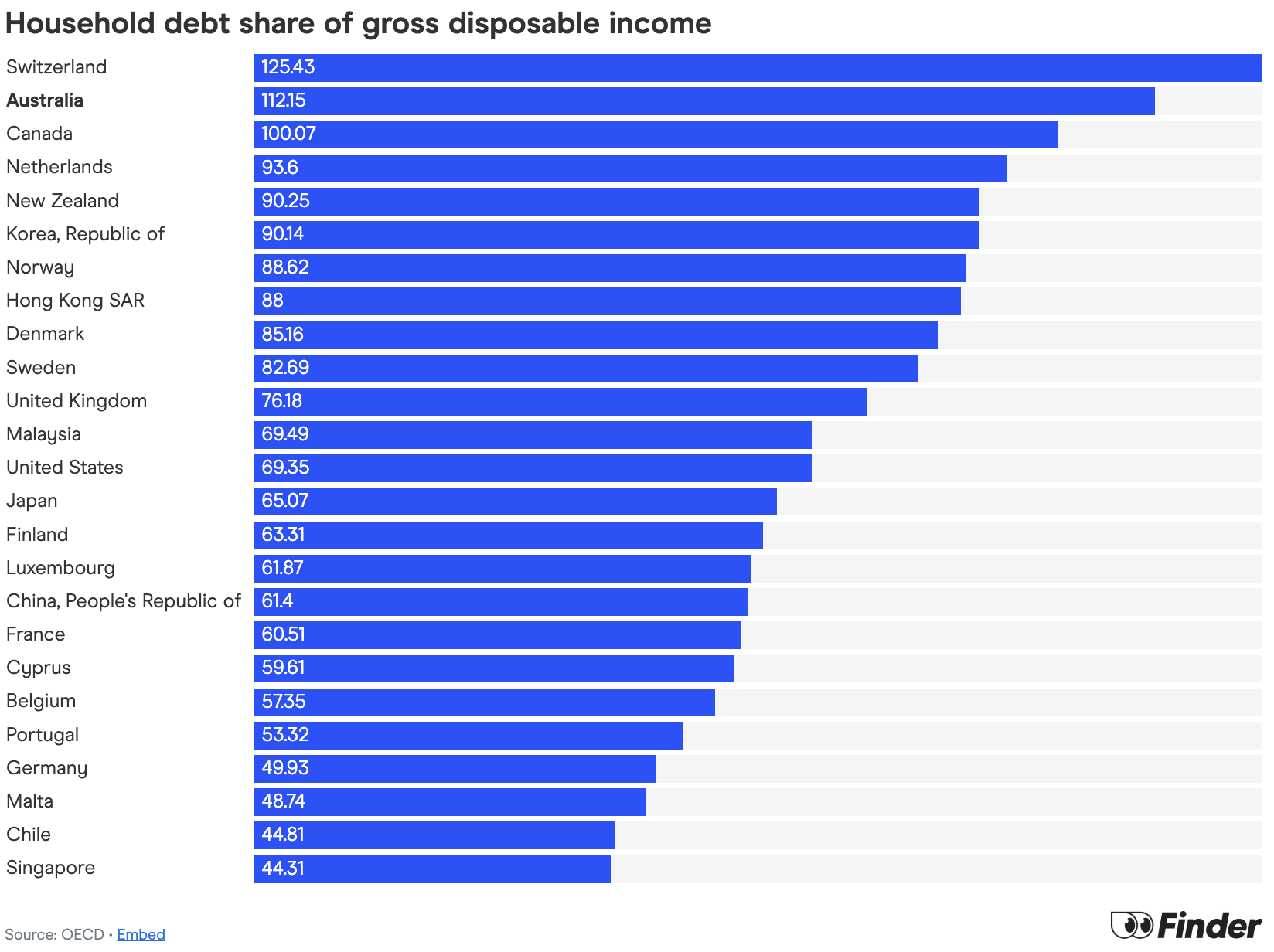
On a debt-to-GDP basis, Australia has the second-highest level of household debt in the world, with total borrowings worth 112% of GDP, trailing only Switzerland.
As always with data points like this, context is important.
It’s worth highlighting that the countries with the highest household debt tend to be wealthy, developed economies with deep financial systems, stable banks and high rates of home ownership.
Switzerland, Canada and Australia share those traits.
Moreover, poorer countries generally have lower household debt levels because fewer residents have access to formal credit at all.
So, high debt in Australia’s case is indicative of a thriving financial system. It’s substantially a mortgage story, a by-product of expensive housing and a banking system that has been willing to lend heavily against it.
However, debt is debt. It still has to be serviced, and at a cash rate that’s meaningfully higher than three years ago.
A Shifting Debt Mix
Let’s dig deeper into the data for a view of the composition of Australian household debt, which is shifting in ways worth watching.
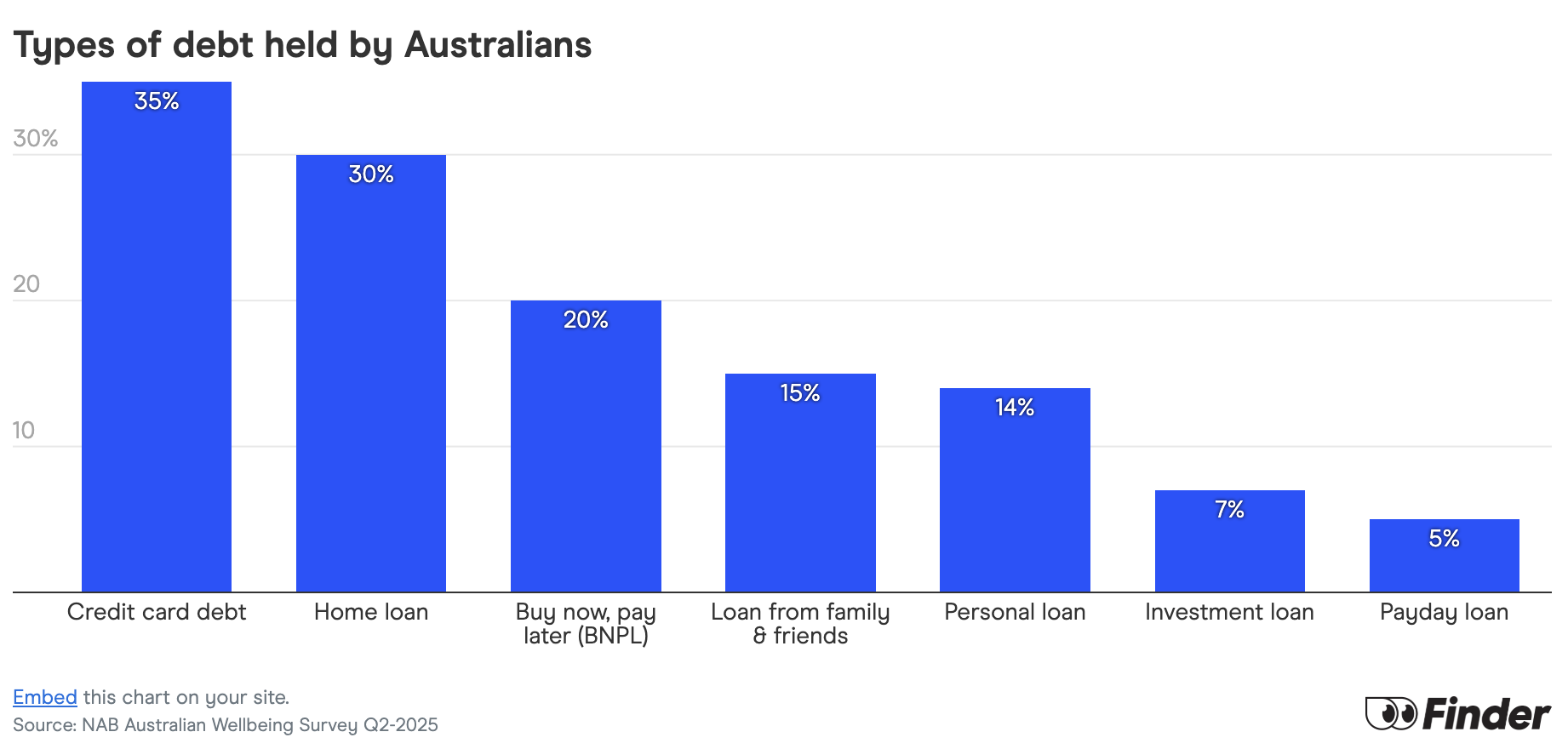
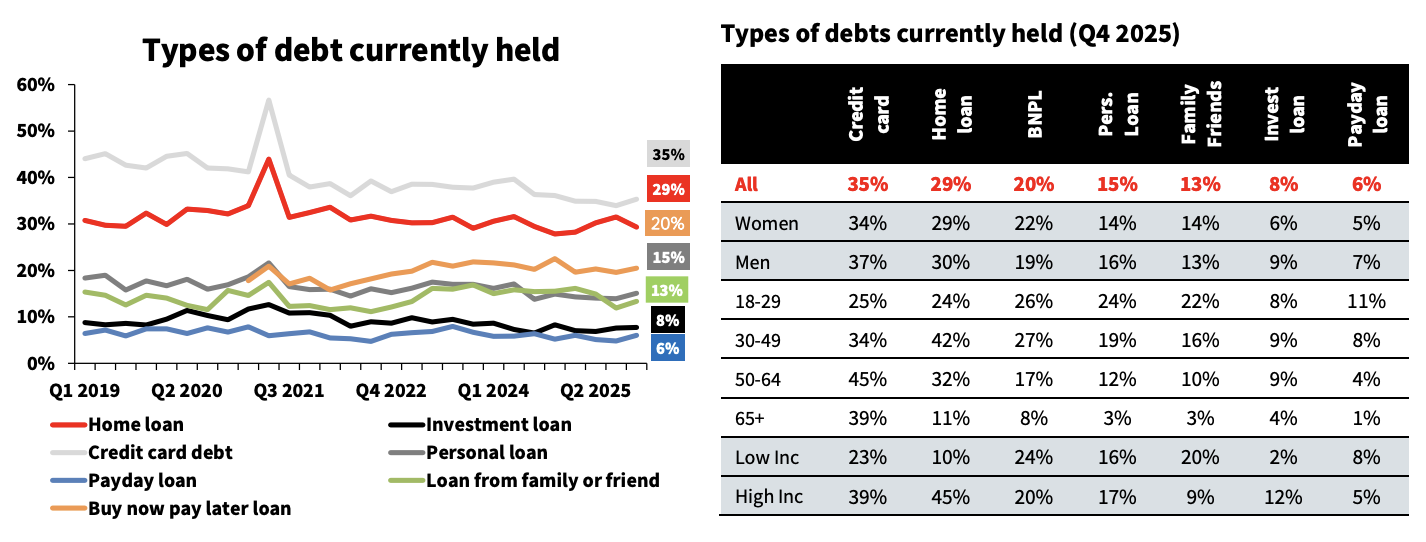
NAB's Australian Wellbeing Survey showed credit card debt topped the list for most Australians (35%), followed by home loans (29%), buy-now-pay-later (BNPL) loans (20%), personal loans (15%), loans from family or friends (13%), investment loans (8%) and payday loans (6%).
Source: NAB
These averages mask sharp divides across age and income.
Younger Australians (18–29) are leaning hardest on short-term, high-cost credit with the highest rates of personal loans (24%), family/friend borrowing (22%) and payday loans (11%), plus the second-highest BNPL use (26%). That’s a signature of thin savings buffers and constant liquidity needs.
In contrast, middle-aged Australians (30–49) are in peak borrowing mode with home loans surging to 42%, alongside elevated BNPL, payday loans, credit cards and personal loans as mortgages, children and general life costs stack up.
Debt eases sharply after 65, although credit cards remain surprisingly common (39%), suggesting they’re still a go-to for everyday spending even as other debt falls away.
Income is the sharpest divide of all.
Source: NAB
Lower-income households are turning to BNPL (24%), family/friend loans (20%) and payday loans (8%), the credit types most closely tied to financial stress.
Higher-income households, meanwhile, lead in home loans (45%), credit cards (39%) and investment loans (12%), reflecting far greater room to build long-term wealth.
Why This is a Portfolio Issue
Against this backdrop of rising debt levels, rising interest costs are flowing through into investment markets in three fairly direct ways:
- Interest rate sensitivity.
A heavily indebted household sector amplifies the impact of every RBA decision.
The RBA is painfully aware of this. Their Financial Stability Review flagged that lending standards need to remain prudent given the high level of household indebtedness and recent strong credit growth.
That context means that further RBA rate increases would likely have a significant impact on the high-duration segment (most sensitive to higher rates) of the Australian fixed income markets.
Will that be enough to dissuade the RBA from raising rates again in August? Maybe. Maybe not.
Watch out for: The possibility of a fourth 2026 rate rise by the RBA at their next decision on August 11th and its potentially outsized impact in squeezing mortgage holders further.
- Bank and credit exposure to household financial stress.
Australian banks are, in effect, a leveraged bet on the collective balance sheet of Australian households.
As a result, investors holding bank shares, hybrids or bank-heavy index funds are more exposed to mortgage stress and consumer credit quality than a diversified global portfolio would be.
This is one reason why being diversified by sector and geography is so important.
Watch out for: A slowdown in consumer spending as debt servicing costs eat into more Australians’ disposable income. The banking sector is exposed.
- Property and REIT valuations.
Debt-funded property underpins a large share of listed and unlisted property returns.
Higher-for-longer rates test that support, particularly for properties near the edge of serviceability.
Watch out for: Unlisted property and credit funds are likely to offer significantly lower liquidity in a stress scenario than their listed equivalents.
All of the above are reasons to prepare for rates to remain higher for longer, and potentially higher than they are at present.
It may be prudent for investors who want defensive ballast against a heavily leveraged, rate-sensitive household sector to focus on low-duration fixed interest assets.
Growth-oriented investors may see the current environment as a reason to broaden beyond their domestic banking and property exposure towards diversified global strategies.
The RBA May be About to Raise the Risks of Owning Duration
Now may well be a good time to check how exposed your portfolio is to Australian household leverage through the banking sector, high-duration fixed income, property funds or mortgage-linked credit.
Compare your current exposure with your appetite for interest-rate-sensitive assets heading into the RBA's next decision on August 11th. If the RBA does raise rates again, be prepared for your interest-rate-sensitive exposure to underperform, at least in the short term.
Disclaimer: This article is prepared by Simon Turner. It is for educational purposes only. While all reasonable care has been taken by the author in the preparation of this information, the author and InvestmentMarkets (Aust) Pty. Ltd. as publisher take no responsibility for any actions taken based on information contained herein or for any errors or omissions within it. Interested parties should seek independent professional advice prior to acting on any information presented. Please note past performance is not a reliable indicator of future performance.
Author

Simon Turner
Head of Content (CFA), InvestmentMarkets
Related Articles

-4zmyqkmstz4l2huud8bf.png)
Investments You May Like

Fixed Income Solutions - Individually Managed Accounts (IMAs)
We have a pure fixed income focus and construct bespoke portfolios/accounts that cater for each client’s individual fixed income investing objectives including liquidity, credit, duration, and diversification (Wholesale Investors Only).

Skyring Fixed Income Fund
Designed for investors who seek both flexibility and regular income (paid monthly). This Fund offers a competitive distribution rate plus the freedom to reinvest your distributions.

CRAFT Fixed Income (A "Risk-Off Capital" Investment)
"Risk-Off Capital" Investment, Lowest Default Risk Credit Market, Asset-Backed, Financing the Real Economy, Essential Global Trade.
Categories
Recent Articles
View all articles-rev76nk32o2qbrmnygt6.png)
-cjqoall8pxc4nlocz98x.png)
-l41u2ptkx9onbqj7pipi.png)