Australia’s 2026-27 Federal Budget has dramatically changed the tax conversation in ways few budgets have. In particular, the Government’s plan to replace the 50% CGT discount with cost-base indexation and a 30% minimum tax rate from 1st July 2027 has massive investment implications.
As with all aspects of investing, panicking isn’t a sensible reaction. Carefully considering the optimal pathway forward may instead lead to the type of empowered response that allows investors to thrive regardless of higher CGT.
After-Tax Returns to the Fore
For years, Australian investors built their portfolios around a simple trade-off: accept volatility, hold your investments for more than 12 months, and receive the 50% CGT discount when a capital gain is realised.
Under the proposed new rules, investors will still be rewarded for holding assets for the same twelve-month period, but the reward is more closely tied to inflation rather than a flat discount.
While the intent is to tax only real gains, the 30% minimum rate means the final outcome in most cases will be more CGT due depending on the investor’s circumstances, inflation and timing of the assets held.
The upshot is portfolio construction now needs to pay more attention to how after-tax returns are delivered; not just how high those returns appear before tax.
Why ETFs May Benefit from the Budget Changes
One of the bigger implications is that ETFs may become more attractive on a relative basis as post-budget investment vehicles.
ETFs aren’t tax-free, and investors still need to declare their ETF distributions and capital gains.
However, broad index ETFs stand out as useful post-budget portfolio building blocks because many have relatively low turnover.
As State Street Global Advisers notes, market cap index ETFs such as broad-based Australian share exposures tend to require minimal rebalancing, although higher-turnover index strategies can distribute more realised gains.
Betashares also argues that ETFs are often comparatively tax-efficient because index-tracking funds tend to have lower turnover and may allocate their capital gains more efficiently between redeeming and continuing investors.
This advantage is often more significant than you may expect.
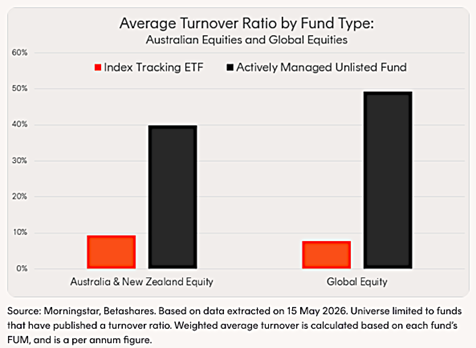
As shown below, the average turnover rate in Australian and global ETFs is, on average, significantly lower than in comparable actively managed funds.
Post-Budget Portfolios Should Balance Four Return Types
So, what are the ideal post-budget portfolio building blocks for most investors?
There are four main return sources to call upon:
- Growth-Focused Funds and ETFs.
You may be tempted to react to the budget by veering away from all growth-focused assets.
Be careful with that thinking. It may cripple your longer-term performance, even in after-tax terms.
Why? Because CGT is only payable when you sell an asset. If you own growth-focused funds and ETFs for years, even decades, you’re still able to successfully compound your returns without paying the taxman anything.
Remaining growth-focused will probably lead you to maintaining global exposure. Relying too heavily on Australian banks, miners and dividend names can leave investors underexposed to major global growth thematics such as AI, technology, and the energy transition.
Having said that, given the budget changes you may need to be more tax-aware when you select the growth-focused funds and ETFs you invest in.
For that reason, global ETFs may warrant receiving a higher share of your growth allocation than they would have prior to the budget.
- Global Income-Generating Funds and ETFs.
The budget is surely good news for income investing.
After all, for most investors, fixed income and diversified income funds are likely to play a bigger portfolio role when capital gains become less tax-advantaged, as is proposed.
Just make sure you consider the full gamut of income-generating investment vehicles when you’re planning your income allocation.
That includes the many high-quality government bond funds and ETFs, short-duration bond funds and ETFs, property and REIT funds, private credit funds, mortgage funds, and equity income funds and ETFs available to Australian investors.
It’s worth remembering that risk in this space varies by duration, credit quality and investment structure. Chasing the highest yields on offer may not be the most prudent strategy if you’re focused on portfolio resilience.
- Franked Australian Income Funds and ETFs.
Franking credits remain a distinct feature of Australian income investing.
Franking credits exist to prevent company profits being taxed twice, first at the company level and again in the hands of shareholders.
With this benefit on offer, Australian equity income funds and ETFs arguably deserve renewed attention in a post-budget world.
- Diversifying Funds and ETFs.
As we often highlight, portfolio diversification is one of the few free lunches in finance.
In return for a little thought and planning, investors are able to improve their risk-adjusted returns through careful diversification across asset classes, regions, and themes.
This may include diversifying investment vehicles such as infrastructure funds and ETFs, market-neutral funds and ETFs, or gold-related exposures.
The point is to reduce your reliance on one tax outcome, market cycle or source of return.
What the Ideal Portfolio May Look Like
There’s no single best portfolio after the CGT changes.
The right mix will depend on your objectives, time horizon, risk tolerance and tax position.
By way of example, the table below illustrates how conservative, balanced and growth investors might allocate across these four main asset categories in a post-budget world:
Conservative investors are likely to prioritise income stability and capital preservation over maximum growth.
Fixed income ETFs and funds are likely to form the foundation of their portfolio.
For example, the Vanguard Australian Fixed Interest ETF (VAF), Vanguard International Fixed Interest ETF (VBND) and a range of diversified income funds combining bonds, credit and income-producing assets are likely to be core exposures.
Franked Australian equity strategies may provide them with valuable exposure to dividend income and franking credits, while a smaller allocation to broad equity ETFs helps conservative investors maintain their exposure to long-term growth.
Diversifiers such as infrastructure funds and ETFs provide additional and independent return drivers.
Balanced investors seek a combination of capital growth and income.
Broad Australian and global equity ETFs tend to be their largest core exposures, supported by meaningful allocations to fixed income and Australian dividend strategies.
For example, broad Australian equity ETFs such as the SPDR S&P/ASX 200 ETF (STW) or iShares Core S&P/ASX 200 ETF (IOZ), alongside global exposures such as Vanguard MSCI International Shares ETF (VGS) are common core exposures.
Diversified income funds help reduce volatility, while property and infrastructure exposures provide additional diversification.
Growth-oriented investors remain focused primarily on long-term capital appreciation, even in a world where capital gains receive less favourable tax treatment.
Their portfolios are likely to remain dominated by Australian and global equity funds, reflecting their superior long-term return potential.
However, compared with the pre-budget environment, there may be a stronger case for maintaining some exposure to income-producing assets rather than relying almost entirely on growth-focused assets.
A modest allocation to fixed income can also enhance their portfolio resilience during market downturns, while alternatives such as infrastructure and gold may help broaden their sources of return.
Tip: Tax should never be the only driver of portfolio decisions. A low-tax investment can still be a poor investment.
The proposed CGT changes don’t necessarily make growth investing unattractive. But they do clearly make it more important to sensibly diversify your after-tax return drivers.
In this new era, investors may increasingly benefit from diversifying across capital growth, income distributions, franking credits, and alternative sources of return. The result is a portfolio that may be more resilient across changing market conditions, tax policies and economic cycles.
For now, the most prudent response is to review where your returns are coming from, how they are taxed, and whether your portfolio is still fit for purpose in a post-budget world.
Funds Mentioned
Vanguard Australian Fixed Interest Index ETF seeks to track the return of the Bloomberg AusBond Composite 0+ Yr Index before taking into account fees, expenses and tax.
Retail Investor
Vanguard International Fixed Interest Index (Hedged) ETF seeks to track the return of the Bloomberg Global Treasury Scaled Index hedged into Australian dollars before taking into account fees, expenses and tax.
Retail Investor
The SPDR® S&P®/ASX 200 ETF, seeks to closely match, before fees and expenses, the returns of the S&P/ASX 200 Index.
Retail Investor
Objective
Growth and Income
The fund aims to provide investors with the performance of the S&P/ASX 200 Accumulation Index, before fees and expenses. The index is designed to measure the performance of the 200 largest Australian securities listed on the ASX.
Retail Investor
Objective
Growth and Income
Vanguard MSCI Index International Shares ETF seeks to track the return of the MSCI World ex-Australia (with net dividends reinvested), in Australian dollars Index, before taking into account fees, expenses and tax.
Retail Investor
Objective
Growth and Income
Disclaimer: This article is prepared by Simon Turner. It is for educational purposes only. While all reasonable care has been taken by the author in the preparation of this information, the author and InvestmentMarkets (Aust) Pty. Ltd. as publisher take no responsibility for any actions taken based on information contained herein or for any errors or omissions within it. Interested parties should seek independent professional advice prior to acting on any information presented. Please note past performance is not a reliable indicator of future performance.


-5pmpvmd2nrv3novymh6d.png)
-wxt11otlkrhyb69z9xd4.png)
-jxn73aex57baxqm0dwu9.png)
-x9ncxgltmlhab5yvh7nd.png)
-biy2kjxbgtb4uoevomc0.png)
-f9omdi3sg0r89crzabcq.png)