-jxn73aex57baxqm0dwu9.png)
Being bearish sounds smart. Being bullish tends to pay. Here’s the evidence.
Markets have never lacked reasons to worry. There’s generally a long list of macro risks and challenges that need to be navigated. Yet the data on which investors succeed tells a clear story: cautious optimism has consistently outperformed pessimism.
Here’s the evidence, and what it means for how you build your portfolio…
Plenty of Reasons to Worry
Investors have no shortage of reasons to feel uneasy.
Trade tensions, geopolitical flashpoints, sticky inflation and talk of AI-driven job losses have combined with an information-overloaded environment that makes every wobble feel like the start of something bigger.
It’s entirely reasonable to want to sit on the sidelines until the coast is clearer.
However, history offers a useful corrective.
Over the past century, the investors who have built real wealth are overwhelmingly the ones who stayed invested through the noise, rather than the ones who tried to dodge every potential downturn.
The case for cautious optimism is a strong one.
Understanding why it tends to be rewarded is one of the most useful lessons for all investors, no matter how much experience they have.
Why Pessimism Feels Smarter Than It Really Is
There’s a psychological reason why gloomy forecasts get more attention than upbeat ones.
Human brains carry a strong bias toward loss aversion thanks to our evolutionary past, when missing a genuine threat could be fatal.
That hardwiring means a market fall registers far more strongly with investors than an equivalent gain.
Hence, negative news headlines always beat their more positive counterparts for investors’ attention.
Given the sheer volume of information now available, our brains are focusing on more negative data points than ever before.
However, greater access to data doesn’t tend to translate into better decisions.
Combined with recency bias, whereby investors overweight whatever has happened most recently, the result is a tendency to sell after bad news has already done its damage, and to project short-term setbacks indefinitely into the future.
Social media compounds this further, since the algorithms reward whatever gets the strongest reaction. Fearful perspectives are amplified far more than balanced ones.
Of course, the risks aren’t always imaginary. But their volume is generally turned up well beyond what the underlying data justifies.
Explore 100's of investment opportunities and find your next hidden gem!
Search and compare a purposely broad range of investments and connect directly with product issuers.
The Case for Staying Invested
The strongest argument for optimism is evidential.
Let’s compare the performance of $100 invested in Australian shares, property, bonds and cash since 1900, with income reinvested along the way. Cash, the most pessimist-friendly option, would have grown to $15,897 today. Bonds would be worth $49,864. Shares, the most optimist-aligned option, would have grown to $3.8 million.
-030g3acbez0enyrfzrpd.png?_a=BAMAAAhM0)
Source: ASX, Bloomberg, RBA, AMP
Translation: the cost of pessimism is much lower returns, and optimism pays over the long term.
Despite their emotional barriers to fully embracing optimism, most investors intuitively understand this.
Cash and bonds feel safer because their short-term path is smoother, but smoothness has a price, and over a long horizon that price is enormous.
Shares are volatile because they are claims on the future profits of real businesses, and that uncertainty is what investors are compensated for bearing. The frequency of gains reinforces this point. Since 1900, Australian shares have delivered a positive annual return 81% of the time, and US shares 74% of the time — as shown below.

The instructive point here is that the success rate for investing in higher risk asset classes such as equities is high but it’s well below certainty.
Most years reward the equity investors who simply stay put, but maintaining their optimism while staying put is necessary to benefit from the next upward market move.
Why Trying to Time the Market Tends to Backfire
The case for optimism doesn’t rest on ignoring risk.
Markets do fall, sometimes sharply. I can’t tell you when that may occur with any certainty, and no one else can either.
Hence, this is a case for cautious, rather than blind, optimism.
The best way to reflect this is by staying invested through a diversified, well-considered portfolio, and not selling during market selloffs.
Pessimism does the most damage through its temptation to exit the market at exactly the wrong moment.
The numbers are unequivocal on this front.
Using Australian share returns from January 1995, an investor who remained fully invested earned 9.4% p.a. An investor who managed to dodge the ten worst days over that period would have lifted their return to 12%, while avoiding the forty worst days would have pushed it to 16.5%. The catch is that almost nobody achieves this in practice (no matter what they broadcast on social media).
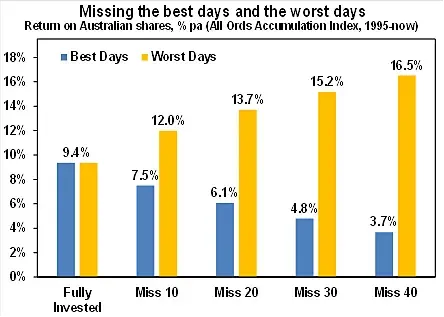
Source: Bloomberg, AMP
The more common outcome runs the other way.
Investors who turn pessimistic tend to sell after the damage is done, which puts them at risk of missing the all-important rebound. Missing just the ten best days over that same period cut the annual return to 7.5%. Worse, missing the best forty days brought it down to a lowly 3.7%.
The key takeaway is that because the best and worst trading days often cluster together in the same volatile stretches, there’s no reliable way to catch one and dodge the other.
Sitting tight is the only way to guarantee you’ll benefit from the long-term upsides of optimism.
Subscribe to InvestmentMarkets for weekly investment insights and opportunities and get content like this straight into your inbox.
What This Means in Portfolio Terms
This is a case for building your portfolio deliberately, and for recognising that discomfort is the price of admission for long-term growth.
That means:
■ Setting an asset allocation plan aligned to your goals, risk tolerance and time horizon.
■ Diversifying across asset classes, sectors and geographies. A core-satellite approach, which pairs a low-cost diversified core with more targeted allocations, is one way to structure this.
■ Accepting that volatility is a normal part of investing in growth assets, rather than a signal that something has gone wrong.
■ Reviewing all prospective investment decisions against your plan rather than yesterday’s headlines.
■ Actively avoiding market noise when it’s at its most dangerous: when your emotions are vying for the driver’s seat in your investment decisions.
■ Recognising that the constant availability of real-time data is also a form of noise that pushes investors to sabotage their own plans at exactly the wrong moment.
The Numbers Don’t Lie
The evidence is consistent across more than a hundred years of data: pessimism sounds sophisticated, but optimism pays.
That means recognising that the instinct to retreat from risk assets when the news headlines darken is exactly the instinct that has historically cost investors the most. Instead, build a portfolio robust enough to stay the course when your will inevitably gets tested.
Disclaimer: This article is prepared by Simon Turner. It is for educational purposes only. While all reasonable care has been taken by the author in the preparation of this information, the author and InvestmentMarkets (Aust) Pty. Ltd. as publisher take no responsibility for any actions taken based on information contained herein or for any errors or omissions within it. Interested parties should seek independent professional advice prior to acting on any information presented. Please note past performance is not a reliable indicator of future performance.
Author

Simon Turner
Head of Content (CFA), InvestmentMarkets
Related Articles
-yl671u6drcf32cbl7glf.png)
-s5c0uf81il26meg3icyx.png)
Categories
Recent Articles
View all articles-x9ncxgltmlhab5yvh7nd.png)
-biy2kjxbgtb4uoevomc0.png)
-f9omdi3sg0r89crzabcq.png)