You may think of momentum as a basic strategy that involves buying whatever has gone up most recently. That would be unfair, though.
In reality, momentum is a systematic factor exposure built on a very specific empirical observation. Securities that have outperformed over intermediate horizons have tended, on average, to keep outperforming for a period, while laggards have tended to keep lagging. In other words, winners tend to keep winning and losers tend to keep losing.
Whilst momentum investing isn’t for everyone, its philosophy offers lessons to most investors looking to improve their performance.
Momentum vs Performance-Chasing
Jegadeesh and Titman’s early work on buying winners and selling losers showcased the performance benefits of momentum investing based on US data.
AQR’s long-running ‘Value and Momentum Everywhere’ research confirmed the outperformance of a momentum strategy using global data, and confirmed it’s a persistent feature of markets.
What separates momentum from performance chasing is the methodology behind it.
Performance chasing is behavioural, discretionary, and usually retrospective.
In contrast, rules-based momentum investing is pre-committed, transparent, and designed to avoid precisely the emotional errors that discretionary investors make.
MSCI’s methodology illustrates this. Its momentum indices combine 6-month and 12-month price momentum, exclude the most recent month, adjust for the local risk-free rate, and then scale the signal by realised volatility. In other words, the signal is a risk-adjusted, multi-horizon measure intended to identify persistence rather than noise. The exclusion of the latest month matters because it tries to reduce the influence of very short-term reversals, which are often where undisciplined chasing is most destructive.
MSCI’s Australian Momentum Index makes the case more nuanced, and more credible. Since its 1995 inception, it’s delivered a gross return of 11.1% p.a. versus 8.7% for the broader MSCI Australia index. That’s solid long-term outperformance. But interestingly, over the most recent year to 31st March 2026, the momentum index returned 18.9% against 21.8% for the parent index, while over 10 years it has also trailed, at 7.8% p.a. versus 8.4% p.a.
That’s exactly the sort of pattern you’d expect from a genuine factor premium. It works over long horizons, but it doesn’t work all the time, and it can be distinctly uncomfortable over shorter windows.
This cyclicality is central to understanding momentum investing.
As per Daniel and Moskowitz’s research, momentum investing can suffer severe reversals, especially when markets rebound sharply after selloffs, and the previously weak, high-beta names bounce the hardest.
This is the reason why sophisticated momentum investors place so much weight on risk control, and regular rebalancing. It makes the inevitable pain of the strategy legible, anticipated, and governable.
This knowledge is a superpower that enables seasoned momentum investors to hold their exposure through inevitable bouts of market volatility.
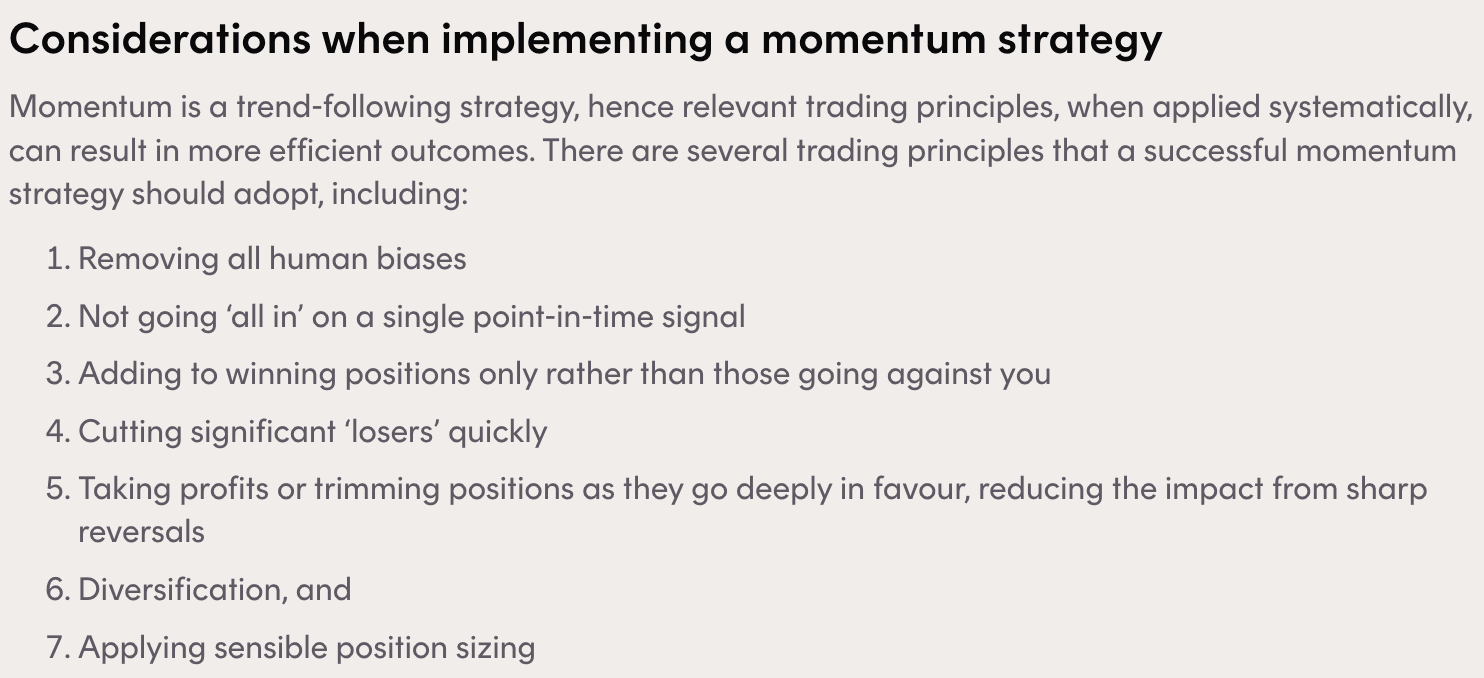
A rules-based approach, like the BetaShares rules below, forces momentum investors to buy strength only when it fits within a pre-specified signal, to cut deteriorating names when they fail that signal, and to accept periods of underperformance without improvising a new philosophy every quarter.
Source: Betashares
Explore 100's of investment opportunities and find your next hidden gem!
Search and compare a purposely broad range of investments and connect directly with product issuers.
Examples of Local Momentum Funds
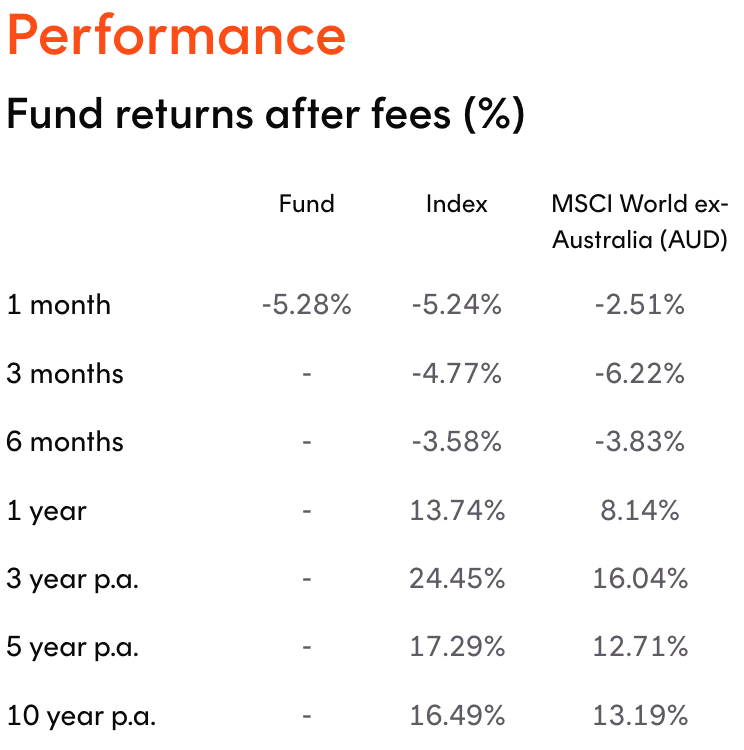
The clearest pure-play example of a momentum strategy in Australia is the BetaShares Australian Momentum ETF (MTUM). The fund tracks an index of Australian companies with above-average momentum scores measured by risk-adjusted returns. The portfolio construction is notably specific: the index ranks the 200 largest ASX stocks by 6-month and 12-month risk-adjusted returns, selects the top 50 at each selection date, repeats that process every two months across the last four selection days, and typically ends up with around 90 holdings after applying its consistency and removal rules. As at 10th April 2026, BetaShares had A$199.5 million in net assets and charges a management cost of 0.35% p.a. The great benefit of this ETF is that it provides a codified, momentum-focused selection and rebalancing process with explicit rules about entry, persistence and exit.
Source: Betashares
The iShares Edge MSCI Australia Multifactor ETF (AUMF) is also noteworthy. It isn’t a pure momentum vehicle, but utilises the strategy to its benefit. The fund targets four factors, quality, value, size and momentum, while seeking to keep overall risk similar to the broader market. As at 31st March 2026, the fund had A$140.2 million in assets, and charges a management fee of 0.30% p.a. For investors who believe in the power of momentum but are wary of the factor’s standalone cyclicality, it may offer a more tolerable and balanced route. This type of fund dilutes the purity of the signal, but it also reduces the risk that one factor’s bad season dominates the whole experience.
There’s also an interesting managed fund worth being aware of. Ausbiz Capital Growise Fund invests based on trend following, momentum signals, mean reversion, statistical arbitrage, and intermarket analysis. That is not the same thing as a transparent factor ETF, but it does show how momentum can be embedded within a broader, more tactical process.
Another Tool for Your Toolkit
Momentum deserves a place in your investment toolkit. The data supports it too strongly for dismissal, yet its drawdowns and reversals are too real for complacency. The sensible conclusion is that momentum is most useful when it’s part of a repeatable process rather than a source of excitement.
Momentum investing’s greatest contribution may be that it imposes a form of discipline which many investors discover too late that they were lacking.
Funds Mentioned
MTUM aims to track the performance of an index (before fees and expenses) comprising a portfolio of Australian companies with above average momentum scores, as measured by risk-adjusted returns.
Retail Investor
The fund aims to provide investors with the performance of the MSCI Australia IMI Diversified Multiple Factor (AUD) Index, before fees and expenses. The index is designed to measure the performance of Australian equities that have favorable exposure to four target style factors subject to constraints.
Retail Investor
Access a High Performing Algorithmic hedge fund.
Retail Investor
Category
Hedge/Short/Geared Funds
Availability
Open for investment
Funding Stage
Unlisted Early-Stage Fund
Disclaimer: This article is prepared by Simon Turner. It is for educational purposes only. While all reasonable care has been taken by the author in the preparation of this information, the author and InvestmentMarkets (Aust) Pty. Ltd. as publisher take no responsibility for any actions taken based on information contained herein or for any errors or omissions within it. Interested parties should seek independent professional advice prior to acting on any information presented. Please note past performance is not a reliable indicator of future performance.



-drhkgsdwk8x3oqxim0go.png)
-uo4eg7ge0ysewqkveu92.png)
-qn47nb2t9h7iuvyq9ohf.png)
-cjojn8hw3e0gc4lk8069.png)
-91mhtehskiukrsa930g2.png)
-t5z4ob41uwrlwil2guow.png)