-ud47t4rjssebstvildat.png)
The World Is Bigger Than Wall Street: How to Choose a Global Ex-US ETF
Here’s an investment truth that not everyone is focused on: when most Australian investors think they are diversifying globally, they are really just buying more US exposure.
It’s often an unconscious move.
Most global indices, ETFs and funds are massively overweight the US market. For example, the MSCI World Index has a US weighting of 72%.
Think about that for a moment. Almost three-quarters of the market cap of the most-used global index in the world is invested in just one country: America. Most would agree that’s an extraordinary state of affairs.
In short, it’s time to be more conscious of your international exposure and the intention behind it.
If you intend to be overweight the US market, that may well make sense longer term. After all, the US market remains an innovation powerhouse on a scale the world has arguably never seen before.
But this strategy should be a decision rather than a default setting care of America’s dominance of the global market cap within the main indices.
Equally, if you want international diversification without so much US dominance, there’s an optimal pathway forward worth being aware of to achieve that.
Key Takeaways
- A global ex-US ETF holds listed companies outside the US, and understanding the index it tracks is the key to ensuring you are genuinely diversifying.
- MSCI World has a 72% weighting in the US, and MSCI World ex Australia still holds 73% of its weight in American companies, while MSCI ACWI ex USA and FTSE All-World ex-US exclude the US but include emerging markets, and MSCI EAFE does not.
- Global ETF investors should focus on: index coverage, currency hedging, and how an ETF overlaps with what you already own.
A Second Home Bias?
Australian investors’ home market bias is well documented.
The investment implications are major.
For starters, the ASX represents just 2% of global equity market capitalisation, while there are enormous sectoral differences in the local market versus the global market.
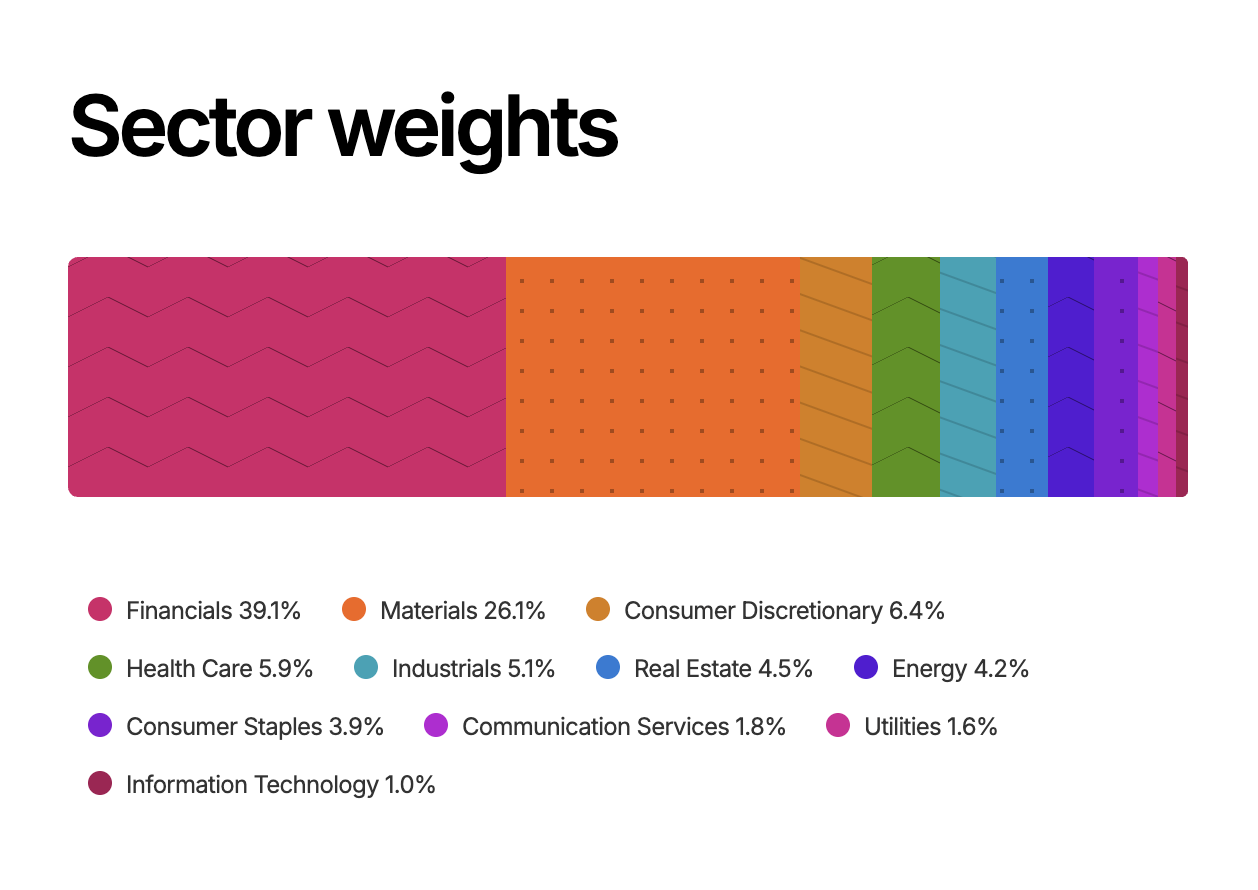
For example, financials and materials make up 65% of the local market, against 19% of the MSCI World ex Australia Index.
MSCI Australia Breakdown
Source: MSCI
Moreover, information technology represents 30% of the MSCI World ex Australia Index versus a lowly 1% of the MSCI Australia Index. Given the technology sector’s global dominance in recent years, this glaring local gap is one of the more important ones to be aware of.
MSCI World ex Australia Index Breakdown

Source: MSCI
So, the arguments in favour of Australian investors ensuring they are globally diversified are compelling — which brings us back to the inherent US overweight in the global indices.
At the heart of the issue is how successful big tech in the US has been in recent years.
Case in point: the top 10 companies, many of them in the technology sector, now account for 38% of the S&P 500.
The upshot is that an investor who owns most global ETFs (and many global funds) is effectively making a concentrated bet on the US tech sector.
That may well prove fruitful over the long term, although it’s important to be aware of your US tech bias to ensure your portfolio is as diversified as you intend it to be.
As shown over the past year, the US market will not always be the top-performing global market.

Valuation is also part of the story, with many global markets offering better value than the US market at this juncture.

Explore 100's of investment opportunities and find your next hidden gem!
Search and compare a purposely broad range of investments and connect directly with product issuers.
Six Steps to Identify the Right Global Ex-US ETF for Your Portfolio
1. Focus on the right index
‘ex-US’, ‘ex-Australia’ and ‘international’ are not synonyms, and the differences between them are enormous.
For example, MSCI World ex Australia still holds 73% of its weight in American companies.
MSCI EAFE excludes the US, Canada and all emerging markets.
FTSE All-World ex-US and MSCI ACWI ex USA include emerging markets.
Understanding index differences like these is the highest-value minute of research an ETF investor can spend.
2. Check the concentration
Ex-US means differently concentrated rather than perfectly diversified.
The largest holdings in a typical all-world ex-US fund are Taiwan Semiconductor, ASML, Novo Nordisk, Toyota and Nestlé, with the top 10 accounting for 15% of the fund. Two of those five are semiconductor businesses. Hence, a meaningful slice of your diversification is the same AI trade as is provided by US and global ETF exposure, just priced in a different currency.
Emerging market indices are more concentrated again, typically carrying around three-quarters of their weight in Taiwan, China and South Korea. This is worth knowing before buying an emerging markets ETF.
3. Should you hedge currency or stay unhedged?
Currency is where Australian investors most often lose money without noticing, as a rising Australian dollar reduces unhedged offshore returns when they are converted home.
Unhedged exposure has historically cushioned portfolios in global risk-off episodes, because the Australian dollar tends to fall when the world panics.
Currency-hedged ETFs isolate the underlying asset return, which may suit investors spending in Australian dollars now.
There’s no one right answer to the currency-hedging question for all market conditions.
4. Market exposure or a factor tilt?
Some global ETFs provide pure market exposure aligned with a global index.
Others embed a value, quality or small-cap tilt, such as the VanEck MSCI International Quality (AUD Hedged) ETF (QHAL) or the Dimensional Global Small Companies Active ETF (DGSM).
These different strategies can significantly diverge over years, so buying them intentionally is important.
And if you opt for active global exposure, make sure you set the bar high.
SPIVA Australia’s 2025 scorecard found that 70% of global equity fund managers underperformed over one year, and 96% over 15 years.
Adding value has rarely been more important for active managers in this competitive space.
5. What does a global ETF really cost?
Fees on broad international ETFs can be very low, but the ASX trading day barely overlaps European and American hours, so spreads can widen when underlying markets are closed.
Hence, using limit orders arguably matters more for global ETFs than for domestic ETFs.
6. How should you size an ex-US allocation?
Treat ex-US as an allocation with a job to do, rather than a product to buy.
Decide first whether your aim is to reduce your US concentration, access cheaper earnings or diversify your currency exposure, because those goals point to different ETFs.
Then size your exposure against what you already own.
From there, a global ETF comparison is relatively straightforward.
A Compelling Case for Global Diversification Beyond the US
The case for Australian investors looking beyond Wall Street is compelling. A home bias combined with the US dominance within global ETFs and funds tends to result in a concentrated portfolio wearing the costume of a diversified one. The past year’s performance has made that cost more visible.
It’s worth remembering that almost 30% of global market capitalisation sits outside the US, along with far more than 30% of the world’s companies, revenues and growth. Owning some of that exposure deliberately is a key step towards genuine diversification.
Subscribe to InvestmentMarkets for weekly investment insights and opportunities and get content like this straight into your inbox.
Frequently Asked Questions
Is a global or world equity fund the same as an ex-US fund?
No. The MSCI World Index has a 72% US weighting, and MSCI World ex Australia still has a 73% US weighting. Only indices built to exclude the US, such as MSCI EAFE, MSCI ACWI ex USA and FTSE All-World ex-US, remove that exposure.
How much US exposure does a typical Australian portfolio already carry?
Across 14 large Australian super funds, the US accounts for 61% of listed international exposure, with Europe at 12% and all emerging markets at just 5%.
Added to an ASX allocation dominated by financials and materials, that’s effectively two concentrated positions rather than one diversified portfolio.
Should Australian investors hedge currency on international shares?
There is no right currency choice for everyone at all times.
Unhedged exposure has historically cushioned portfolios in global risk-off episodes, whereas hedging isolates the underlying asset return and suits investors spending in Australian dollars now.
Are global ex-US ETFs genuinely diversified?
They are differently concentrated rather than unconcentrated.
The largest holdings in a typical all-world ex-US fund are Taiwan Semiconductor, ASML, Novo Nordisk, Toyota and Nestlé, with the top 10 at about 15% of the fund.
Emerging market indices typically carry around three-quarters of their weight in Taiwan, China and South Korea.
Have markets outside the US actually outperformed?
Recently, yes.
In 2025 the MSCI ACWI rose 22.3% in US dollar terms against 17.9% for the S&P 500. The Japanese market has been a noteworthy outperformer.
What are the main risks of a global ex-US allocation?
Cheaper valuations can reflect weaker fundamentals.
From mid-2008 to end-2024, the S&P 500 grew earnings about four times faster than those in the MSCI EAFE. In global investment markets, you tend to pay up for quality.
Overlap is the other main risk. Holding a global fund, an ex-US fund, an emerging markets fund and a semiconductor thematic can mean owning the same company four times.
Disclaimer: This article is prepared by Simon Turner. It is for educational purposes only. While all reasonable care has been taken by the author in the preparation of this information, the author and InvestmentMarkets (Aust) Pty. Ltd. as publisher take no responsibility for any actions taken based on information contained herein or for any errors or omissions within it. Interested parties should seek independent professional advice prior to acting on any information presented. Please note past performance is not a reliable indicator of future performance.
Author

Simon Turner
Head of Content (CFA), InvestmentMarkets
Related Articles
-gfp1xjdx24emq6stx0qn.png)

Categories
Recent Articles
View all articles-x9ncxgltmlhab5yvh7nd.png)
-biy2kjxbgtb4uoevomc0.png)
-f9omdi3sg0r89crzabcq.png)