-vmtf4wo29a20xxj6oknl.png)
The Great Uranium Deficit: A Shortage the Market Has Stopped Paying For
Uranium has become a rare commodity where almost everyone agrees on its direction and almost nobody agrees on the optimal timing.
Long-term uranium contracts are being written at the highest prices in 18 years, the world’s largest producer is deliberately holding back supply, yet uranium equities are still roughly a third cheaper than they were in January.
That glaring gap between the physical market and uranium equities could well be an opportunity in the making.
A Thesis that Stopped Working for a While
The Global X Uranium ETF (ASX: ATOM) is currently trading around a third below its 52-week high achieved in late January this year.
The pattern is global rather than local.
VanEck has noted that its Uranium and Nuclear ETF fell 35% from its own 28 January peak through mid-July, while pre-revenue reactor developers such as Oklo and NuScale dropped 73% and 83% respectively from their 52-week highs.
It’s been a selloff to test even the most ardent uranium bulls.
What makes this hard for many investors to understand is that the physical uranium market hasn’t deteriorated during that time.
Cameco reported an end-of-July spot price of about US$86 a pound, close to where it’s been since February.
TradeTech’s long-term indicator, which tracks the multi-year contracts utilities sign, hit US$93 a pound on 31 March, its highest in more than 18 years.
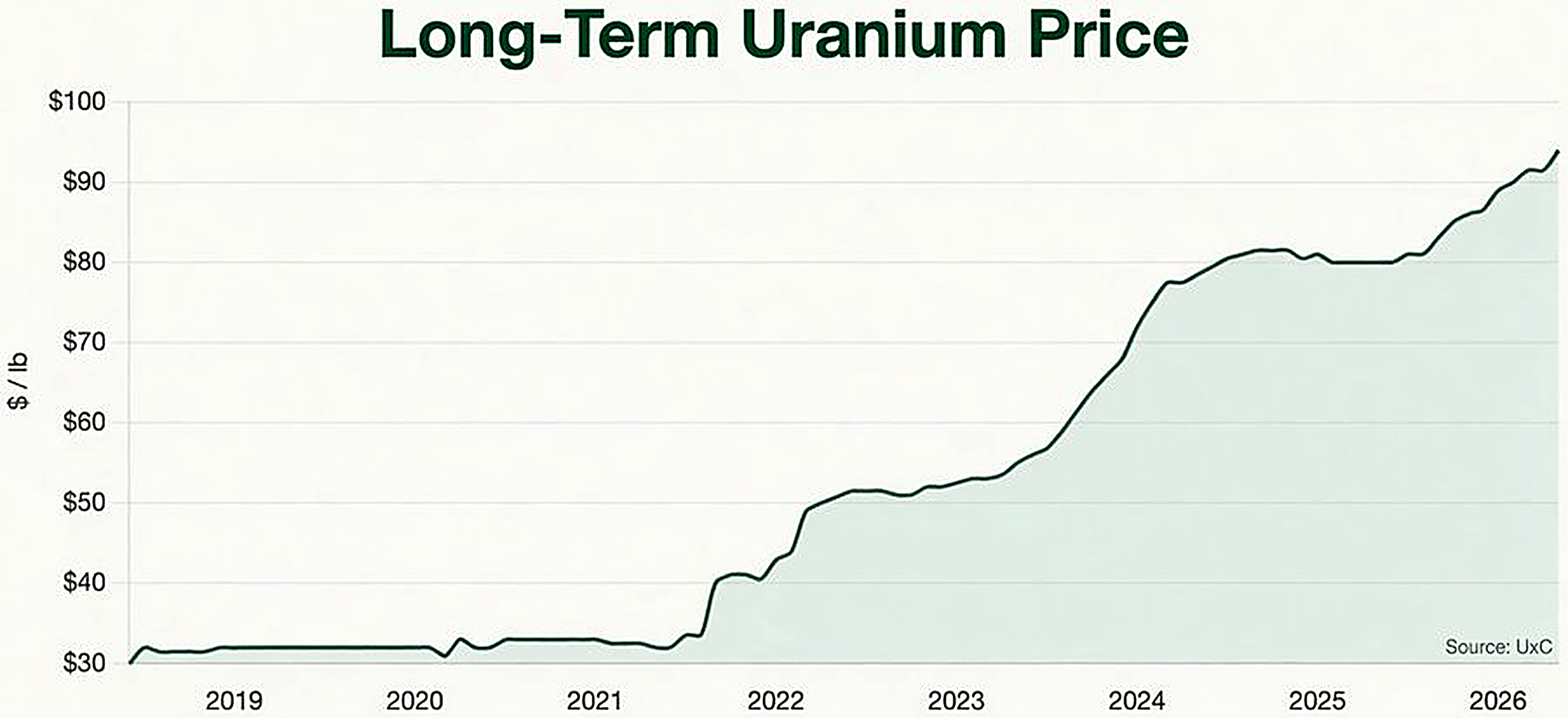
When a commodity holds and its producing equities fall by a third like this, either the market has decided that the anticipated deficit isn’t realistic, or that it will arrive later than the market previously assumed.
The evidence points to the latter implication.
Explore 100's of investment opportunities and find your next hidden gem!
Search and compare a purposely broad range of investments and connect directly with product issuers.
What the Physical Market is Saying
The outlook for nuclear energy is undeniably bright.
The World Nuclear Association’s Nuclear Fuel Report projects global nuclear capacity rising from 398 gigawatts in mid-2025 to 746 gigawatts by 2040.
Today’s fleet consumes roughly 70,000 tonnes of uranium a year. Under the upper projected scenario, that’s on track to approach 200,000 tonnes annually by 2040, and the 1,200 gigawatts implied by the pledge to triple nuclear capacity would need about 250,000 tonnes.
Supply is moving in the other direction.
Kazatomprom, which produces more than a fifth of global primary supply, confirmed it would cut its 2026 nominal production from 32,777 to 29,697 tonnes. That’s close to 5% of global supply.
The stated reason is a big deal for the uranium price outlook.
While earlier cuts were blamed on sulphuric acid shortages, this one was based on prices being too low. The company said current prices and uncovered demand don’t justify returning to full capacity.
That’s supply discipline rather than supply failure, and considerably harder for utilities to wait out.
The association’s own fuel cycle conference this year described the industry’s position as ‘abundant ambition, but constrained commitment’.
The potential for a larger-than-expected deficit is significant. Top-producing mines are expected to deplete during the 2030s, while new ones take close to a decade to permit and build.
In the words of UBS: ‘While the earth’s uranium resources are ample, the main challenge is timing: Many of today’s largest mines will see declining output or exhaustion within 10-20 years.’
This is why the major investment banks are forecasting an enormous uranium deficit in the coming years, as illustrated below.
-5hwq1pydb7pq9gbvoaxl.jpeg?_a=BAMAAAiw0)
This significant and expanding deficit is the very reason uranium skyrocketed from US$10 to US$143 a pound between 2003 and 2007 when the last major uranium bull market played out.
There are few obstacles on the way up once a uranium bull market reaches the euphoric state it’s known for. Reactors can’t switch fuel, utilities can’t defer purchases indefinitely, and fuel is a small enough share of their operating cost to ensure a rising price will rarely constrain demand.
Why Has the Sector Underperformed?
Of course, understanding why a sector has underperformed helps explain why that situation may reverse in the future.
The fundamental challenge faced by uranium equities in 2026 has been that the sector has increasingly been integrated within the broader AI trade, which faced headwinds earlier in the year.
VanEck places most of the sector’s decline around and after the first-quarter hyper-scaler earnings results, as investors shifted from celebrating data centre capex to questioning its pace and returns.
This led to a valuation reset across the AI-adjacent complex, including uranium equities, rather than a repricing of nuclear fuel.
There was also a genuine analytical dispute worth respecting.
The mid-2030s supply gap in the association’s latest report was contested by fuel buyers, partly because of a technical change in how secondary supplies are counted.
Producers want long contracts at high prices. Utilities don’t. So, investors focusing on producer research like this have been hearing just one side of a live negotiation at a time when the deficit is building faster than ever.
Subscribe to InvestmentMarkets for weekly investment insights and opportunities and get content like this straight into your inbox.
Australian Exposure Not Really Australian
Australia holds 27.7% of the world’s uranium resources and mines very little of it.
Western Australia has banned new uranium mining since 2017, Victoria bans it outright, and Queensland and New South Wales allow exploration but not extraction, although a repeal bill passed the New South Wales upper house in May.
So, the Australian uranium sector generally includes companies operating in other parts of the world. Paladin Energy, for example, operates its Langer Heinrich mine in Namibia.
Portfolio Implications
For most investors, not picking individual stocks within the uranium sector is probably a prudent strategy given the complexities of investing in specialist miners and the conviction required to succeed in this space.
Thankfully, thematic uranium ETFs spread operational risk across the main uranium stocks in the world. They are a prudent option for most investors wanting exposure to this niche theme.
For example, Global X Uranium ETF (ASX: ATOM) holds 52 positions which provide diversified exposure to the global sector.
Some Trade-Offs to Weigh Up
Three risks deserve prospective investors’ attention:
- Uranium equities are a geared expression of a volatile commodity, so a flat uranium price can still produce a 30% drawdown, as this year has shown.
- Execution matters. For example, weather suspended Boss Energy’s Honeymoon operation in South Australia in March, and Paladin has a history of guidance downgrades.
- Then there’s time. Contracts signed today deliver revenue years from now, and a thesis resolving in the early 2030s may be a mismatch for shorter-term capital.
An Opportunity Worth Being Aware Of
The uranium investment case remains as compelling as ever. It has been de-rated at a time when the long-term upside appears higher than ever.
For investors wanting exposure, uranium exposure could represent a solid satellite holding, sized so that the next unexpected 30% fall is inconvenient rather than consequential, and held with the patience the mine developers are being asked to show.
Disclaimer: This article is prepared by Simon Turner. It is for educational purposes only. While all reasonable care has been taken by the author in the preparation of this information, the author and InvestmentMarkets (Aust) Pty. Ltd. as publisher take no responsibility for any actions taken based on information contained herein or for any errors or omissions within it. Interested parties should seek independent professional advice prior to acting on any information presented. Please note past performance is not a reliable indicator of future performance.
Author

Simon Turner
Head of Content (CFA), InvestmentMarkets
Related Articles
-0h3zq8uq8ku929lsj9b8.png)
-tynzb3z5dtparcxsf2d2.png)
Recent Articles
View all articles-uo4eg7ge0ysewqkveu92.png)
-qn47nb2t9h7iuvyq9ohf.png)
-01xhfy3zxeb8rav1zavf.png)