-8uexkx4bnscs7ze3rtpw.png)
Is Zimbabwe’s Stock Market Explosion a Preview of Coming Events for Developed Markets?
Since Zimbabwe reintroduced its own currency in 2019, its stock market has produced one of the strangest scoreboards in modern finance. The Zimbabwe Stock Exchange’s All Share Index has risen 30,000-fold in local currency, yet an investor counting their returns in US dollars would have lost more than half their capital.
Meanwhile, the developed world is carrying debts last seen after the Second World War: US federal debt held by the public has passed 100% of GDP for the first time since then.
Zimbabwe’s infamous history shows what persistent money printing does to equity prices, savings and the yardstick investors use to judge them, while its 2026 rally, which has put the exchange at the top of Africa’s performance tables, shows what happens when monetary discipline returns.
The lessons are surprisingly useful to developed market investors: judge returns in real, hard-currency terms, favour businesses with pricing power, and be wary when a weakening currency is doing the heavy lifting for you.
So, is Zimbabwe a timely warning or an irrelevant curiosity?
Key Takeaways
- Since Zimbabwe reintroduced its own currency in 2019, its All Share Index has risen about 30,000-fold in local currency but fallen about 54% in US dollars.
- Shares soared because a collapsing currency shrank the measuring stick, savers had nowhere else to go, and listed companies own real assets whose prices rise with inflation.
- The 2026 rally is different. With inflation near 4%, local and US dollar returns have converged above 70%.
- US deficits of about 6% of GDP point to a slow-motion, developed-market version of the same pressure. Judge every return in real, hard-currency terms.
Why Zimbabwe Became the World’s Favourite Monetary Parable
Zimbabwe is the modern textbook case of a government printing money to pay its bills.
When inflation peaked in November 2008, economist Steve Hanke estimated the annual rate at 89.7 sextillion percent, with prices doubling roughly every 24 hours. With official statistics largely useless at the time, Hanke measured it using the share price of Old Mutual, which traded in both Harare and London.
The Lesson: when money devalues too fast to be useful, a share in a real business becomes one of the few reliable stores of value.
Explore 100s of investment opportunities and find your next hidden gem!
Search and compare a purposely broad range of investments and connect directly with product issuers.
Nominal Gains Can Be a Mirage
The thing is, a soaring index in a collapsing currency mostly measures the shrinking yardstick.
Case in point: since the Zimbabwe dollar returned in early 2019, the Zimbabwe Stock Exchange (ZSE) All Share Index has risen 30,000-fold in local currency terms. At the same time, an investor counting their returns in US dollars at official exchange rates would still be down 54%.
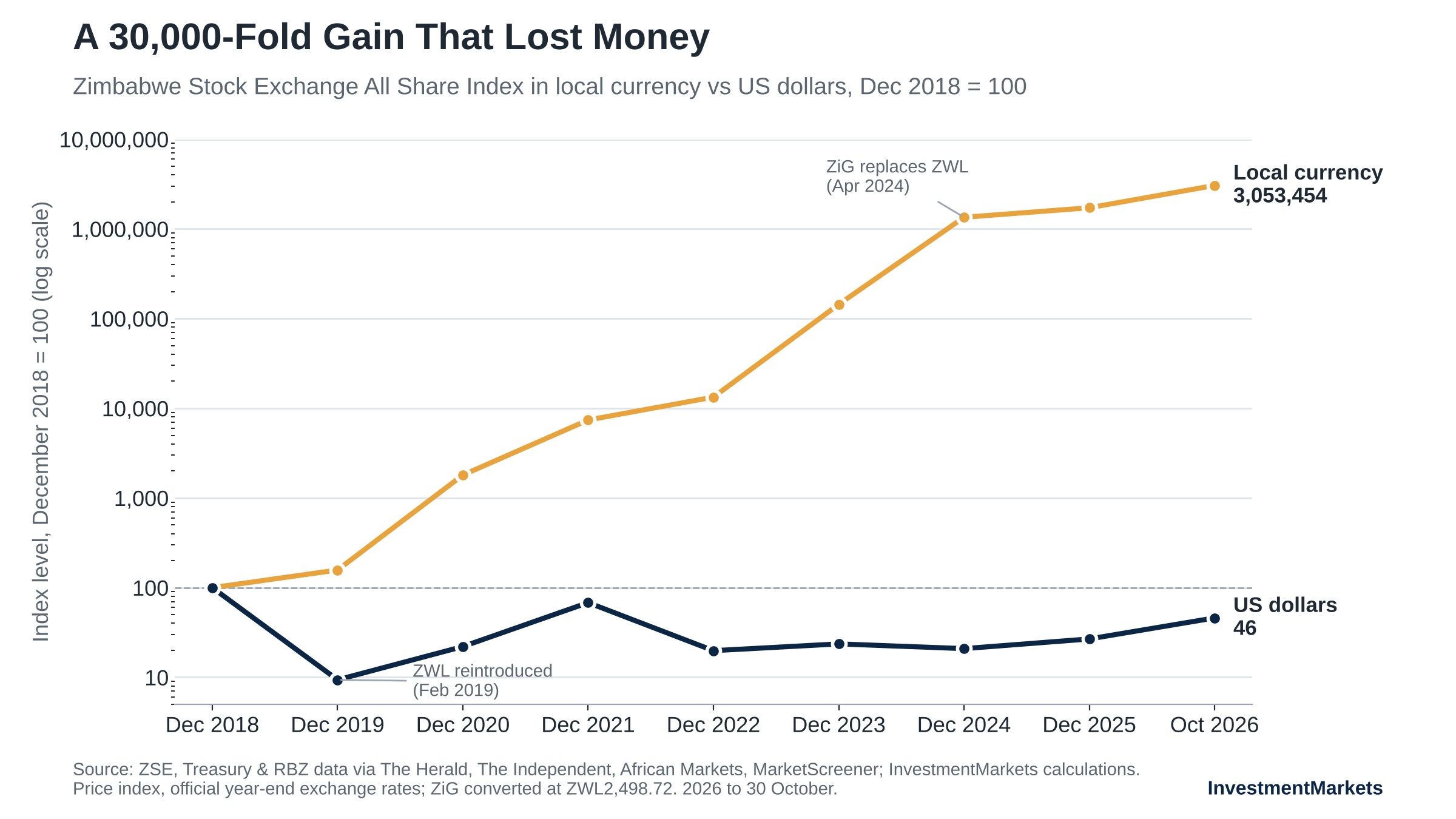
Zimbabwe Stock Exchange All Share Index in local currency and US dollars, December 2018 = 100. Sources: ZSE, Zimbabwe Treasury and Reserve Bank data; InvestmentMarkets calculations.
In short, while the index skyrocketed, the Zimbabwean dollar fell even faster.
Still, holding Zimbabwean equities protected far more local purchasing power than cash, which has lost almost all its value.
Why Did Rising Inflation & a Falling Currency Send Zimbabwean Shares Soaring?
Between 2019 and early 2024, Zimbabwe’s main index posted some of the largest nominal gains ever recorded on a stock exchange. It rose 1,046% in 2020 and 982% in 2023.
As one Zimbabwean executive observed during the 2008 hyperinflation, ‘In a hailstorm, even chickens can fly.’
Five forces explain why, and each carries a lesson that travels well beyond Harare.
- The yardstick kept shrinking.
If a currency halves, the same business must be priced at twice as many local dollars just to hold its value. ‘The market cap is tracking the exchange rate,’ Harare market analyst Batanai Matsika explained.
When inflation outran the Zimbabwean index, the illusion was exposed: in 2022 the index rose 80%, but inflation reached 243.8% and the market lost 74% in US dollars.
In 2020, by contrast, the 1,046% gain translated into a rise of 135% in US dollars.
The Lesson: A rising index doesn’t imply rising fortunes. Convert every return into a stable currency and subtract inflation before judging it.
- Earnings repriced with inflation, then moved into US dollars.
Zimbabwe’s retailers, brewers and telcos raised prices as costs rose, so nominal revenue and profit ballooned.
They also reduced their reliance on the local currency. Delta Corporation, Zimbabwe’s largest beverages group and a long-standing ZSE heavyweight, earned more than half of its Zimbabwean revenue in foreign currency in the year to March 2022, above 70% during 2023 and more than 94% in the year to March 2026, when its revenue passed US$1 billion for the first time.
Miners and exporters earning US dollars gained even more in local terms with every fall in the exchange rate.
The Lesson: Pricing power and hard-currency revenues protect shareholders, not the listing itself. In 2022, only eight of the ZSE’s 48 active stocks kept pace with inflation.
- Savers had nowhere else to go.
Bank deposits paid deeply negative real interest rates, capital controls limited access to US dollars and property was illiquid.
Listed shares were the one liquid asset that could keep pace, so pension funds, insurers and households piled in.
As one analyst told The Insider, investors were ‘running away from holding monetary assets to real assets.’
The upward volatility was something to behold. In 2023 savers pushed the main index up 600% within months, and in a single week that June the exchange halted trading twice after the index hit its 10% daily limit.
The Lesson: Trapped capital can lead to inflated valuations. When savers have no alternatives, prices reflect that lack of choice rather than business quality, and money leaves once it can.
- The stock market’s exits were closed.
Dual-listed shares let investors effectively move money offshore by buying in Harare and selling in London or Johannesburg.
Old Mutual’s Harare price implied an exchange rate far weaker than the official one, and became the black-market benchmark. The ZSE suspended Old Mutual in 2020, leaving its Zimbabwean shareholders frozen for six years until the listing moved to the VFEX on 12 August 2026.
The Lesson: In a currency crisis, the exits can be closed. Capital controls, trading suspensions and frozen listings are real risks for anyone using shares as an escape hatch.
- Negative real rates lifted valuations.
With interest rates far below inflation, the cost of holding equities instead of cash collapsed, and investors paid more for each dollar of future earnings.
The Reserve Bank’s policy rate was 40% for most of 2021, inflation ended that year at 60.7% and the All Share Index rose 311%.
When the bank lifted its rate to a world-high 200% in June 2022, with inflation at 191.6%, real rates briefly turned positive, and the market slumped in US dollar terms that year.
The Lesson: Real interest rates are a powerful hinge. Equities soar when cash pays far less than inflation and struggle when real rates turn positive, which is exactly the variable developed-market investors should watch.
What Has Driven Zimbabwe’s Inflation?
The root cause of inflation has been consistent: Zimbabwean governments spending money they don’t have, with the central bank creating it.
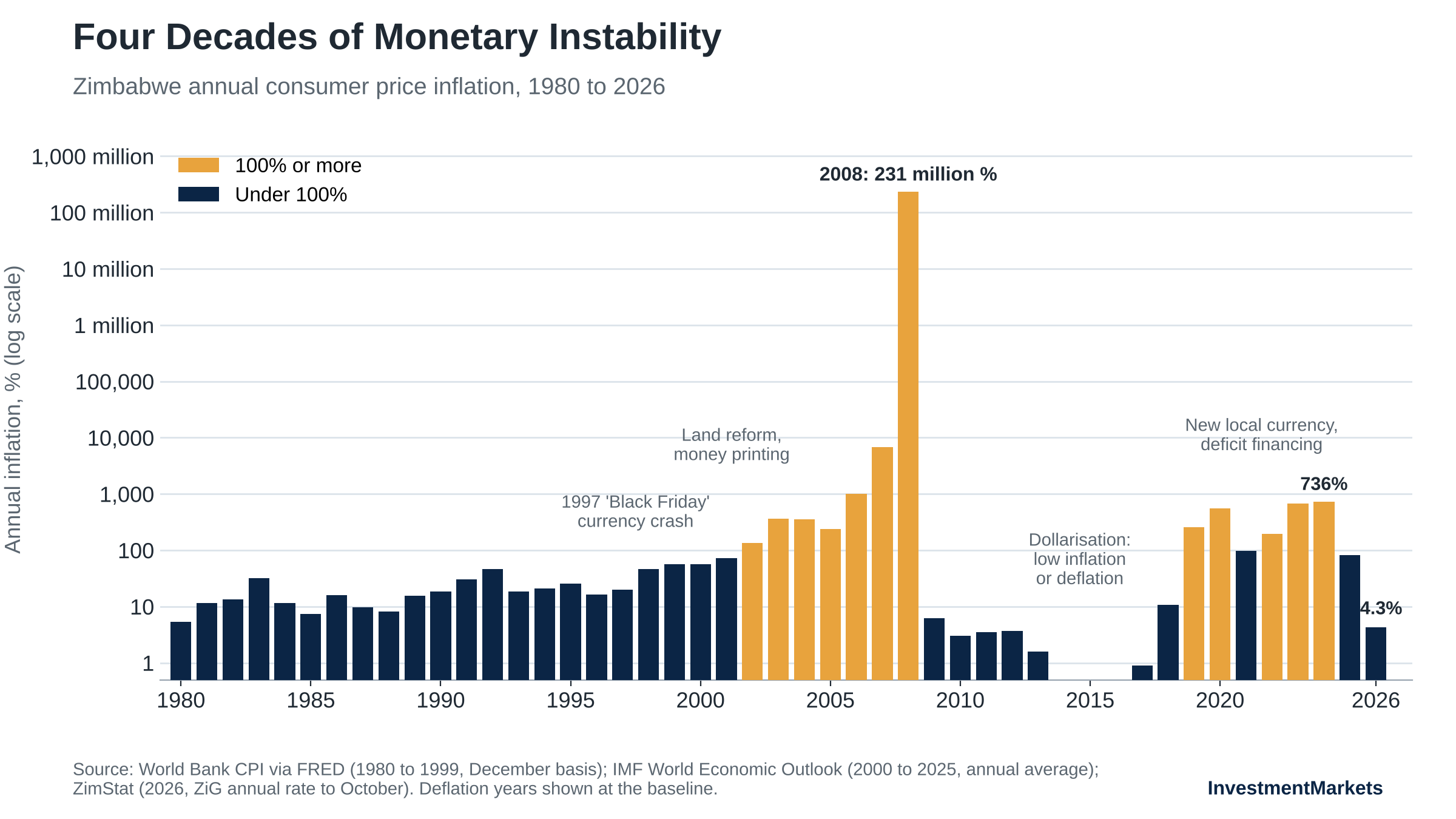
Zimbabwe annual consumer price inflation, 1980 to 2026 (log scale). Sources: World Bank, IMF World Economic Outlook, ZimStat.
Four periods stand out:
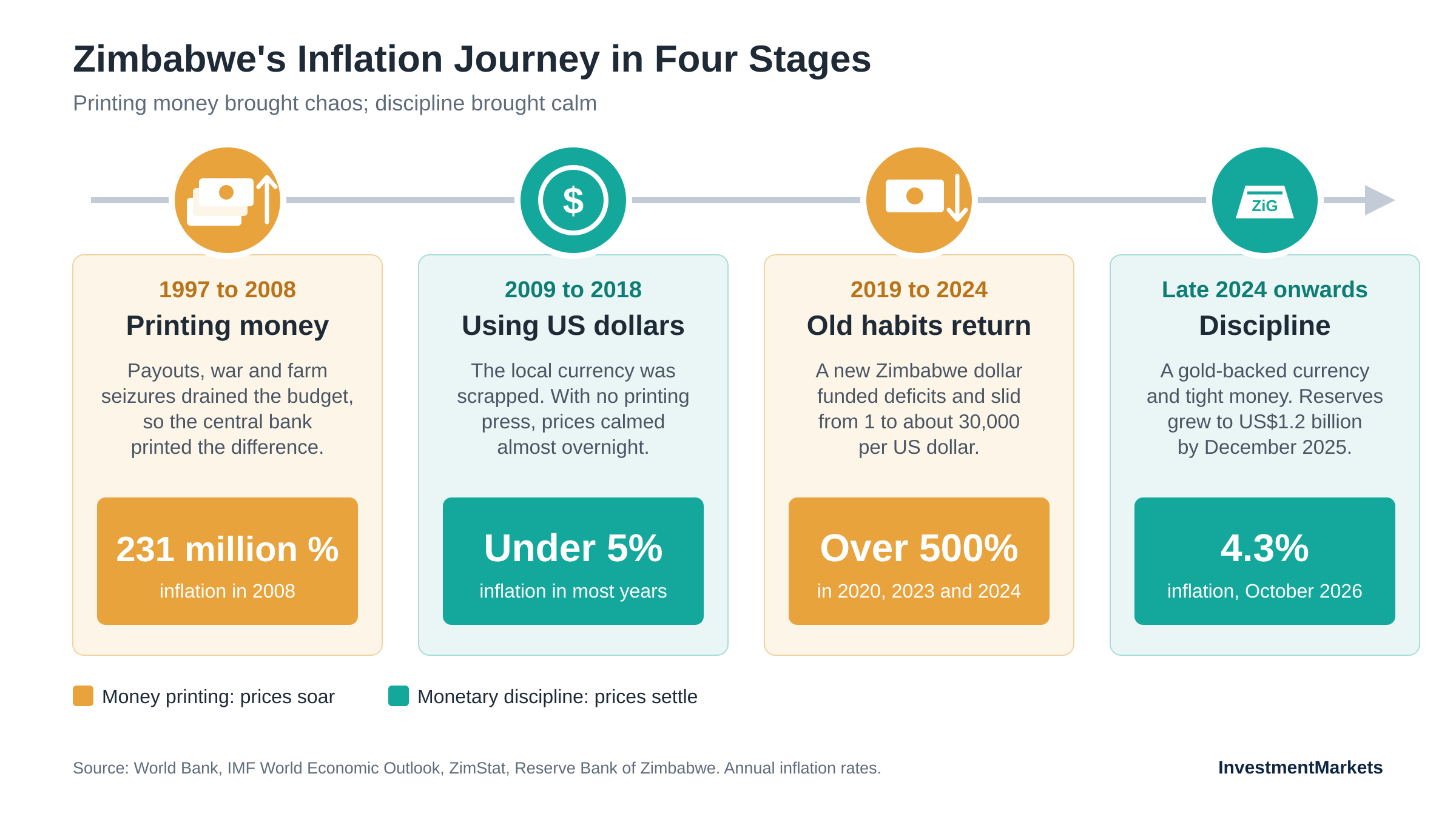
Zimbabwe’s inflation journey in four stages. Sources: World Bank, IMF World Economic Outlook, ZimStat, Reserve Bank of Zimbabwe.
2026: A Very Different Kind of Rally
This year’s surge in Zimbabwean equities shows up in hard currency. The ZiG has held near 26 to the US dollar, inflation has fallen from a peak of almost 96% in July 2025, and the central bank has cut its policy rate from 35% to 27.5% since June.
By 30 October the ZSE was up 77% for the year in local currency, or 72% in US dollars, after a 27.7% gain in 2025.
The irony is hard to miss. Zimbabwe’s best real returns arrived only when it stopped behaving like Zimbabwe. Stability, not printing, created genuine wealth.
Subscribe to InvestmentMarkets for weekly investment insights and opportunities and get content like this straight into your inbox.
Are Developed Markets Drifting Toward the Same Playbook?
Few people seriously expect American inflation to follow the Zimbabwean playbook.
The US issues the world’s reserve currency and has deep bond markets and an independent central bank.
However, America’s fiscal arithmetic is moving in a worrying direction.
The Congressional Budget Office projects a 2026 deficit of US$1.9 trillion, or 5.8% of GDP, with public debt rising from 101% of GDP to 120% by 2036, above the 1946 record of 106%.
Moreover, the Committee for a Responsible Federal Budget estimates the fiscal 2026 deficit came in closer to US$2 trillion, or 6.2% of GDP, with interest alone hitting US$1.1 trillion in fiscal 2026.
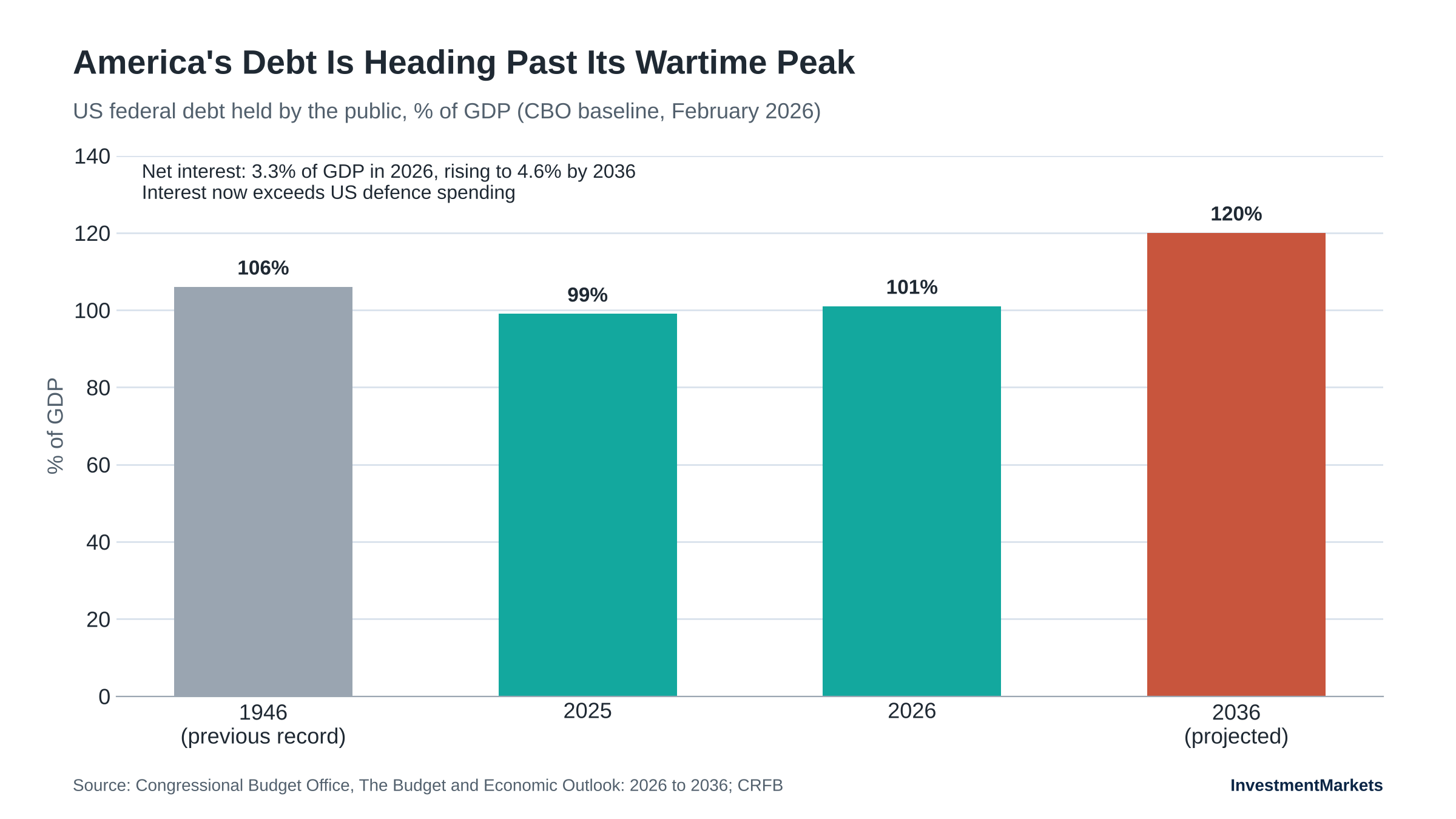
US federal debt held by the public as a share of GDP. Source: Congressional Budget Office.
When debts outgrow the economy like this, governments have historically leaned on mild inflation to shrink them.
Bridgewater founder Ray Dalio shares the concern.
He has warned that the monetary order is breaking down and has suggested 10% to 15% of a portfolio in gold.
Nomura strategist Charlie McElligott describes much of the developed world as pivoting to a ‘Run It Hot’ fiscal framework.
Against this backdrop, the evolution toward a developed-market version of Zimbabwe’s story could be a slow-burn process: a few extra points of inflation each year, compounding against long-dated bonds and cash.
Investment Implications
Australia is not immune.
The RBA raised rates for the fifth time this year on Melbourne Cup Day, taking the cash rate to 4.85%, and Australian 10-year yields reached 5.4% in late September, their highest level since 2011.
The currency is also playing a role. A weaker Australian dollar flatters returns on unhedged offshore assets, much as a weaker Zimbabwe dollar flattered Zimbabwean share prices, while a falling US dollar erodes them.
Australia’s mining and resources companies benefit from the same mechanism: they earn in US dollars, so a falling Australian dollar lifts their local profits.
Here are five practical steps to apply the lessons from Zimbabwe:
- Measure in real terms.
Judge every return after inflation and in a consistent currency.
- Own real claims over real businesses.
Businesses with pricing power, accessed through Australian equity funds or global ETFs, have protected purchasing power over long periods, just as Zimbabwean equities did.
Infrastructure and property with inflation-linked income can play a similar role.
- Hold a measured hedge.
A modest allocation through commodities and gold ETFs or commodities and gold funds can cushion monetary shocks, but size it to withstand 20% drawdowns.
Bitcoin and other digital assets swing far more.
- Balance your currency exposure.
Blending unhedged exposure with currency-hedged ETFs or currency-hedged global equity funds avoids a single bet on the US dollar.
- Watch duration.
Long-dated nominal bonds are most exposed to slow debasement, which is an argument in favour of shorter-duration bond funds and treating cash as a reserve rather than a long-term store of wealth.
Learn the Lesson, Skip the Panic
Zimbabwe’s stock market provides a useful stress test that shows, in extreme form, how money printing distorts the scoreboard. Its earlier booms were illusions created by a dying currency; its 2026 rally is the reward for restoring trust in money.
Developed markets don’t face the same extremes, but their steady drift towards higher debt is a warning sign.
The prudent response is to create a portfolio that keeps compounding in real terms whatever happens to the currency: own quality businesses and real assets, hold a sensible hedge, and keep a clear view of what your returns are worth after inflation.
To test how your current mix would cope, read our guide on how to stress test your portfolio and our stagflation survival guide.
Frequently Asked Questions
Why Did Zimbabwe’s Stock Market Rise So Much?
Mainly because its currency collapsed. Share prices rose to reflect a shrinking currency, inflated earnings and savers fleeing negative real interest rates. Measured in US dollars, most of those gains disappeared, and long-term investors remain behind even after the 2026 rally.
How Has Zimbabwe’s Stock Market Performed in US Dollars?
Poorly over the long term. From December 2018 to October 2026 the All Share Index fell about 54% in US dollars at official exchange rates, despite a roughly 30,000-fold rise in local currency. In 2026 alone, it has returned about 72% in US dollars.
What Caused Zimbabwe’s Hyperinflation?
Government deficits funded by the central bank, made worse by the collapse of commercial farming after land reform, which slashed exports and tax revenue.
Is the United States at Risk of Zimbabwe-Style Hyperinflation?
Very unlikely. The US issues the world’s reserve currency, borrows in its own currency and has an independent central bank. The realistic risk is inflation running modestly above target for years, eroding the real value of cash and long-term bonds.
How Can Australian Investors Protect a Portfolio Against Currency Debasement?
Common approaches include owning quality equities and real assets such as infrastructure, holding a modest allocation to gold, balancing hedged and unhedged currency exposure, and limiting long-duration bonds. The right mix depends on your goals and time horizon, so consider personal advice before making changes.
Can Australians Invest in Zimbabwean Shares?
Direct access is limited and liquidity is thin. Most Australian-listed emerging markets funds and emerging markets ETFs hold little or no Zimbabwean exposure, and the market’s small size and currency history make it a speculative exposure at best.
Disclaimer: This article is prepared by Simon Turner. It is for educational purposes only. While all reasonable care has been taken by the author in the preparation of this information, the author and InvestmentMarkets (Aust) Pty. Ltd. as publisher take no responsibility for any actions taken based on information contained herein or for any errors or omissions within it. Interested parties should seek independent professional advice prior to acting on any information presented. Please note past performance is not a reliable indicator of future performance.
Author

Simon Turner
Head of Content (CFA), InvestmentMarkets
Related Articles
-9kk4g7cq08gxnxeroenz.png)
-8vp7vkl6lrlbdlb7l4yg.png)
Categories
Recent Articles
View all articles-7g62l08qa8j6jnp0fbvs.png)
-4g91w8wveooicatk7r3d.png)
-ti3096hxzl3gm9am9ig9.png)