-drhkgsdwk8x3oqxim0go.png)
Beyond the Ozempic hype
There has been considerable hype lately surrounding the weight-loss drugs Ozempic/Wegovy which was initially designed for managing diabetes.
From short sellers who believe Ozempic will disrupt competitors to endorsements by high-profile figures like Elon Musk and former UK Prime Minister Boris Johnson, these slimming drugs have transcended medical circles, shaking up entire industries from biotech and healthcare to fast food.
Novo Nordisk’s shareholders are happy
By way of background, Ozempic/Wegovy, classified under the GLP-1 class of drugs, have been used for almost a decade to manage blood sugar levels by regulating appetite and food intake. Initially approved by the FDA in 2017 for diabetes patients, they quickly gained popularity after their weight loss side effect became their biggest selling point.
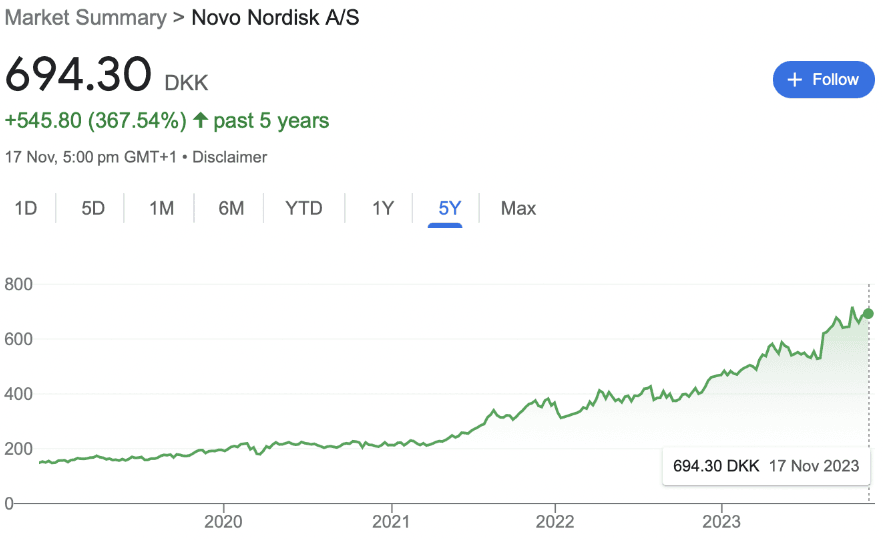
Such is the craze for these slimming drugs that in September, Novo Nordisk, the maker of Ozempic, surpassed LVMH to become Europe’s most valuable company. As shown below, its share price has almost quadrupled in the past five years and its market cap now exceeds $US450 billion—more than the entire GDP of its home country, Denmark.
The Ozempic effect
The global market for obesity treatments is tipped to explode in the next decade, with Novo Nordisk and its rival Eli Lilly leading the charge.
Novo Nordisk recently raised its outlook for the third time this year, fuelled by strong demand for Wegovy and Ozempic. Wegovy sales rose 28% to $US1.36 billion in the third quarter. The company now expects sales growth this year of 32-38%, up from a previous forecast of 27-33%.
For similar reasons, Eli Lilly has emerged as the most valuable healthcare company in the world, boasting a valuation of $US526 billion. Its success has partially been driven by its slimming drug, Mounjaro, which last month surpassed $US1 billion in quarterly sales for the first time.
According to Goldman Sachs, Lilly and Novo Nordisk are expected to collectively secure around 80% of the obesity market by 2030, with the market projected to reach $100 billion. The main challenge they are facing is the availability of drugs, though competition is also looming, with Pfizer and AstraZeneca both developing experimental drugs.
Explore 100's of investment opportunities and find your next hidden gem!
Search and compare a purposely broad range of investments and connect directly with product issuers.
A long list of casualties
The success of GLP-1 drugs has triggered a sell-off in a number of healthcare companies that have so far benefited from the obesity crisis, including makers of insulin pumps, glucose monitors, dialysis machines, and those addressing conditions like sleep apnoea. Sales of devices used for bariatric surgery have also taken a hit as many are choosing GLP-1 drugs instead.
In fact, the Australian healthcare sector has fallen 22% since early June amid growing concerns about the potential impact of the weight-loss drugs on sector heavyweights CSL and ResMed. Both are down more than 20% in the past six months.
Short sellers expect ResMed to lose out as these slimming drugs can suppress sleep apnoea. ResMed is known as a global market leader in sleep devices with roughly two-thirds of its sales stemming from the sleep apnoea market.
The outlook for CSL's recently acquired kidney dialysis business has also been impacted with recent reports suggesting the GLP-1 drugs are effective at treating kidney diseases.
As the buzz surrounding the weight-loss drugs intensifies and new, more affordable products enter the market, their potential impact on reducing the risk of cardiovascular disorders and kidney problems in non-diabetic obese patients is becoming a significant industry disruptor.
Furthermore, these weight-loss drugs could also lead to a drop in the consumption of fast food and sugary drinks. Analysts warn that food companies might experience a sales dip in the upcoming months as these drugs become increasingly accessible.
Are the share price moves overdone?
In many ways, Ozempic's viral rise parallels the AI boom in the way its disruptive impacts have ravaged various listed stocks.
However, uncertainties remain given the unpredictable landscape of GLP-1 drugs as well as their availability and price point. Currently priced at around $US1,000/month, these drugs are unaffordable for most people.
This makes the impact on near-term earnings for ASX companies like ResMed and CSL appear minimal. Hence, ResMed management remain confident about the company’s 5-year forecast, anticipating that the total addressable market growth for its products will outpace any adverse effects from GLP-1 drugs.
Similarly, kidney dialysis only accounts for a low single-digit percentage of CSL's revenue, so the shorter term risks are on the low side.
The long term picture is a different story. While GLP-1s may not be a panacea for everything from cardiovascular diseases to sleep apnoea to diabetes to dodgy knees, investors should not underestimate their potential.
Subscribe to InvestmentMarkets for weekly investment insights and opportunities and get content like this straight into your inbox.
Key takeaways for Investors
1.The recent surge in anti-obesity drugs has prompted a sell-off in both healthcare and retail companies. However, the potential impact on near-term earnings for companies like ResMed and CSL appears to be minimal.
2.Despite the hype, there is uncertainty surrounding GLP-1 drugs, including their availability and price point with the current price of these drugs potentially making them unaffordable for many.
3.However, the long picture remains bright. The obesity treatment market is anticipated to reach $100 billion by 2030, with drug manufacturers Novo Nordisk and Eli Lilly expected to account for 80% of it.
Disclaimer: This article is prepared by Ankita Rai. It is for educational purposes only. While all reasonable care has been taken by the author in the preparation of this information, the author and InvestmentMarkets (Aust) Pty. Ltd. as publisher take no responsibility for any actions taken based on information contained herein or for any errors or omissions within it. Interested parties should seek independent professional advice prior to acting on any information presented. Please note past performance is not a reliable indicator of future performance.
Author

Ankita Rai
Finance Journalist, InvestmentMarkets
-bdbiwz8205nswwsyamvg.png)
-5pmpvmd2nrv3novymh6d.png)

Recent Articles
View all articles-cjojn8hw3e0gc4lk8069.png)
-91mhtehskiukrsa930g2.png)
-t5z4ob41uwrlwil2guow.png)