-6xblbfxg17ij0ex7hwqw.png)
Hard Truths: How Often Should You Check Your Portfolio?
A large and expanding portion of investors know their portfolio value to the dollar on any given day, yet they can’t tell you what their asset allocation is.
Maybe you can relate.
The digital world is conspiring to fuel more of this behaviour. Modern platforms are making the least useful information and most addictive trading services more and more accessible.
As a result, checking your portfolio takes three seconds and feels like you’re being diligent.
In truth, you’re not.
Portfolio checking is a costly habit, often a lot more costly than the fund fees investors are so focused on minimising.
So, how often should you be checking your portfolio?
Key takeaways
- For most investors, checking your portfolio monthly or quarterly is likely to be more optimal than checking it daily.
- Since 1950, the S&P 500 has set new all-time highs on less than 7% of trading days, so frequent checking mostly shows a portfolio sitting below its peak.
- Morningstar found the average dollar invested in US funds and ETFs returned 8.7% p.a. over the decade to 2025, 1.2% p.a. less than the funds themselves, largely due to poorly timed buying and selling.
- Over three decades, $10,000 in Australian shares grew to $132,931 despite multiple crises, none of which required a daily portfolio check.
- Match your checking frequency to genuine decisions such as contributions, rebalancing, tax and plan reviews, and focus on inputs rather than price.
- Checking less often is not the same as neglect: geared products and anything with a maturity date may need closer monitoring.
The Uncomfortable Arithmetic of Looking at Your Portfolio
The issue with checking your portfolio too often is that it’s relatively rare that your portfolio will reach new highs.
This inconvenient truth creates ample room for our emotional biases to conspire against us.
Case in point: since 1950 the S&P 500 has made 1,325 new all-time highs.
That may sound like a large number.
However, that represents less than 7% of trading days. The other 93% of the time, the market was below a previous peak.
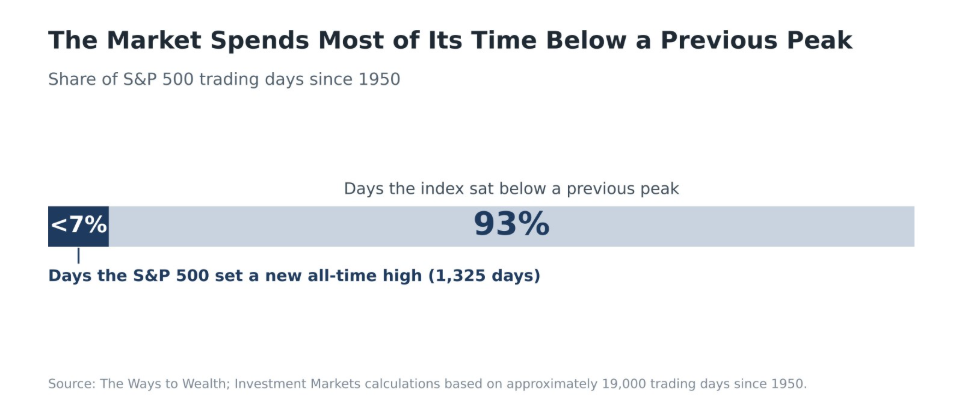
Figure 1: The S&P 500 has spent around 93% of trading days since 1950 below a previous peak.
Source: The Ways to Wealth; Investment Markets calculations
So, on average, since 1950, an investor checking their portfolio at any random moment would find the portfolio valuation reflecting an index around 11% below its all-time high.
That creates perception challenges for most investors.
Even though their portfolio value is trending upwards over the long term, and doing exactly what their investment plan requires, trading well below its peak valuation creates the misguided impression of poor performance.
Add loss aversion into the mix and checking daily portfolio movements does just one thing: it pushes investors’ emotional ledgers into a dangerous deficit, even in a rising market.
Explore 100's of investment opportunities and find your next hidden gem!
Search and compare a purposely broad range of investments and connect directly with product issuers.
An Expensive Habit: The Investor Return Gap
Morningstar’s Mind the Gap study reveals the price tag.
Over the decade to 31 December 2025, the average dollar invested in US funds and ETFs made an 8.7% p.a. return, well below the 9.9% p.a. generated by the funds they invested in.
Figure 2: US fund investors have trailed the funds they own by more than 1% a year in every rolling 10-year period to 2025. 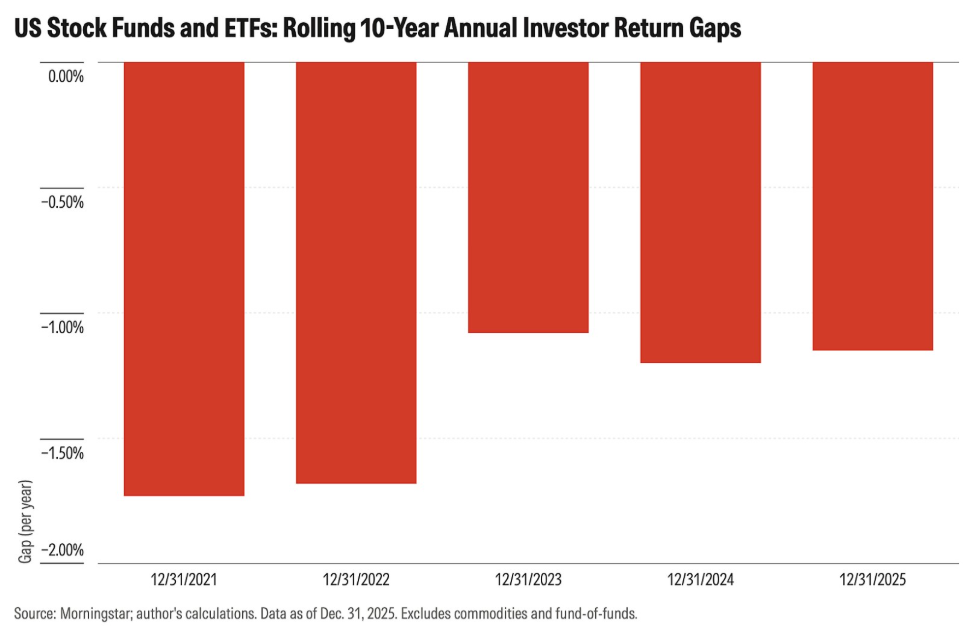
Source: Morningstar
That 1.2% p.a. difference reflects 12% of the aggregate returns in those funds, and is a measure of investors buying when others are greedy and selling when others are fearful, the opposite of Buffett’s famous advice.
Checking portfolios too frequently is one of the main drivers of investors’ buying and selling badly like this.
In effect, every time investors check their portfolios, they are exposing themselves to the market’s emotions. That often drives them to follow the actions of the herd, to sell when others are selling and buy when others are buying.
The Case for Checking Your Portfolio Less Frequently
The case for checking your portfolio less frequently is a simple one: it provides you with fewer opportunities to be scared out of your positions that are on track to deliver long-term returns on your behalf.
In other words, it minimises your chances of tripping yourself up.
The long-term data affirms why this is a more prudent pathway forward.
Over the three decades to 30 June 2026, $10,000 in Australian shares grew to $132,931, a return of 9.0% p.a., while the same amount in US shares grew to $218,544, a return of 10.8% p.a. Left in cash, it became $32,459.
Figure 3: Over the three decades to 30 June 2026, $10,000 grew to $218,544 in US shares and $132,931 in Australian shares, compared with $32,459 in cash. 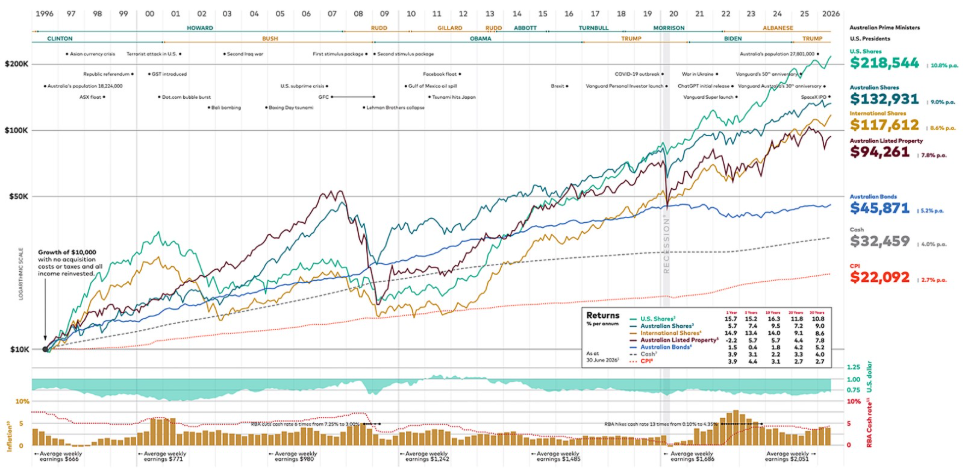
Source: Vanguard
As a reminder, those three decades contained the Asian currency crisis, the dot-com collapse, the global financial crisis, a global pandemic, and the sharpest tightening cycle in a generation.
In hindsight, none of those crises required a daily portfolio check.
None of them required selling into weakness to achieve those impressive headline returns.
How Often Should You Check Your Portfolio? The Right Cadence Must Survive Contact with Reality
Here are four strategies to avoid being victimised by the market like this:
- Match the frequency to any genuine decisions you need to make
Checking your portfolio is only productive if it feeds an investment decision you actually need to make.
Rebalancing suits an annual review or a tolerance band, such as acting when an allocation drifts five percentage points from target.
Contributions belong on a monthly or quarterly direct debit.
Tax matters deserve attention once a year ahead of 30 June.
A plan review may be appropriate before or after a major life event. For example, a new job, a house, a birth, a redundancy, or retirement.
Nothing on this list requires a daily portfolio check, so don’t do it.
For most investors, checking monthly or quarterly is likely to be more optimal.
Figure 4: A simple guide to matching your portfolio checks to the decisions you genuinely need to make.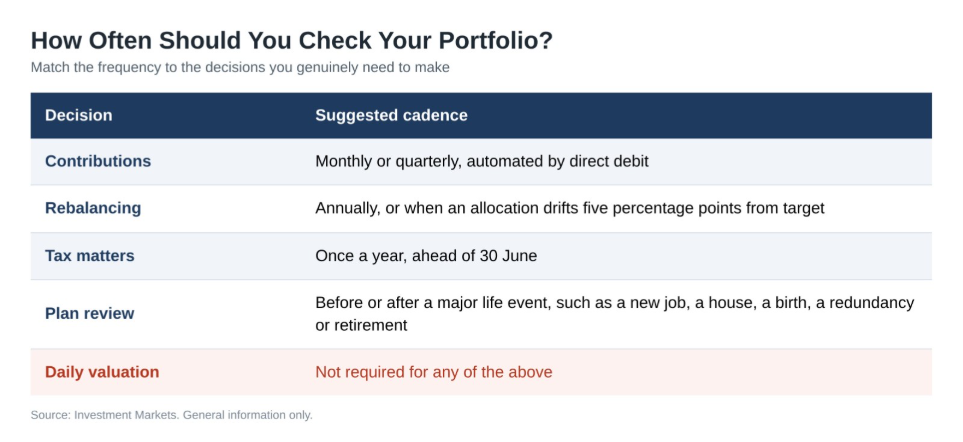
- Separate your accounts by temptation
Most people leave their superannuation alone because it feels long term and largely inaccessible.
Brokerage accounts get checked more often, traded more, and are more likely to be steered by the news headlines.
If you know which account you are more likely to fiddle with, you’ll know which one needs friction: fewer notifications, the app off the phone, or a written rule about what would justify a trade.
- Avoid checking your portfolio during market sell-offs
One of the biggest mistakes investors make is to check their portfolios on a daily, or even hourly, basis during market sell-offs.
This is a dangerous habit that could well inspire you to sell out of fear.
Don’t cause yourself unnecessary emotional pain if you don’t have to.
- Change what you look at, not just how often
When you do look at your portfolio, look at useful inputs rather than price outcomes.
How much did you contribute this year?
What is your asset allocation against your target?
What are you paying in fees?
Those questions have answers that are helpful.
Today’s portfolio valuation doesn’t. All it is doing is tempting you to trade rather than honour your long-term plan.
Subscribe to InvestmentMarkets for weekly investment insights and opportunities and get content like this straight into your inbox.
Where This Advice Can Be Taken Too Far
Not looking is not a strategy in itself.
Portfolios drift, managers change, fees creep, and concentrated positions build until a single holding dominates a previously diversified portfolio.
Deliberate neglect and avoidance look identical on a statement but are different in practice.
Also, the optimal approach isn’t the same for all assets and products.
For example, if you hold geared products or anything with a maturity date, low-frequency monitoring may not be as useful.
In general, the frequency you check your portfolio should align with your portfolio’s nature and long-term goals.
Control the Controllables, Then Step Back
The most valuable thing you can do with your portfolio this year may be to decide, in advance and in writing, how often you will look at it and what you would need to see before taking action.
Set the cadence, automate your contributions, switch off the notifications, and reserve your valuable attention for the decisions that compound in the right direction: asset allocation, cost minimisation, regular contributions and time in the market.
And be ready for the market to spend the vast majority of the time below a previous high.
That’s the reality of investing in a market that trends upwards over the long term. The investors who actually capture those returns are far more likely to be the ones who accept the realities of the investment journey.
It’s time to protect your wealth and your mental health. Stop checking your portfolio so often.
Frequently asked questions
How often should you check your investment portfolio?
For most investors, checking monthly or quarterly is likely to be more optimal than checking daily. Checking your portfolio is only productive if it feeds an investment decision you actually need to make, such as rebalancing, contributions, tax matters or a plan review.
Why is checking your portfolio too often a bad idea?
Markets rarely sit at new highs. Since 1950, the S&P 500 has made 1,325 new all-time highs, representing less than 7% of trading days. Frequent checking mostly shows a portfolio below its peak, which, combined with loss aversion, can push investors to sell out of fear.
How much does poor timing cost investors?
Morningstar’s Mind the Gap study found that over the decade to 31 December 2025, the average dollar invested in US funds and ETFs returned 8.7% p.a., well below the 9.9% p.a. generated by the funds themselves. That 1.2% p.a. difference reflects 12% of the aggregate returns in those funds.
Has long-term investing paid off despite market crises?
Yes. Over the three decades to 30 June 2026, $10,000 in Australian shares grew to $132,931, a return of 9.0% p.a., while the same amount in US shares grew to $218,544, a return of 10.8% p.a. Left in cash, it became $32,459. That period included the dot-com collapse, the global financial crisis and a global pandemic.
Should you check your portfolio during a market sell-off?
Checking your portfolio daily, or even hourly, during a sell-off is one of the biggest mistakes investors make. It is a dangerous habit that could well inspire you to sell out of fear, often at exactly the wrong time.
What should you look at when reviewing your portfolio?
Look at useful inputs rather than price outcomes: how much you contributed this year, your asset allocation against your target and what you are paying in fees. Today’s portfolio valuation simply tempts you to trade rather than honour your long-term plan.
Can you check your portfolio too rarely?
Yes. Not looking is not a strategy in itself. Portfolios drift, managers change, fees creep and concentrated positions build. If you hold geared products or anything with a maturity date, low-frequency monitoring may not be as useful.
Disclaimer: This article is prepared by Simon Turner. It is for educational purposes only. While all reasonable care has been taken by the author in the preparation of this information, the author and InvestmentMarkets (Aust) Pty. Ltd. as publisher take no responsibility for any actions taken based on information contained herein or for any errors or omissions within it. Interested parties should seek independent professional advice prior to acting on any information presented. Please note past performance is not a reliable indicator of future performance.
Author

Simon Turner
Head of Content (CFA), InvestmentMarkets
-b0157qfbffa4kd76pbxp.png)
-vmtf4wo29a20xxj6oknl.png)

Recent Articles
View all articles-drhkgsdwk8x3oqxim0go.png)
-uo4eg7ge0ysewqkveu92.png)
-qn47nb2t9h7iuvyq9ohf.png)