Could 1929 Repeat as Per the New York Times Warning?

Simon Turner
Thu 4 Dec 2025 8 minutesThe four most dangerous words in finance have always been it’s different this time. Financial history is littered with stories of incidents and eras when investors en masse genuinely believed it was different that time. Those were times when the crowd collectively gulped down the Kool-Aid and wanted seconds.
One of the most catastrophic incidents of this was the stock market boom during the late 1920s which was built upon the conviction that the old rules no longer applied as speculative credit and feelings of euphoria flourished. Investors essentially convinced themselves that innovation, new credit products, and rising assets made risk management obsolete. The result was the proliferation of leverage, an absence of regulatory oversight, and a unique interplay of individual psychology and systemic weakness that sowed the seeds of the market’s collapse.
It’s easy to spot similarities in today’s market. For example, speculative behaviour by retail investors is at a similar extreme. Hence, the question recently posed by the New York Times: could the global financial system experience a similar collapse of the magnitude of 1929?
The New York Times Warning
The New York Times recent warning that 1929 may repeat itself was one of the more noteworthy pieces of financial journalism this year due to the magnitude of the Great Depression and its aftermath.
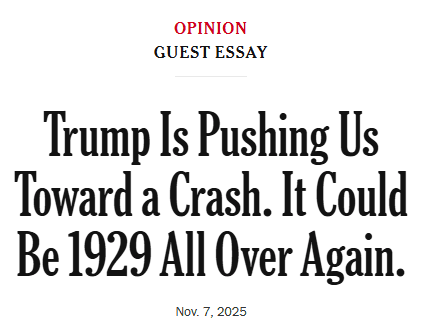
In the New York Times’ words:
‘The parallels between the 1920s and the 2020s are numerous — and ominous. The 1920s economy boomed while America recovered from a deadly pandemic, the flu of 1918. Americans used instalment plans — the precursor to today’s ubiquitous “buy now, pay later” plans at online checkouts — to spend liberally on consumer products, and they poured money into speculative new investments. Automobile and telephone stocks were the high-flying tech investments of their day; Tesla and Apple are two of ours.
The prevailing interest rate was around 5 percent, as it is today. And as with today, masses of Americans took advantage of easy credit and ubiquitous stock brokerages to speculate in finance. In 1929, a New York Times editor quoted a major newspaper’s financial expert who said that the “huge army that daily gambles in the stock market” had come to include, in the editor’s words, “the woman nonprofessional speculator,” whose share of market trading grew by one estimate from less than 2 percent to 35 percent. That influx of buying from 1919 to 1929 drove the stock market up more than six-fold over the decade — a growth rate our market has actually surpassed over the past three years.’
Speculation is Indeed at an Extreme
The current similarities with 1929 are hard to argue with as the New York Times warns.
In particular, speculation amongst retail investors has trended significantly higher in recent months.
Case in point: retail investor participation in the speculative options markets hit a record 55% last quarter, whilst total options contracts traded have doubled over the last 5 years.

So retail investors are essentially taking over the options market as they embrace speculation in an historic manner.
It’s a similar story with margin debt, which recently hit a record $US1.13 trillion thanks to exploding retail investor interest. Meanwhile, 5 times levered ETFs have just been proposed to the SEC.

The risk this leveraged backdrop raises is that the excitement of speculation may be dulling the broader market’s risk perception like it did in 1929, just before the tide turned. This is arguably the most compelling argument in support of a 1929 recurrence.
Explore 100's of investment opportunities and find your next hidden gem!
Search and compare a purposely broad range of investments and connect directly with product issuers.
What’s Not Aligning with 1929
There’s a but coming though, and it’s a big one. The financial ecosystem of 2025 is unrecognisable from its 1929 counterpart. That era lacked key regulatory mechanisms. There was no equivalent of the Securities and Exchange Commission, no deposit insurance, no circuit-breakers, little margin regulation, and weak data transparency.
Also, stock ownership is much more prevalent now than it was a century ago.
According to John Kenneth Galbraith, in 1929: ‘only one and a half million people, out of a population of approximately 120 million and of between 29 and 30 million families, had an active association of any sort with the stock market.’
So only 1% of the population at the time owned stocks versus nearly two-thirds of households today. The upshot is that modern investors are much more dependent on the stock market for their retirement planning and financial security. As a result, stock prices affect the broader economy in far more pronounced ways today, including consumer and employee confidence.
In other words, global stock markets are far more important in 2025 than they were in 1929. As a result, they are far more likely to supported by governments and central banks.
These structural differences matter a great deal when assessing the risk of a 1929 repeat. Modern regulators, fiscal and monetary policy back-stops, and institutional mechanisms are all providing stabilising functions that were absent in the 1920s.
So it’s extremely unlikely that the policymakers and high net worth individuals who depend on the stock market for their wealth are going to allow the repeat of an 86% stock market crash. And the risk is even lower when money supply is rising each year, as it currently is.
Lessons From 1929 With 2025 Meaning
Whilst there are profound differences between 1929 and 2025, there are also six important lessons modern investors should be aware of:
1. Valuations Aren’t the Villain.
One of the biggest lessons of 1929 is that market crashes are caused by a crisis of confidence rather than over-extended valuations. When the social contract around markets breaks down, when investors believe they can no longer rely on liquidity or institutions, a market collapse can become self-fulfilling.
2. The Market’s Narrative Matters.
The 1920s euphoria rested on narratives of permanent innovation and inevitable growth. Investors can guard against this risk by interrogating assumptions of new eras in today’s markets. The chances are high that this time is not different.
3. Leverage Remains a Critical Vulnerability.
Whether at the market, sector or fund level, hidden or direct leverage can amplify a market downturn. So ensuring one’s portfolio is resilient to a liquidity squeeze is an essential part of weathering future downturns.
4. Confidence and Liquidity Are Twin Risks.
When margin lenders, brokers, or counterparties are under strain, the market’s normal mechanisms stop working, and liquidity evaporates. In modern markets, circuit-breakers and central-bank liquidity can ease the pressures, but the risk hasn’t vanished entirely.
5. Institutional Strength and Regulation Matter.
The fact that today’s system has better safeguards does not mean it is invulnerable. What it means is that this particular tail-risk has changed in character. So while we’re unlikely to witness an exact recreation of 1929, we’re still likely to face bear markets and crises.
6. Markets Face Some Uniquely Modern-Day Risks.
The reflexivity of modern markets means policy-makers will act if markets were to crash, but that also means that investments increasingly must be assessed for their political/regulatory risk and structural interdependence. As a result, the modern financial system may be more robust in one dimension yet more complex in another.
Subscribe to InvestmentMarkets for weekly investment insights and opportunities and get content like this straight into your inbox.
How to Manage 1929 Risk
So could a 1929-style event recur? It seems highly unlikely because the regulatory and institutional investment world has changed so dramatically. But the underlying human and structural vulnerabilities that led to the 1929 crash, in particular hubris and leverage, remain ever-present.
The more useful use of considering 1929 risk may be as a warning of the dynamics of complacency. It’s when everyone believes in the same narrowly focused outcome that the risk of the opposite occurring is at its highest.
So don’t anchor your thinking on the conclusion that 1929 can’t recur because the rules have changed. Rather, be aware that the risk of market shocks is an inherent risk of investing. The best ways to mitigate against this risk are to be aware of it, to prepare for it by building resilient portfolios, and by holding cash to take advantage of extreme market events as and when they recur.
The memory of 1929 should serve as an ongoing reminder that the real risk is not that exactly the same crash repeats, but that investors start genuinely believing the four most dangerous words in finance.
Disclaimer: This article is prepared by Simon Turner. It is for educational purposes only. While all reasonable care has been taken by the author in the preparation of this information, the author and InvestmentMarkets (Aust) Pty. Ltd. as publisher take no responsibility for any actions taken based on information contained herein or for any errors or omissions within it. Interested parties should seek independent professional advice prior to acting on any information presented. Please note past performance is not a reliable indicator of future performance.

Simon Turner is an ex-fund manager with 20 years investing experience gained at Bluecrest, Kempen and Singer & Friedlander who now writes educational content about investing and sustainability. He's also the published author of The Connection Game and Secrets of a River Swimmer.